
By the Elevate GTM Solutions Team · Updated November 13, 2026 · 28 min read
Does Account-Based Marketing Work, and How Much of the Research Can You Trust?
Account-based marketing has more statistics attached to it than almost any other B2B practice, and most of them are hard to trace. Search for ABM results and you will find large win-rate multipliers, return-on-investment claims and pipeline lifts, often in articles that cite each other. Some come from respected research firms. Many come from vendors who sell ABM software, from surveys of their own customers or from posts that repeat a number without a source.
This page explains whether ABM works, who should own it and how to test it, and it is strict about evidence. It uses only what we could verify at the source or in an accurate summary: Forrester's 2024 summaries on ABM deal size and return, a Forrester audit of ABM practice, McKinsey's 2026 finding on who should own ABM and a 2026 trade benchmark on ABM goals. It says plainly where the evidence is strong, where it is thin and where circulating figures could not be traced. We then add our own reading, clearly labeled, and describe how a team can test ABM on its own accounts, including where a go-to-market platform like ours fits and where it does not.
A disclosure. We make Elevate GTM Solutions, which includes an account-based marketing module, so we have an interest in ABM being seen as worthwhile. We have no data of our own. Where the available evidence is a summary of a paywalled report, we say so. Our examples are invented and labeled.
Does account-based marketing work?
Probably, for focused, high-value accounts, though the evidence is weaker than the circulating statistics suggest. Forrester's 2024 data summaries report that ABM accounts have larger average deal sizes than non-ABM accounts across North America, Europe and Asia Pacific, and that ABM programs deliver a higher return on investment than non-ABM marketing in those regions, but the full reports are available only to Forrester clients and the public summaries give no figures. Forrester also says that not all organizations go about ABM the same way or see the same results. McKinsey's 2026 B2B survey found that organizations anchoring ABM ownership in sales are five to ten percentage points more likely to be in top revenue growth bands than those with shared or marketing-led models. A 2026 trade benchmark reports that 56% of surveyed practitioners name new account acquisition as the primary ABM goal and 28% name account expansion. The honest summary is that the evidence supports ABM as a useful approach for focused, high-value accounts, with consistent direction across sources, but the large multipliers circulating online mostly cannot be traced to a primary source we could read.
Does ABM work? The better-sourced research points toward larger deals and better returns for ABM accounts, with the caveat that the public summaries give no numbers and the results vary by how it is done.
Who should own it? McKinsey's 2026 data associates sales-anchored ownership with stronger revenue growth bands.
The short version
| Question | Answer |
|---|---|
| Is there good evidence ABM works? | Directional, from Forrester and McKinsey, with limits on what is public |
| Forrester 2024 on deal size | ABM accounts have larger average deal sizes than non-ABM accounts in North America, Europe and Asia Pacific (summary only, no figures public) |
| Forrester 2024 on return | ABM programs deliver higher ROI than non-ABM marketing in those regions (summary only) |
| Forrester on consistency | Not all organizations go about ABM the same way or see the same results |
| McKinsey 2026 on ownership | Sales-anchored ABM ownership is five to ten percentage points more likely to be in top revenue growth bands |
| Trade survey 2026 | 56% say new account acquisition is the primary ABM goal; 28% say account expansion |
| Large multipliers online | Mostly could not be traced to a primary source we could read, so we do not repeat them |
| What to do | Test on your own accounts with a control group |
What account-based marketing is and when it makes sense
Account-based marketing, or ABM, treats a chosen set of accounts as markets of their own. Instead of attracting anyone who fits a broad profile, sales and marketing agree on which accounts matter, learn about the people who buy in each, and coordinate what they say and do for those accounts. Programs range from one-to-one work on a handful of strategic accounts, to one-to-few for small clusters, to one-to-many programs that cover hundreds with lighter personalization.
When it tends to fit. Deal values are high enough to justify the effort. The number of target accounts is limited and you can name them. Buying groups are large and sales cycles are long. Sales and marketing are willing to share a plan.
When it tends not to. Deal sizes are small and volume matters more. Your market is wide and fit is hard to judge. Sales and marketing do not cooperate, so "ABM" becomes a rebranded campaign.
What it needs to work. A deliberate way to choose accounts. A plan for each tier. One named owner, or clearly shared ownership. Honest measurement against a comparison group.
So "does ABM work?" depends less on the label than on whether those pieces exist. The sections below show what the better-sourced research says, which circulating statistics we could not trace and how to run a fair test on your own accounts.
Why ABM evidence is hard to trust
Three features of how ABM is studied make the evidence weaker than it looks.
Selection. Companies choose which accounts get ABM treatment. They usually choose accounts that are already the best fit, the biggest or the most engaged. Those accounts would probably have produced larger deals and better returns anyway. A comparison between ABM accounts and non-ABM accounts, without a matched control, mixes the effect of the program with the effect of picking good accounts. That does not make ABM ineffective. It makes the size of the effect uncertain.
Definitions. ABM covers a spectrum, from one-to-one programs for a handful of strategic accounts to one-to-many programs for hundreds. Forrester's early findings from a global audit of ABM, based on research into more than 300 organizations, noted that the lines between ABM deployment types are increasingly blurred. A claim about "ABM" may describe very different practices in different studies.
Source incentives. The people who study and publish on ABM include software vendors, agencies and benchmark programs that sell membership or events. Their incentive is to show the practice works. This is not unique to ABM, and it does not mean the findings are false. It means a reader should prefer sources with stated methods and samples and treat the rest as claims.
A fourth point applies to any report: the unit of "return" is usually self-reported by marketers, who may count influenced pipeline generously.
The evidence we could verify
Forrester: larger deals and higher return
Forrester published two short data snapshots in 2024. One is titled "Account-Based Marketing Results In Larger Average Deal Sizes Across Regions." Its summary says that Forrester's 2024 data shows ABM accounts have larger average deal sizes than non-ABM accounts across North America, Europe and Asia Pacific. The other, "Account-Based Marketing Delivers Higher ROI Across Regions," says Forrester's 2024 data shows ABM programs deliver a higher return on investment than non-ABM marketing efforts in those same regions.
We could read only the public summaries. The full snapshots are for Forrester clients, so we do not know the size of the differences, the sample, how deal size and return were measured or whether the comparison accounts were matched. We therefore state the direction and nothing more.
Forrester's "The State of Account-Based Marketing in 2024" data overview adds a caution in its summary: while ABM has proven its value and solidified its place in B2B marketing, not all organizations are going about it the same way or seeing the same results. Again we have only the summary. The sentence is worth holding onto because it says the variation among organizations is large enough to be a headline.
Forrester SiriusDecisions: a global audit
Forrester's early findings from its SiriusDecisions Global Audit of Account-Based Marketing describe a primary research study of the ABM strategies of more than 300 organizations worldwide. The blog we saw says the lines between ABM deployment types are increasingly blurred. We did not see the date or the full results, so we use it only for two facts: the size of the study and the observation about blurred types.
McKinsey: who owns ABM
McKinsey's 2026 Global B2B Pulse Survey, of nearly 4,000 B2B decision-makers in 13 countries, includes ABM governance as one of three engines separating growth leaders from laggards, which we cover in detail in what separates B2B growth leaders from laggards. It reports that organizations that anchor ABM ownership in sales are five to ten percentage points more likely to appear in top revenue growth bands than those using shared or marketing-led models. Among leaders, 43% reach top revenue bands through sales-led ABM, versus 31%. Joint governance structures are used by 40% of laggards versus 32% of leaders. Recommended practices include a single accountable leader for priority accounts, shared revenue incentives, integrated AI and personalization and account-level measurement.
This is the best-specified piece of ABM evidence we found, because it tests an organizational choice and reports figures. It is still correlational and self-reported.
A 2026 trade benchmark on goals
Demand Gen Report published a 2026 Account Based Marketing Benchmark Survey in spring 2026. The summary we saw says 56% of respondents name new account acquisition as the primary goal of their ABM strategy and 28% name account expansion, and describes a more mature operating model in which broad-based programs and targeted account strategies work together instead of competing for budget or attention. We saw only summaries, and a trade publication's reader survey draws self-selected respondents. We use it only to say what practitioners say they are trying to do.
The ABM claims we could not trace
Search results for ABM statistics are dense with specific numbers: win-rate multipliers, qualified-pipeline lifts of over a hundred percent, shares of budget going to ABM, ROI comparisons attributed to Forrester, ITSMA, Demandbase, 6sense and others. Some appear in articles from software vendors and consultants that aggregate figures from many places, and several cite each other. We could not trace the specific numbers we saw to a primary report we could read, so we do not repeat them.
That is not a claim that they are false. ITSMA and its partners publish ABM benchmark studies, and some of the figures may be accurate. If you want to use one, find the original report, check the sample, the date and how the metric was defined, and cite the primary source. If a number is only available in a secondary article, treat it as unverified.
One vendor view is worth noting. A trade article quoted the CEO of an advertising technology company saying that "people make decisions, not accounts," arguing that account-level tools lack the precision to reach individuals. It is a vendor's argument for contact-level targeting, and we label it as such. It points at a real issue, that accounts do not read emails, but it comes from someone selling a contact-level product.
How to read the evidence
Direction is consistent, magnitude is not known. Forrester's summaries and McKinsey's survey point the same way. We do not know how big the effects are in a way we can verify.
The best-fit accounts get ABM. Any comparison needs a control, and most published comparisons do not say they have one.
ABM is not one thing. One-to-one, one-to-few and one-to-many are different programs with different costs and results.
Goals differ. If 56% are chasing new accounts and 28% expansion, results are measured against different targets.
Time matters. ABM programs take months to show effect on deals with long cycles. A comparison made too early looks like failure.
Ownership matters. McKinsey's finding suggests the organizational design affects results as much as the tactics.
Elevate's reading
Our interpretation, not data.
One. The strongest practical lesson is about focus and ownership, not tactics. The sources point to concentrating effort on a defined list of accounts and having someone clearly accountable. That is consistent with McKinsey's recommendation of a single accountable leader. It does not depend on any particular tool.
Two. The account list is the strategy. Choosing which accounts matter is the decision everything else follows from. If the list is wrong, personalization and orchestration go to the wrong place. See ICP scoring framework and account tiering framework.
Three. Test, do not assume. The selection problem means your own results are the only ones that count. Set aside a comparable group of accounts that do not get the treatment, or stagger the start, and compare. It is slower than copying a benchmark, and it is the only way to know.
Four. Beware ABM that is marketing's project only. McKinsey's finding that joint governance is more common among laggards, and Forrester's point on alignment, suggest ABM works better when sales is accountable. See keeping sales, marketing and product aligned on go-to-market.
Five. Buying groups make accounts the right unit, with a caveat. Forrester's 2026 buying research, which we cover in how B2B buyers use AI and sales reps, reports an average of 13 internal and nine external participants in a purchase. When many people decide, an account-level approach makes sense. The vendor point that people make decisions is also right: an account strategy still reaches individuals. The two are not in conflict.
Six. Smaller teams can do ABM without ABM software. The practice is a list, a shared plan and a regular review. Tools help at scale. See best GTM tools for a small sales team without RevOps.
What this means for different roles
Head of marketing. Do not run ABM as a marketing project. Agree a list with sales, name a single accountable owner for priority accounts and share the targets.
Head of sales. If McKinsey's finding is right, you may be the natural owner. That means you also own the account plans, not only the number.
Sales development. Your outreach should reflect what marketing is doing for the account, and the reverse. Ask for a shared view of each priority account.
Customer success. Expansion is a goal for 28% of practitioners in the 2026 benchmark. Your accounts are ABM accounts too.
Revenue operations. Build the account list and the measurement. Account-level reporting, not lead-level, is what McKinsey recommends.
Finance. Ask for a control comparison before approving a larger ABM budget.
Founders. In a small company, ABM can be a spreadsheet of twenty accounts, a plan for each and a weekly conversation.
A worked example, invented for illustration
Imagine a company that sells compliance software to mid-size insurers. It has about 400 target accounts. Marketing runs broad campaigns, and sales picks up whoever replies. Deals are few and long. The head of marketing proposes ABM.
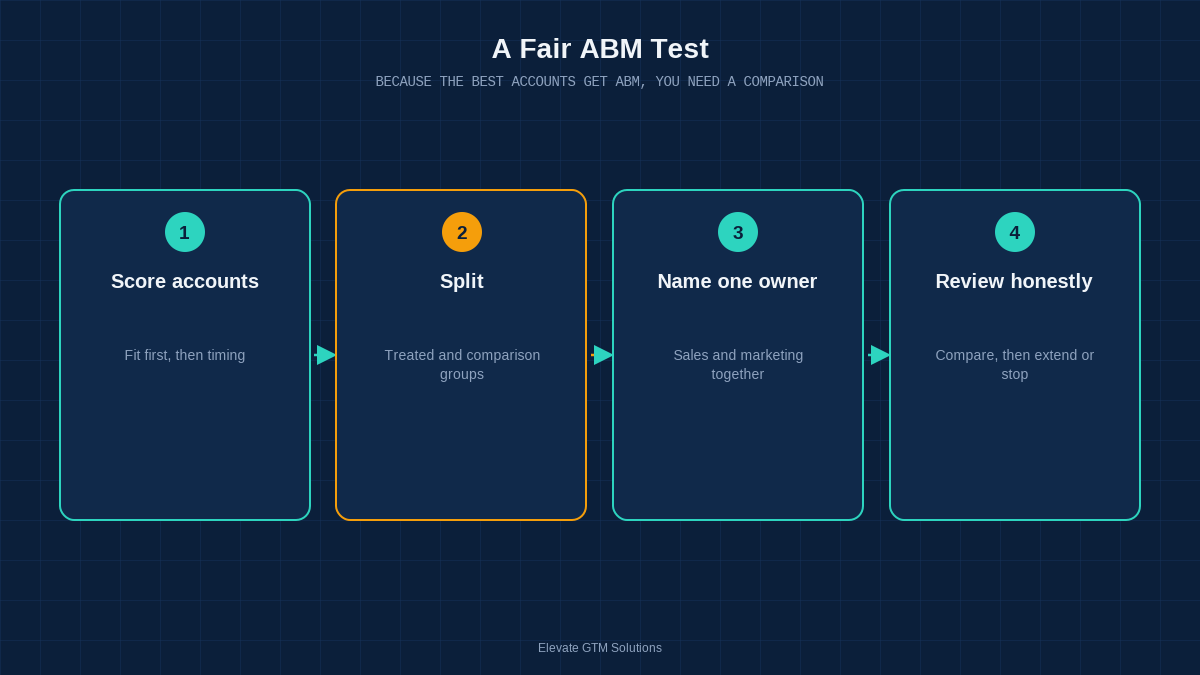
The head of sales and head of marketing agree on a plan. They score the 400 accounts on fit and timing and choose 40 for focused treatment, with a plan for each. They split another 40 of similar score at random into two groups of 20, one receiving the focused program and one receiving the usual outreach, so they have a comparison. The head of sales is the single accountable owner for the 40. They agree on three measures reviewed monthly: engaged contacts per account, meetings and stage movement.
They expect it to take two quarters before stage movement shows. They do not predict a multiple. After two quarters they compare the treated and untreated groups and decide whether to extend.
This is one way to apply what the evidence supports: focus, ownership and a comparison. The result belongs to the company, not to a benchmark.
How to run an ABM test on your own accounts
A short, honest test takes about two quarters. Here is how.
Step one: define the goal. New account acquisition, expansion or both. Pick one for the test. Mixed goals make results hard to read.
Step two: build the list. Score accounts on fit and, if you can, timing. Do not choose only the ones you like.
Step three: split. From accounts of similar score, assign some to the program and some to a comparison group. Random assignment is best. If you cannot randomize, stagger the start and compare.
Step four: name the owner. One person, with authority across marketing and sales for these accounts.
Step five: design the program. For each treated account, decide who you are trying to reach, what you will say and what you will offer. Keep the number of actions small.
Step six: choose measures. Leading ones, such as engaged contacts and meetings, and lagging ones, such as stage movement and deal size. Decide the review date in advance.
Step seven: review honestly. At the end, compare the groups. If there is no difference, say so. If there is, ask whether it is large enough to justify the cost, including people's time.
Step eight: decide. Extend, change or stop. Write down why.
Our GTM experimentation framework gives a longer method for tests like this.
Choosing the accounts: the step the research leaves out
None of the sources we could verify says how to pick accounts, yet it decides most of the outcome. Here is a practical way to do it, and a way to be honest about it.
Start from your best existing customers, not from a wish list. Look at the accounts that bought, stayed and expanded. What do they share: industry, size, a technology they use, a trigger event, a type of buyer? That is evidence about fit. Many companies skip this and build lists from what a data vendor sells.
Separate fit from timing. Fit asks whether an account looks like your best customers. Timing asks whether it is likely to be thinking about the problem now. A great-fit account at the wrong moment is a long-term relationship, not a quarter's target. Treat them differently.
Score simply. Three to five criteria with a score from one to three each is enough. More criteria produce false precision. Write the criteria down and share them, so that sales and marketing argue about the criteria and not about each account.
Tier the list. A small group for the deepest, most personal treatment. A larger group for lighter, more templated treatment. A broad group for programmatic outreach. The tiers should reflect both account value and how much customization pays back. Our account tiering framework covers this in detail.
Leave room for surprises. Some of your best deals will come from accounts you did not list. Keep a way for sellers to nominate additions with a reason, and review additions monthly.
Review the list on a schedule. Accounts change. A company that was a poor fit a year ago may have been acquired, changed strategy or hired a new leader. Check quarterly which accounts to promote, demote or drop.
Record why. For each account in the top tier, write one sentence on why it is there. When a deal is won or lost, look back at the sentence. Over time you will learn which reasons were good.
What an account plan contains
If the account is the unit, the plan for it is the working document. A useful plan is a page, not a binder.
The account in one paragraph. What the company does, what is changing for it and why it might need what you sell. Written from public information and conversations, not from a template.
The people. Who is in the buying group, what each cares about and what you know about their position. Mark the gaps. Forrester's finding of large buying groups, with external participants as well as internal ones, is a reason to name the people you have not met.
What you are trying to achieve. A specific goal for the next quarter: a meeting with a named person, a workshop, a trial. Not "build awareness."
The message. What you will say to this account that you would not say to another, and why it should matter to them.
The actions. A short list of what marketing, sales and any others will do, by when and who owns each.
The measure. How you will know whether the plan is working: engagement from specific people, meetings, movement in stage.
The review date. When you will look again, and what would make you change the plan or drop the account.
A plan like this takes an hour to write for a top-tier account and ten minutes for a middle-tier one. It is also the document that shows whether marketing and sales are working together, which is the finding in McKinsey's data that is easiest to act on.
What ABM costs, honestly
The sources we could verify say little about cost, and many articles about ABM leave it out. For a team deciding whether to start, a candid list helps.
People's time. Account research, plan writing, personalized content and coordination take hours per account. Multiply by the number of accounts in each tier to see the real figure.
Reduced reach. Focusing on forty accounts means not pursuing four hundred. The accounts you leave out may produce deals you will not see.
Tools. Account-level advertising, intent data and orchestration tools carry subscriptions. Many teams start without them.
Coordination. Sales and marketing must meet regularly, agree on accounts and share information. If that coordination does not happen, the program fails regardless of spend.
Patience. Long cycles mean slow evidence. Leadership must be willing to wait for it.
Opportunity cost. The same hours could go to other programs. A comparison group helps you see what the hours bought.
None of these is a reason not to do ABM. They are reasons to size it to what you can sustain, and to start with fewer accounts than feels exciting.
Reading ABM vendor claims with care
You will be shown ABM statistics in sales presentations, including possibly ours. A short set of questions helps you judge them.
Who ran the study, and who paid for it? A vendor survey of its own customers measures satisfied customers. A benchmark from a membership organization measures its members.
How many respondents were there, and how were they chosen? A survey of readers of a trade newsletter is not a sample of all companies.
What was compared with what? "ABM accounts versus non-ABM accounts" says little if the ABM accounts were chosen because they were better.
How was the result defined? "Influenced pipeline" is a generous measure. Closed revenue is not.
When was it done? A figure from several years ago may describe a different market.
Can you read the original? If a deck cites a source and you cannot find it, ask the presenter for it.
What would it look like if the claim were false? If the answer is "nothing," the claim is not testable and should be treated as marketing.
How a go-to-market platform can help, and where it cannot
Elevate GTM Solutions is a go-to-market strategy platform. Its homepage describes building, executing and evolving strategy with connected modules, including account-based marketing, ideal customer profile and segmentation, competitive intelligence, product positioning, product messaging, marketing alignment, sales enablement, customer success and customer advocacy, plus a unified strategy. The product flow, as we describe it, runs from GTM Insights and Strategy Context through Strategy Builder, a Workflow Engine, Strategy Insights, GTM Activation, GTM Playbooks, GTM Pulse and executive dashboards. Users can create multiple strategies and compare them.
Here is how that relates to the evidence, without overclaiming.
The account strategy in one place. The account-based marketing module is where a team records its approach to priority accounts, connected to the ideal customer profile, positioning and messaging that the plan depends on. It does not replace an ABM advertising or intent platform, and we do not claim to be one. See GTM platform vs ABM platform.
Comparing approaches. Because users can create more than one strategy and compare them, a team could set out a one-to-few approach and a one-to-many approach side by side before committing. The comparison reflects what you put in. It does not predict results. See how to compare multiple GTM strategies before committing budget.
Collaboration and stages. The workflow stages and collaborators make it easier to show who is involved in a program for priority accounts. Accountability is still a leadership decision.
Weekly rhythm. GTM Pulse provides weekly actions, recommendations and scores, a natural place for the monthly or weekly account review that McKinsey's practices imply.
What it cannot do. It does not run advertising, supply intent data or reach contacts. It cannot choose your accounts, create a control group or prove ABM works for you, and we have no data on ABM results among our customers.
Questions to ask yourself
- Which accounts are we treating as priority, and how did we choose them?
- Who is the single accountable owner, by name?
- What is the goal of our ABM: new accounts, expansion or both?
- Do we have a comparison group, or are we comparing to our best accounts?
- Which tactics reach individuals inside the account?
- How long is our sales cycle, and when will we see movement?
- What do we measure at the account level?
- Are marketing and sales working from one account plan?
- What would we stop doing if the test showed no difference?
- Which statistics are we relying on, and have we read the original?
Common mistakes
Quoting an uncited multiplier. If you cannot find the original, do not use it.
Treating best accounts as proof. Good accounts produce good results with or without ABM.
Making it marketing's project. McKinsey's data points the other way.
Treating ABM as a tool purchase. The practice is a list, a plan and a rhythm.
Judging too early. Long-cycle deals take time to show movement.
Mixing goals. Acquisition and expansion programs need different plans and measures.
Ignoring the individuals. Accounts are made of people, and the plan must reach them.
What to do this week
Write down your top twenty accounts and, next to each, the name of one person at the account you are trying to reach and one person on your side who owns the relationship. Any row you cannot complete is where ABM is not yet real for that account.
Glossary
Account-based marketing (ABM). Marketing and sales jointly focusing on a defined set of target accounts with coordinated, account-specific effort.
One-to-one, one-to-few, one-to-many. Tiers of ABM by the number of accounts treated and the level of customization.
Control group. A set of comparable accounts that does not receive a treatment, used to judge the treatment's effect.
Selection effect. A bias that arises when the accounts chosen for a program differ from those not chosen in ways that affect results.
ABM governance. The structure of ownership and accountability for ABM.
Account-level measurement. Tracking results by account, such as engagement and stage movement, rather than by individual lead.
Priority accounts. The defined set of accounts a company has decided to focus on.
Buying group. The people who take part in or influence a purchase decision.
Where Elevate GTM Solutions fits
Elevate GTM Solutions is a go-to-market strategy platform for building, executing and evolving strategy through connected modules, including account-based marketing. In relation to the evidence, it offers a place to record account strategy, compare approaches before committing and review weekly. It does not provide advertising, intent data or proof of results. For related reading, see alternatives to 6sense, Demandbase and ZoomInfo and why B2B teams use so little of their martech.
Key takeaways
- Forrester's 2024 summaries say ABM accounts have larger average deal sizes and ABM programs deliver higher ROI than non-ABM efforts across North America, Europe and Asia Pacific, but the public summaries give no figures.
- Forrester also says organizations differ widely in how they do ABM and in the results they see.
- McKinsey's 2026 survey associates sales-anchored ABM ownership with being five to ten percentage points more likely to be in top revenue growth bands.
- A 2026 trade benchmark reports 56% aim ABM at new accounts and 28% at expansion.
- Many circulating ABM statistics could not be traced to a primary source we could read, so we do not repeat them.
- Test on your own accounts with a comparison group, and name one accountable owner.
Sources
- Forrester, Account-Based Marketing Results In Larger Average Deal Sizes Across Regions, data snapshot, 2024 (summary only).
- Forrester, Account-Based Marketing Delivers Higher ROI Across Regions, data snapshot, 2024 (summary only).
- Forrester, The State Of Account-Based Marketing In 2024, data overview report (summary only).
- Forrester, Early Findings From Forrester SiriusDecisions' Global Audit of Account-Based Marketing, blog (read through a search excerpt).
- McKinsey & Company, The surprising economics of B2B growth, 2026 Global B2B Pulse Survey.
- Demand Gen Report, What the 2026 ABM Benchmark Survey Reveals About B2B Growth Strategy, 2026 (read through excerpts).
Frequently Asked Questions
Does account-based marketing work?
The better-sourced research points toward larger deals and better returns for ABM accounts. Forrester's 2024 data summaries say ABM accounts have larger average deal sizes and ABM programs deliver higher ROI than non-ABM efforts in North America, Europe and Asia Pacific. The public summaries give no figures, and results vary by how it is done.
Why are ABM statistics hard to trust?
Accounts chosen for ABM are usually already the best fit, so comparisons without a matched control mix the program's effect with the effect of choosing good accounts. ABM also covers very different practices, and many published figures come from vendors or secondary articles whose original sources are unclear.
What does McKinsey say about ABM?
Its 2026 survey found organizations anchoring ABM ownership in sales are five to ten percentage points more likely to appear in top revenue growth bands than those with shared or marketing-led models. It recommends a single accountable leader for priority accounts, shared revenue incentives and account-level measurement.
What are most companies trying to achieve with ABM?
In a 2026 Demand Gen Report benchmark survey, 56% of respondents named new account acquisition as the primary goal and 28% named account expansion. It is a trade publication survey, so respondents are self-selected.
Should I trust the big win-rate multipliers online?
Only if you can find the original report and check the sample, date and definition. We could not trace the large multipliers we saw to a primary source we could read, so we do not repeat them.
Is ABM only for large companies?
No. It is a list of priority accounts, a shared plan and a regular review. Software helps at scale, but a small team can do ABM with a spreadsheet of twenty accounts.
How do I test ABM fairly?
Choose similar accounts, assign some to the program and some to a comparison group, name one accountable owner, pick leading and lagging measures and review after enough time for your sales cycle. Our experimentation framework gives a longer method.
Do people or accounts make decisions?
Both. Forrester reports buying groups averaging 13 internal and nine external participants, which supports an account-level view, while a vendor argues that individuals decide. A good ABM plan chooses the account and then reaches the right individuals inside it.
Can a GTM platform run ABM?
Not on its own. Elevate GTM Solutions has an account-based marketing module for recording strategy for priority accounts and lets users compare strategies, but it does not run advertising, supply intent data or prove that ABM works for you.
How long until ABM shows results?
It depends on your sales cycle. For long cycles, engagement signals may show within weeks, but stage movement and deal size can take quarters. Decide the review date before you start.
How current is this evidence?
The Forrester snapshots are from 2024, the McKinsey survey from 2026 and the trade benchmark from spring 2026. We could read only summaries of the Forrester and trade material, so check the originals before quoting.
What should we do first?
Write down your top twenty accounts and, next to each, one person at the account you are trying to reach and one person on your side who owns the relationship. Any row you cannot complete shows where ABM is not yet real for that account.