
By the Elevate GTM Solutions Team · Updated November 13, 2026 · 27 min read
What Are the Best Alternatives to 6sense, Demandbase and ZoomInfo for Signal-Driven B2B Go-to-Market? An Honest Guide by the Job You Need Done
People who ask for alternatives to 6sense, Demandbase and ZoomInfo in one breath are usually describing a situation, not a product category. The contracts are expensive, the renewal is approaching, the team suspects it uses a fraction of what it pays for or the results never matched the pitch. Someone is asked to find something better, cheaper or more suited to a smaller team, and quickly discovers that the three names are not interchangeable. One is mainly known for account-based marketing and predictive intent, one for account-based advertising and orchestration and one for contact and company data with intent and engagement features added on.
A good answer therefore depends on the job. This guide separates the jobs these platforms are bought to do, explains what "signal-driven" actually means, maps categories of alternatives to each job, shows how to test data quality and intent before you switch, covers the practical issues of contracts and migration, gives a decision guide by company profile and says plainly what a strategy platform such as ours does and does not replace. We make a GTM strategy platform, so we have an interest, and in this case our product is not a like-for-like replacement for a contact database, which we say below. We describe other vendors in general terms and tell you to confirm current details on their own sites. We cite no pricing, no match-rate statistics and no rankings.
What are the best alternatives to 6sense, Demandbase and ZoomInfo?
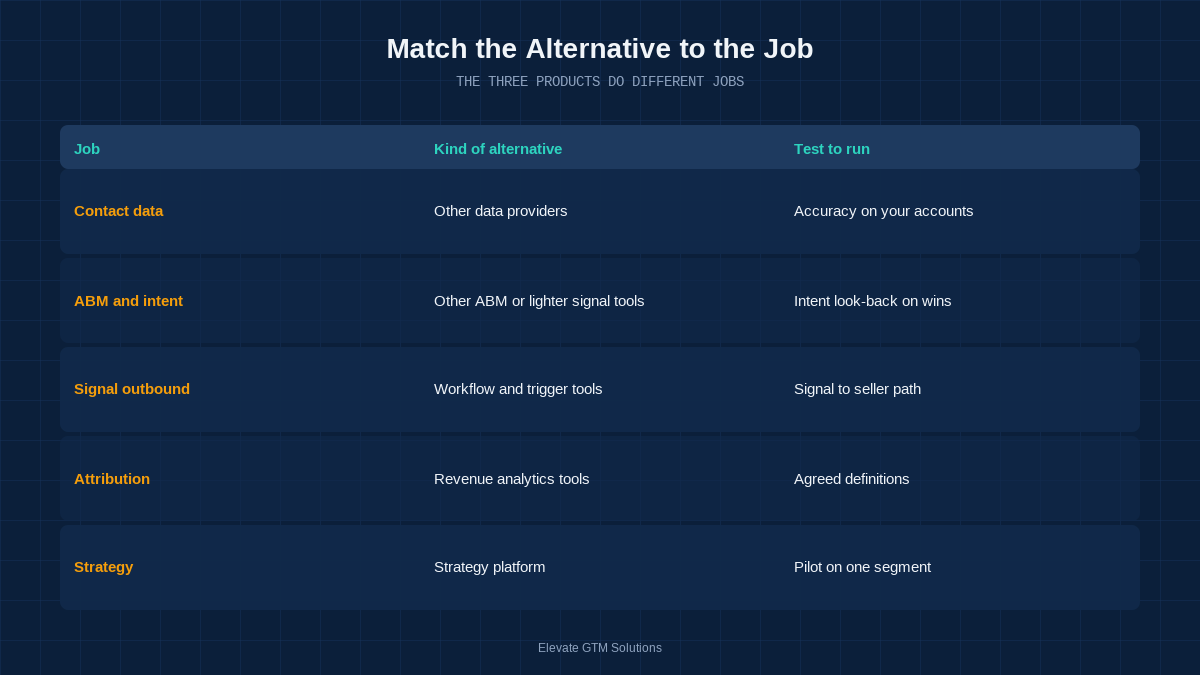
There is no single best alternative, because the three products do different jobs. If you mainly need contact and company data, look at other sales intelligence and data providers and test their coverage on your own accounts. If you mainly need account-based marketing, intent and advertising, look at other ABM platforms or lighter signal tools, and test whether the intent data predicts anything for your market. If you want signal-based outbound for a small team, newer tools built around workflows, job changes and product usage may fit better and cost less. If the real gap is deciding which accounts and messages matter before any of those tools run, a strategy platform addresses a different layer. Before switching, measure what you actually use, test the data on your own accounts and check contract terms. A change of vendor will not fix a problem that is really about targeting, messaging or follow-up.
Is there a drop-in replacement for all three? Not really. Each covers a different mix of data, intent, advertising and engagement.
What should you check first? Which features and data you use today, and what results they produced, before you compare anything.
The short version
| Question | Answer |
|---|---|
| Are the three the same kind of product? | No. They overlap, but differ in emphasis: ABM and predictive intent, ABM and advertising, and contact data with intent and engagement |
| What does "signal-driven" mean? | Acting on events that suggest an account's situation or intent, such as research behavior, job changes, product usage and funding |
| How do you choose an alternative? | By the job: data, intent, advertising, outbound workflow or planning |
| What should you test? | Coverage and accuracy on your accounts, and whether intent predicts conversions in your market |
| What are common reasons to switch? | Cost, low usage, poor fit for company size, data accuracy, complexity, a better fit elsewhere |
| What are common mistakes? | Switching without measuring use, comparing by feature lists and ignoring contract terms and migration work |
| Where does a strategy platform fit? | A different layer: deciding who and what to target, not supplying contact data. It does not replace a data provider |
What each of the three is generally used for
Descriptions below are general and reflect how these products are commonly understood. They change, and each vendor describes itself differently, so confirm current capabilities on each vendor's own site.
6sense. Commonly associated with account-based marketing, predictive intent and account scoring, used by marketing and sales teams to find accounts that appear to be in market and to coordinate outreach and advertising. See Elevate vs 6sense.
Demandbase. Commonly associated with account-based marketing and advertising, with intent data and account identification. Often bought by marketing teams running account-based programs. See Elevate vs Demandbase and best Demandbase alternatives for mid-size B2B.
ZoomInfo. Commonly associated with a large database of company and contact information, with intent, engagement and workflow features added over time. Often bought by sales and marketing teams for prospecting data. See Elevate vs ZoomInfo.
Notice that the three are bought for different budgets and owners. Marketing usually owns the ABM platforms, and sales or revenue operations often owns the data provider. A company replacing "all three" may in fact be rationalizing several overlapping contracts held by different teams.
What "signal-driven" means
"Signal-driven go-to-market" means acting on events that suggest something about an account or person, instead of working a static list. Signals come from several places, and they differ a lot in reliability.
| Signal type | Examples | Typical use | Caution |
|---|---|---|---|
| Intent and research | Topic research across the web, search and content consumption | Flag accounts that may be in market | Methods differ by provider. Test whether it predicts your conversions |
| Website behavior | Visits, pricing page views, repeat visits | Prioritize outreach and ads | Many visitors are anonymous or unrelated to a purchase |
| Product usage | Signups, feature use, usage thresholds | Product-led sales and expansion | Strongest when you own the product data |
| Job changes | A champion moves to a new company | Reach a warm contact in a new account | Needs accurate tracking |
| Company events | Funding, hiring, leadership changes, launches | Time outreach to a trigger | Easy to over-read |
| Technology signals | Tools a company uses or adopts | Fit and displacement plays | Data can be stale |
| Engagement | Email replies, call outcomes, meeting history | Judge response and warmth | Depends on your own activity |
| Community and social | Mentions, questions, participation | Warm outreach | Needs care with privacy and tone |
| Conversation | What buyers say on calls | Learn objections and needs | Needs consent and policy |
An important point: signals are inputs. They tell you where to look. They do not tell you whether an account is a good fit, who owns it, what to say or whether another team is already speaking to them. See what is signal-based selling and what is GTM orchestration.
Start with the job, not the vendor
Break the purchase into the jobs it was meant to do. Then check which of them you still need, which you actually use and which you could do differently.
| Job | What it means | Questions to ask |
|---|---|---|
| Contact and company data | Names, titles, emails, phone numbers, firmographics | Do we reach the people we need? How accurate is it on our accounts? |
| Account selection and scoring | Choosing which accounts to prioritize | Does the scoring reflect our ICP? Can we explain it? |
| Intent and research signals | Finding accounts that appear to be in market | Does it predict meetings and wins in our market? |
| Advertising to target accounts | Showing ads to chosen accounts | Is spend traceable to pipeline? |
| Outbound workflows | Sequences and outreach tied to signals | Is it used? By whom? |
| Orchestration across teams | Coordinating marketing and sales actions | Are the plays actually running? |
| Reporting and attribution | Showing what influenced pipeline | Do leaders trust the reports? |
| Strategy and planning | Deciding who and what matters | Where does this live today? |
Most companies find that they use two or three of these jobs heavily and the rest lightly. Replace the jobs you need and drop the rest.
Alternatives by job
The lists below group general kinds of products and mention some commonly known names to orient you. They are examples, not rankings or endorsements, and products change often, so verify each on its own site.
If you mainly need contact and company data
Options include other sales intelligence and data providers, some with free or low-cost tiers, and tools that assemble data from several sources. Apollo is one commonly known example, and Clay-type tools let a team combine several data sources through workflows. See Elevate vs Apollo, Elevate vs Clay and Clay alternatives for GTM teams.
What matters: coverage in your target geographies and segments, accuracy of direct contact details, freshness, pricing structure and how data enters your CRM. Regional rules about contact data and consent differ and change. This is not legal advice, so involve privacy advisers.
If you mainly need ABM, intent and advertising
Options include other ABM platforms, lighter account-identification and advertising tools and approaches that combine your own website and product signals with a smaller set of third-party data. See GTM platform vs ABM platform.
What matters: whether your market is large enough for account-based advertising to matter, whether the intent data adds anything beyond what you already know and how advertising spend connects to pipeline.
If you want signal-based outbound for a small or mid-size team
A group of newer tools focuses on triggers such as job changes, website visits and product usage, with workflows that route signals to sellers. Examples that come up often include Unify, UserGems and Common Room. See Elevate vs Unify, Elevate vs UserGems and Elevate vs Common Room.
What matters: the quality of the specific signals you will act on, how they reach sellers and whether the team has the capacity to act on them.
If you need attribution and reporting
Analytics-focused tools such as HockeyStack aim at showing what influenced pipeline. See Elevate vs HockeyStack.
What matters: trust in the numbers, and agreement on definitions, since a better dashboard on poor definitions only tells the wrong story faster.
If you need conversation and deal insight
Conversation intelligence tools capture what buyers say and how deals progress. Gong is a commonly known example. See Elevate vs Gong.
If the gap is strategy, planning and consistency
If the problem is deciding which accounts and segments matter, what to say to them and keeping the answer consistent across teams and tools, then more data or more signals may make things noisier. A strategy platform addresses that layer. See GTM platform vs revenue intelligence and GTM platform to build strategy before CRM campaigns.
If you could build part of it yourself
Teams with technical skill sometimes assemble signals and data from several sources with workflow tools. This offers control and takes engineering time to maintain. See custom stack vs unified platform.
Why companies look for alternatives
Knowing your own reason helps you pick the right one.
Cost. The platform is expensive relative to the use the team gets from it.
Low usage. Features were bought and not adopted. Seats sit idle.
Complexity. Setup and administration take more effort than the team has.
Fit for company size. A product built for large enterprises can be heavy for a team of ten sellers.
Data accuracy. Bounce rates, outdated titles and wrong numbers erode trust.
Unproven intent. The team cannot show that intent data led to meetings or wins.
Overlap. Several tools do similar things, bought by different teams.
Contract friction. Multi-year terms, automatic renewals and limited flexibility. Check your own contract for terms and dates.
Change in strategy. The company moved upmarket, downmarket or into new regions, and the data coverage no longer fits.
A better-fitting tool has appeared. Newer products focus on specific workflows.
Measure before you switch
Most switching decisions start from a feature comparison, which is the weakest basis. Start with evidence about your own use.
1. Audit usage. For each platform, list the features and data you used in the last six months, by team and by person. Count active users against seats.
2. Trace outcomes. For the signals, accounts and contacts from each platform, how many led to meetings, opportunities and wins? Be honest about attribution. Where you cannot trace, say so.
3. Check data accuracy. Take a sample of contacts used last quarter. What share bounced, were out of date or were wrong?
4. Map overlap. List which jobs each tool does and where two or three do the same one.
5. Find the contract facts. Renewal dates, notice periods, auto-renewal terms, seat commitments and data export rights. Put the dates on a calendar well before they arrive.
6. Ask the users. Interview the sellers and marketers who work in the tool. They know what is genuinely useful.
This audit often shows that a smaller subset of features carries most of the value, which narrows what a replacement must do. See GTM stack audit.
How to test an alternative
Run a test on your own accounts, with a clear question and a fixed period.
Test data on your own list
Choose a sample of one to two hundred accounts that reflect your real targets, including some you know well. Ask each candidate to return contacts and company data. Then compare:
- Coverage. What share of the accounts and of the right personas did each find?
- Accuracy. For a sample of contacts, how many emails were valid, how many titles were current and how many were the right person?
- Freshness. Does it reflect recent job changes you know about?
- Regional fit. Does coverage hold for your priority countries?
Use the same sample for each candidate, and record the results in a simple table. Do not rely on a vendor's quoted match rate.
Test intent on your own outcomes
Intent claims are the hardest to judge. A fair test:
- Take accounts that you know became opportunities in the last year, and accounts that did not.
- Ask whether the provider's signals, looking back, flagged the converting accounts earlier or more often than the others.
- Compare against a simple baseline, such as website visits or your own engagement data.
- Be careful about hindsight and small samples.
If a provider cannot support a backward-looking test with data you can inspect, treat its intent claims as unproven. Forward-looking tests, where you act on signals for a fixed period and compare conversion to a control group, are better and slower.
Test the workflow
How does a signal reach a seller? How long does it take? Does the seller know what to do with it? Run two or three real signals through the full path, with the real people. A signal that arrives in a dashboard nobody opens has no value.
Test the people cost
Count the time to set up, administer and maintain. A cheaper tool that needs an engineer may cost more than a pricier one that works out of the box.
A decision guide by company profile
These are patterns, not rules. They assume invented but typical situations.
Small team, tight budget, a few sellers. You probably need accurate data for a defined market and a few well-chosen signals. A large ABM platform is likely more than you can use. Consider a lighter data provider and a signal tool, plus a clear target list. Put effort into the ICP and messaging.
Mid-size company, marketing and sales both running account-based programs. You may still need an ABM platform, though perhaps a different one or a smaller package. Check whether marketing and sales use overlapping tools, and consolidate. Measure intent against outcomes before renewing.
Large enterprise with many regions. Data coverage by region, governance and integration with the CRM matter most. Replacement is a major project, so budget for migration. Decision rights and data policy matter as much as the tool. See best GTM platform for an enterprise with several products and regions.
Product-led company. Your own product usage may be the best signal. Tools that connect usage to sales workflows may matter more than third-party intent. See what is product-led growth.
Company with technical capacity. You can assemble data and signals from several sources and keep control, at the cost of maintenance.
Company where strategy is unclear. Fix the targeting and messaging first. More data and signals just give you a longer list of the wrong accounts.
Contracts, migration and risk
Switching is not only a product question.
Know your dates. Renewal windows and notice periods are often short. Missing one can lock in another term.
Negotiate with evidence. Usage data and test results strengthen your position, whether you stay or leave.
Plan data export. Make sure you can take your records, history and configuration. Check formats and timing.
Run in parallel briefly. A short overlap reduces the risk of a gap in coverage.
Retrain and re-tag. Sellers need to know where signals will now come from, and tags and fields may need to change.
Check integrations. Confirm how the new tool connects to your CRM and marketing tools, in which direction and how often.
Review privacy and compliance. Contact data and tracking are regulated in many places, and rules vary by region. This is not legal advice, so involve privacy and legal advisers and review each vendor's data practices.
Account for switching cost. Migration, retraining and the loss of familiarity are real costs. A modest improvement may not justify them.
Where a strategy platform fits, and where it does not
We want to be direct here, because the question was about alternatives to three products that are mainly data, intent and ABM platforms.
Does not replace: a contact and company database, third-party intent data, account-based advertising or a large provider's coverage. If you need names and email addresses for a market, a strategy platform is not the tool.
Addresses a different layer: which accounts and segments you should target and why, how to position and message to each persona, how plans and messaging stay consistent across teams and how results feed back. This can make any data and signal tool more effective, because signals are far more useful when the team knows what a good account looks like and what to say.
Can reduce the load on data tools. If a team has clear ICP and tiering, it may need less data volume, since it is working a smaller, better-chosen list. That is a possible effect, not a guarantee.
In practice, a strategy platform is often added beside a lighter data tool, and sometimes used while a company reduces the size of an expensive contract. See GTM platform vs ABM platform, account tiering framework and ICP scoring framework.
A thirty-day plan for evaluating alternatives
Days 1 to 7: audit. Pull usage by feature and by user, trace outcomes where you can, sample data accuracy and collect contract dates and terms.
Days 8 to 12: define the jobs. Decide which jobs you still need, which you can drop and which you want to do differently. Write six to eight requirements.
Days 13 to 25: test. Shortlist two or three alternatives for the jobs that matter. Run the data test on your sample, the intent look-back and a workflow test with real sellers.
Days 26 to 30: decide. Compare results, total cost including people and migration, and risk. Decide whether to switch, renegotiate, reduce scope or keep things as they are, and write down why. Put renewal and notice dates on the calendar.
Common mistakes
Comparing feature lists. Features are cheap to list and expensive to adopt. Compare outcomes and usage.
Treating the three as one category. They solve different problems, so a single alternative rarely matches all.
Switching to fix a targeting problem. If you are chasing the wrong accounts, new data will find more of them.
Trusting quoted accuracy. Test on your own accounts.
Ignoring contract dates. The best negotiation position is before the renewal notice period.
Underestimating migration. Data, workflows, training and habits take time.
Buying intent without a test. Make the provider show it predicts something in your market.
Letting each team buy its own tool. Overlap grows and nobody owns the whole.
Forgetting privacy. Data sourcing and consent rules vary by region and change over time.
Expecting the new tool to create adoption. People adopt tools that fit their work. Involve users early.
A worked example, invented for illustration
Picture a company of about 150 people with 14 sellers and a four-person marketing team. It holds three contracts: a data provider used by sales, an ABM platform owned by marketing and a second intent feed that an earlier marketing lead bought. None of the numbers below are real, and none describe a particular vendor.
The audit at the end of week one shows that the data provider has 14 seats and 9 active users, the ABM platform has 6 seats and 2 active users and the second intent feed is read by one person, who exports a list monthly. The outcome trace shows that sellers can point to meetings that came from the data provider's contacts, that marketing can point to some ad engagement but no traceable pipeline from the ABM platform and that nobody can point to any result from the second feed. The accuracy sample shows that roughly one in five contacts used last quarter had an outdated title or a bounced email.
The conclusions are modest and useful. The second feed is a candidate to drop at renewal. The ABM platform may be worth keeping at a smaller scope, or replacing with something lighter, but only if marketing can first define what pipeline it expects the program to produce. The data provider is doing real work, so the question there is whether another provider has better accuracy for this company's segments, which only a side-by-side sample test can answer. Notice what did not happen: nobody compared feature lists, and nobody concluded that the answer was a single replacement for all three.
Questions to put to any alternative vendor
Use the same list for every candidate, and write down the answers so you can compare them later.
| Question | Why it matters |
|---|---|
| Can we run a test on our own accounts before signing? | Quoted accuracy and coverage rarely match your segments |
| How is the intent signal produced, in plain terms? | You need to know whether it reflects research behavior, your own site visits or something else |
| Can you show a look-back on accounts that converted? | A claim that cannot be inspected should be treated as unproven |
| What does a typical setup take, and who does the work? | Setup effort is a cost that rarely appears in the quote |
| How does data move to and from our CRM, and how often? | Sync direction and frequency decide whether sellers trust the records |
| What are the term length, renewal and notice terms? | These decide how easy it is to leave if it does not work |
| What can we export if we leave, and in what format? | Your history and configuration should not be trapped |
| Where does your contact data come from, and how do you handle opt-outs? | Sourcing and consent practices vary and carry risk. This is not legal advice |
| Which customers of our size and market use this successfully? | Fit by size and segment matters more than a general reputation |
| What do customers typically stop using after the first year? | It tells you which features are shelfware |
How sellers and marketers actually judge these tools
Procurement sees price and features. The people who use the tools judge them by much simpler things, and their view often decides adoption.
Sellers ask whether it saves them time. If a signal arrives with context, such as who the person is, why the account matters and what has happened recently, they use it. If it arrives as a raw alert, they ignore it within a few weeks.
Marketers ask whether they can show results. If an advertising or account-based program cannot be tied to pipeline in a way leadership accepts, it becomes the first line cut in a budget review, however good the tool.
Revenue operations asks whether it creates work. Every new tool brings field mapping, deduplication, routing rules and user administration. A tool that adds more maintenance than it removes tends to be resented.
Leadership asks whether the numbers can be trusted. Reports built on data that sellers know to be wrong lose credibility quickly.
Treat those four questions as part of the test. Ask each group what would make them keep using a tool after the novelty is gone, and weigh the answers alongside any technical comparison.
Glossary
ABM (account-based marketing). Marketing and sales focused on chosen accounts instead of broad lead generation.
Intent data. Signals suggesting an account may be researching or ready to buy.
Signal. An event or data point that may indicate an account's situation or interest.
Sales intelligence. Data and tools used to find and prioritize prospects.
Match rate. The share of your records that a provider can match to its database. Definitions vary.
Enrichment. Adding data to existing records from external sources.
Orchestration. Coordinating actions across teams and tools. See what is GTM orchestration.
Account tiering. Grouping accounts by priority so effort matches potential. See account tiering framework.
Switching cost. The time, money and disruption involved in changing vendors.
Where Elevate GTM Solutions fits
Elevate GTM Solutions is an AI GTM platform for creating, executing and adapting go-to-market strategy. Its homepage describes modules including "Market Research," "ICP & Segmentation," "Competitive Intelligence," "Account-Based Marketing," "Product Positioning," "Product Messaging," "Launch & Execute" and "Measure & Optimize," and a shared model across Marketing, Sales, Product and RevOps. The homepage says "15 connected GTM modules" and names sixteen, so count what you see.
To be plain about the comparison: Elevate is not a replacement for ZoomInfo's database, for 6sense's or Demandbase's third-party intent and advertising or for any provider's contact coverage. It addresses the layer before and around them: deciding which segments and accounts to prioritize, how to position and message, how to keep plans consistent across teams and how to track results. If your situation is that you pay for large data and ABM contracts, and your team cannot say which accounts are the best fit or what to say to them, then adding signals will not help much, and strategy work may. If your situation is that you need contact data, a data provider is what you need. See what Elevate GTM Solutions is, Elevate vs 6sense, Elevate vs Demandbase and Elevate vs ZoomInfo.
What to do this week
- For each of the three platforms you pay for, list who owns the contract, the renewal date and the notice period.
- Pull active users against seats and the features used in the last six months.
- Pick a sample of last quarter's contacts and count bounces and outdated titles.
- List the jobs each tool does, and mark overlap.
- Take twenty accounts that became opportunities and check whether intent flagged them earlier.
- Write your top six requirements for a replacement or a reduced scope.
- Interview three sellers and two marketers about what they actually use.
- Decide whether the gap is data, signals, workflow or strategy, and write it down.
Key takeaways
- 6sense, Demandbase and ZoomInfo are not the same kind of product. Their emphasis is ABM and predictive intent, ABM and advertising, and contact data with added intent and engagement, so there is no single like-for-like alternative.
- Start with the job: data, intent, advertising, outbound workflow, orchestration, attribution or strategy.
- Signal-driven means acting on events, but signals only say where to look. They do not say what to say or whether an account fits.
- Measure your own usage and outcomes before comparing vendors, and test data coverage, accuracy and intent on your own accounts.
- Watch contract dates, data export rights, migration work and privacy rules.
- Different company profiles point to different answers, from lighter data and signal tools for small teams to governance-heavy choices for large enterprises.
- A strategy platform does not replace a contact database or third-party intent. It addresses which accounts and messages matter and keeps teams consistent.
- Fix targeting and messaging problems before buying more data.
Sources
- Elevate GTM Solutions: descriptions of modules, audience and shared-model design, as stated on the company's homepage.
- Related Elevate guides linked in the text, including Elevate vs 6sense, Elevate vs Demandbase, Elevate vs ZoomInfo and best Demandbase alternatives for mid-size B2B.
- Descriptions of 6sense, Demandbase, ZoomInfo and the other products named are general and reflect commonly understood positioning. Products, ownership and pricing change, so confirm current details on each vendor's own site. We state no pricing, rankings or accuracy figures.
- The jobs framework, tests and plan reflect our judgment and common practice. Privacy and contract points are not legal advice.
Frequently Asked Questions
What are the best alternatives to 6sense, Demandbase and ZoomInfo?
It depends on the job. For contact and company data, look at other sales intelligence providers. For ABM and intent, look at other ABM platforms or lighter signal tools. For signal-based outbound, newer workflow tools may fit smaller teams. For strategy and planning, a strategy platform addresses a different layer. Test any option on your own accounts.
Are 6sense, Demandbase and ZoomInfo the same type of product?
No. They overlap, but they are generally known for different things: ABM and predictive intent, ABM and advertising, and contact and company data with intent and engagement features. Confirm current details on each vendor's site.
What does signal-driven go-to-market mean?
It means acting on events that suggest an account's situation or intent, such as research behavior, job changes, product usage or funding, instead of working a static list. Signals tell you where to look, not what to say or whether an account is a good fit.
How do I test whether intent data works?
Look back at accounts that became opportunities and accounts that did not, and check whether the provider's signals flagged the winners earlier or more often than a simple baseline. If a provider cannot support such a test with inspectable data, treat its intent claims as unproven.
How do I test data accuracy?
Take a sample of one to two hundred of your real target accounts, have each candidate return contacts, and compare coverage, valid emails, current titles and right-person rates. Use the same sample for each and do not rely on quoted match rates.
Why do companies switch away from these platforms?
Common reasons are cost, low usage, complexity, poor fit for company size, data accuracy, unproven intent, overlapping tools and contract terms. Know your own reason before you shop.
Can a strategy platform replace ZoomInfo?
No. A strategy platform does not supply a contact and company database. It addresses which segments and accounts matter, how to position and how to keep teams consistent. It can reduce how much data you need to work, but it is not a data provider.
What should I check in a contract before switching?
Renewal dates, notice periods, auto-renewal terms, seat commitments, data export rights and any restrictions on how data can be used. Put the dates on a calendar early.
Is it better to consolidate tools or use several specialists?
It depends on overlap and the integration burden. Consolidate where tools truly overlap and the seams cost more than the depth is worth. Keep specialists where one function needs depth.
How long does an evaluation take?
A focused evaluation with an audit, a data test, an intent look-back and a workflow test can take about a month. Longer processes tend to add delay more than clarity.
What if our real problem is targeting?
Then fix that first. More data and signals will produce a longer list of the wrong accounts. Clarify the ICP, tier your accounts and align messaging, then decide what data you need.
Are there privacy risks with contact data and tracking?
Yes. Rules about contact data, consent and tracking vary by region and change over time. This is not legal advice, so review each vendor's data practices and involve privacy and legal advisers.
Contents