
By the Elevate GTM Solutions Team · Updated November 13, 2026 · 27 min read
Build a Custom Clay, HubSpot and Gong Stack or Buy a Unified AI-Native GTM Platform? A Fair Comparison of Cost, Control and Risk
Among revenue operations teams, one of the most common architecture debates goes like this. One camp assembles the best tool for each job: a data and workflow tool such as Clay for enrichment and outbound logic, a CRM such as HubSpot for records and process, and a conversation intelligence tool such as Gong for calls and deal insight, then wires them together with a GTM engineer or an agency. The other camp buys a single platform that claims to cover strategy, execution and measurement in one connected model and spends less time on glue.
Both approaches work for some companies and fail for others. The debate is usually conducted by people who have already decided, and the vendors on each side have an interest in the outcome. We make a unified GTM platform, so we have an interest here too. This guide tries to give you a fair comparison: what each approach actually involves, where the hidden costs sit, what each gives you and takes away, a point that the debate usually misses, a method for comparing total cost without inventing figures, a decision guide and a bake-off you can run before you commit. We describe other vendors only in general terms and tell you to confirm their details on their own sites. The numeric example is invented.
Should you build a custom Clay, HubSpot and Gong stack, or buy a unified AI-native GTM platform?
Build if you have the engineering talent to maintain it, your workflows are unusual enough that off-the-shelf logic will not fit and you value control and best-of-breed depth over speed. Buy if you want fewer seams, a faster start, a shared model across teams and you would rather not depend on one or two people to keep the glue working. Many companies end up with a hybrid: keep the CRM, keep one or two specialist tools where depth matters and add a unified layer for strategy and coordination. One point is easy to miss: a stack of Clay, HubSpot and Gong covers data and enrichment, records and process, and call intelligence. It does not by itself hold the strategy layer, the decisions about who your best customer is, what to say and why. A unified platform may address that layer, or you may build it yourself in documents, which is the part that drifts. Compare options on total cost over three years, including people, and test both with the same hard scenarios before deciding.
Is this an either-or choice? Often not. The tools in a custom stack and a unified platform can coexist, and the real question is which layer each should own.
Which is cheaper? It depends on your people costs and how long the glue stays healthy. Count staff time and failure risk, not just licenses.
The short version
| Question | Custom stack (for example Clay, HubSpot, Gong) | Unified AI-native GTM platform |
|---|---|---|
| Core idea | Best tool for each job, connected by you | One connected model across planning, execution and measurement |
| Speed to start | Slower, because you design and connect it | Faster, if it fits your process |
| Control and flexibility | High | Lower. You work within the vendor's model |
| Depth in any one area | Often higher in the specialist tools | Often broader than deep in some areas. Test it |
| People required | Usually a GTM engineer or strong RevOps and some agency help | Less glue work, but still someone to own it |
| Main risk | Key-person dependence, fragile connections, drift | Vendor dependence, immaturity, a model that does not fit |
| Strategy layer | Not included. You build or maintain it separately | May be included. Verify |
| Total cost | Licenses plus people plus maintenance | Subscription plus remaining tools plus adoption effort |
| Best fit | Technical teams with unusual workflows and engineering capacity | Teams that value alignment and speed and have limited engineering time |
What each part of the custom stack does
Descriptions here are general, and products change, so confirm current capabilities on each vendor's own site.
Clay-type tools: data and workflow. These tools pull data from many sources, enrich records, apply logic and trigger actions such as pushing records into a CRM or a sequence. GTM engineers use them to build custom outbound and enrichment workflows. They are strong for flexible data work. They are not a CRM and not a strategy tool. See what is a GTM engineer, Clay alternatives for GTM teams and why Clay is not a GTM operating system.
HubSpot-type tools: CRM and process. A CRM holds contacts, accounts, deals and activity, enforces process and offers marketing and sales features. It is the system of record. See Elevate vs HubSpot and GTM platform vs CRM.
Gong-type tools: conversation and deal intelligence. These record and analyze calls and meetings and provide insight into deals, objections and rep behavior. They are strong at learning from what buyers and sellers say. See Elevate vs Gong and what is deal intelligence.
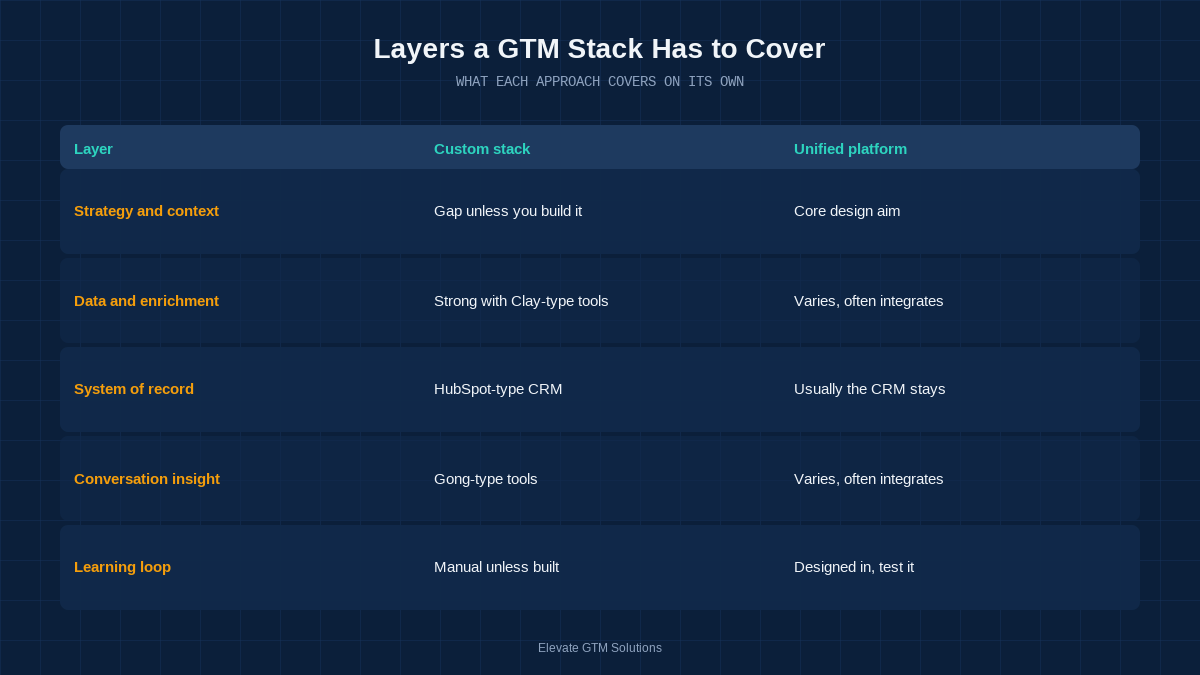
Notice what the three together cover: data and workflows, records and process, and conversation insight. Each is valuable. What none of them is built to hold is the decision layer: who the best customer is and why, how to position, what to say to each persona, which segments to prioritize and the plan that connects them.
The part of the debate that gets missed
The usual argument treats the two options as substitutes. They are often not, because they operate at different layers.
| Layer | What it covers | Custom stack | Unified platform |
|---|---|---|---|
| Strategy and planning | Segments, ICP, positioning, messaging, pricing and channel choices, plays, metrics | Not covered by the three tools. Built in documents or by consultants | Often a core purpose. Verify depth |
| Data and enrichment | Contact and company data, enrichment logic | Strong (Clay-type tool plus data sources) | Varies. May rely on integrations |
| Records and process | Contacts, accounts, deals, workflow | Strong (CRM) | Usually integrates with the CRM and does not replace it |
| Conversation intelligence | Calls, meetings, deal insight | Strong (Gong-type tool) | Varies. May integrate or provide lighter features |
| Coordination | Signals, routing, handoffs, suppression | Built by you with workflows | May be included. Verify |
| Measurement | Plan versus results | Built by you in reports | May be included. Verify |
This is why the choice is rarely "stack or platform." A team that builds a Clay, HubSpot and Gong stack still has to answer where its strategy lives. If the answer is "in a deck and in the head of the head of marketing," then the best data and the best CRM will faithfully execute whatever that deck assumed, and the gap between strategy and execution that frustrates buyers remains. A unified platform of the kind we make is aimed at that gap. It is not necessarily a replacement for the specialist tools, and in many deployments it would sit beside them. See GTM platform to build strategy before CRM campaigns.
Conversely, a company that buys a unified platform and expects it to replace deep data enrichment or deep conversation analysis may be disappointed. Ask what is native and what depends on integrations.
What you take on when you build
Building is attractive because the cost shows up as licenses and you keep control. The costs that do not show up on the invoice are where the surprises are.
People
A custom stack needs someone who understands each tool and the logic that connects them. That is often a GTM engineer, a RevOps lead with technical skill or an agency. Their time is the largest cost, and it continues after the build.
Maintenance
Integrations break when a vendor changes an interface. Enrichment logic goes stale as data sources change. Workflows accumulate exceptions. Someone has to watch, fix and document. A stack that worked well in year one can become fragile in year two without that care.
Key-person risk
If one person built the logic and holds it in their head, the company is exposed when they leave, burn out or get promoted. Documentation helps, but rarely fully.
Drift
Definitions of account, segment and persona differ across the three tools and nobody reconciles them. Each tool can be correct on its own terms and the whole still disagrees.
Security and procurement
Each tool needs a security review, a contract and a renewal. Data flowing among three vendors creates more places to check, especially for regulated buyers. See GTM platform governance checklist.
Speed
Designing, building and testing the connections takes time before value shows up. For a company that needs to move quickly, that delay is a cost.
Opportunity cost
Time spent on plumbing is time not spent on the market. Engineers building workflows are not building new plays.
What you gain when you build
The honest case for building is strong for the right team.
Control. You decide exactly how data is enriched, scored and routed. No vendor's opinion is baked in.
Best-of-breed depth. Specialist tools often go deeper in their own area than a broad platform does.
Flexibility. You can swap one component without replacing everything.
Fit with unusual workflows. If your motion is unusual, custom logic can match it precisely.
Lower lock-in to one vendor. Dependence is spread, though it is spread across several vendors.
Skill building. Teams that build learn their own process in detail.
Cost control at small scale. For a small team that already has the skills, a lean stack can be inexpensive.
What you gain when you buy a unified platform
Fewer seams. One model of accounts, segments and plays reduces definition drift.
Faster start. A platform that fits your process can show value in weeks rather than a quarter.
Less glue work. The vendor maintains the connections inside the platform.
A strategy and planning layer, if the platform includes one. This is the point that most separates it from a stack of execution tools.
Shared visibility. Leaders and teams see plan and results together.
Lower dependence on a few individuals, though you still need a platform owner.
Predictable operating cost, compared with the variable cost of engineering time.
What you give up when you buy
Control. You work within the vendor's model and may not be able to tune every rule.
Depth in specialist areas. A broad platform may not match a specialist's data coverage or conversation analysis. Test the areas you care about.
Vendor dependence. If the vendor changes pricing, direction or support, you feel it.
Maturity risk. Newer platforms may have gaps, and roadmaps can change.
Adoption effort. Teams must change habits, and that takes real work.
Opinions you did not choose. A platform's default definitions and workflows may differ from yours.
A dimension-by-dimension comparison
| Dimension | Custom stack | Unified platform | What to test |
|---|---|---|---|
| Time to first value | Weeks to months, depending on design | Often faster | Ask for a first result on your own market in the first week |
| Flexibility of logic | Very high | Moderate | Bring your two most unusual rules |
| Data coverage and enrichment | Depends on the tool and sources | Varies | Compare coverage on twenty of your own accounts |
| Conversation insight | Strong with a dedicated tool | Varies | Compare insights on the same recorded calls |
| Strategy and planning | Separate effort | Often included | See an ICP, positioning and plan generated with sources |
| Consistency of definitions | Depends on discipline | Built into the shared model | Change a definition and watch what updates |
| People needed | Technical, ongoing | Less technical, still an owner | Ask who maintains each piece |
| Fragility | Integrations can break | Fewer external seams | Ask what happens when an integration fails |
| Security surface | Several vendors, more connections | Fewer vendors, still integrations | Review each data flow |
| Adoption | Teams use familiar tools | Teams adopt a new interface | Pilot with real users |
| Reversibility | Swap components | Migration of the platform | Ask how you would leave |
| Total cost over three years | Licenses plus people plus maintenance | Subscription plus remaining tools plus adoption | Use the worksheet below |
Comparing total cost without inventing numbers
License prices are the visible part of cost. To compare fairly, build a worksheet with your own figures for three years.
| Line | Custom stack | Unified platform plus kept tools |
|---|---|---|
| Software licenses | Sum of all tools you keep | Platform plus the tools you keep |
| People: engineering or technical RevOps | Share of time of the people who build and maintain | Smaller share |
| People: administration | CRM and tool admin | CRM admin plus platform owner |
| Outside help | Agency or contractor time | Onboarding or services |
| Implementation | One-time design and build | One-time setup and migration |
| Data and enrichment sources | Credits and subscriptions | Credits for what you keep |
| Training and change | Moderate | Higher at the start |
| Risk allowance | Cost of a key person leaving, a broken integration, a re-build | Cost of a vendor change or a poor fit |
An invented illustration
The figures below are invented to show the structure. They are not benchmarks or quotes.
Suppose a company runs a custom stack with these annual costs: licenses of $90,000, a GTM engineer at a fully loaded $160,000 and $30,000 of administration time, for $280,000 a year.
Suppose it considers a unified platform while keeping its CRM and conversation tool and dropping the enrichment tool. Annual costs: the platform at $80,000, the retained licenses at $60,000, half of a GTM engineer at $80,000 and $20,000 of administration time, for $240,000 a year.
The difference is $40,000 a year, or $120,000 over three years before one-time costs. That is a small number next to the risk items. If the engineer in the first scenario leaves and the replacement takes four months to hire and ramp, the company lives with a partly working stack for that time. If the platform in the second scenario does not fit and the company must migrate again in year two, it pays for that. A fair comparison puts an estimate on these risks and does not stop at the arithmetic of licenses.
Notice also that the second scenario still has a half-time engineer. In practice, even companies that buy a platform need someone who owns it.
Who should build, who should buy, who should combine
Build is more likely right when
- You have at least one skilled GTM engineer or technical RevOps person, and they are likely to stay.
- Your motion is unusual, and off-the-shelf logic would not fit.
- Data enrichment depth is central to your advantage.
- You are a small team with a clear, narrow process and low need for cross-team alignment.
- You want to own the logic as a competitive asset.
- You can document and maintain the work properly.
Buy is more likely right when
- Several teams or regions must work to the same plan.
- Strategy and messaging drift is a bigger problem than data access.
- You lack engineering capacity, or do not want to depend on one or two people.
- You need to move faster than a custom build allows.
- Leadership wants one view of plan and results.
- Your process is reasonably standard.
Hybrid is more likely right when
- You already have a CRM and a specialist tool that work well.
- The gap is the strategy and coordination layer, not the data or the records.
- You want to try a platform on one segment before committing broadly.
In a hybrid, the unified platform holds strategy, plans and messaging, the CRM remains the system of record, the specialist tools handle data depth and call analysis and the integrations pass decisions down and results back. See unified GTM platform vs point solutions.
Risks on each side, and what to do about them
| Risk | Custom stack | Unified platform |
|---|---|---|
| Key-person dependence | High. Document, cross-train, review quarterly | Lower, but a platform owner is still needed |
| Integration breakage | Real. Monitor and test regularly | Fewer external seams, but check each integration |
| Vendor change | Spread across several vendors | Concentrated in one. Review the contract and exit plan |
| Poor fit | You designed it, so fit is your responsibility | The model may not fit. Pilot first |
| Definition drift | High unless managed | Lower |
| Data privacy and security | More vendors to review | Fewer vendors, still reviews needed |
| Over-engineering | Common, because building is satisfying | Less likely |
| Under-adoption | Lower for familiar tools | Real. Plan training and ownership |
| Cost creep | Usage-based credits and add-ons | Add-on modules and seats. Confirm terms |
Run a bake-off before you decide
Opinions are cheap, and a short test is not. Use the same scenarios on both options, with your own data.
Scenario 1: a new segment. Ask each option to help define a new target segment and produce the ICP, positioning and a first outreach plan for it. Compare the quality, the evidence and the time taken.
Scenario 2: a messaging change. Change the positioning for one persona. How long until sequences, enablement materials and tools reflect it, and how many manual steps were needed?
Scenario 3: a signal. Simulate a high-intent signal on a priority account that is also an existing customer with an open support issue. What does each setup do?
Scenario 4: a definition change. Change the definition of a target account. What updates automatically, and what breaks?
Scenario 5: a leader's question. Ask, "Which segments are we winning in, and does that match our plan?" How long does it take to answer, and how much do people trust the answer?
Scenario 6: a departure. Imagine the person who built the logic is gone. What does a successor need to understand, and how long would it take?
Score each option on result quality, time, manual effort, clarity of reasoning and what would happen if the key person left. Involve the people who would use it every day, not only the sponsor. See questions to ask AI GTM vendors and how to tell if a GTM platform is really AI-native.
A ninety-day plan for deciding
Days 1 to 15: define the problem. Audit your current stack. List what works, what breaks and where definitions differ. See GTM stack audit. Decide which layer hurts most: strategy, data, records, conversation, coordination or measurement.
Days 16 to 30: write requirements. Turn the audit into six to ten requirements, and mark which are essential. Name the owner and the people who will use it.
Days 31 to 60: run the bake-off. Use the six scenarios with your own data. Include the people who would maintain it. Collect the cost worksheet figures from vendors and from your own team.
Days 61 to 75: decide. Compare results, total cost over three years and risk. Choose build, buy or hybrid, and write down why.
Days 76 to 90: plan the rollout. Name an owner, define the handoff between tools, choose the first segment and set the review dates. See pilot to scale framework.
Questions for each side
Ask the person proposing to build:
- Who maintains it in a year, and who is the backup?
- Where does strategy live, and how does it reach the tools?
- What happens when an integration breaks at the end of a quarter?
- How much of your time will this take each month?
- How will definitions stay consistent across tools?
Ask the vendor proposing to buy:
- Which parts are native, and which depend on integrations?
- What do customers still do outside the product?
- What happens when I change an ICP or messaging?
- What is the exit plan, and how would I get my data and definitions out?
- How is pricing structured, and what changes it later?
- What does a first week on my data look like?
Common mistakes
Treating it as a pure cost comparison. License prices hide the people cost and the risk.
Confusing execution tooling with strategy. A good stack runs whatever it is told. It does not decide what to say.
Building for the pleasure of building. Custom work is satisfying, and it is also a liability if nobody maintains it.
Buying a platform to avoid making decisions. The platform will ask you to define your segments and messaging anyway.
Assuming a platform replaces specialist depth. Test the depth you rely on.
Skipping the bake-off. Demos and architecture diagrams are not evidence.
Ignoring who maintains it. Both options need an owner.
Forgetting the exit. Know how you would leave either approach.
Letting the loudest voice decide. Tool preferences are often tribal. Use scenarios and data.
Three company profiles, invented for illustration
Abstract criteria are easier to apply when you can see them in a setting. These profiles are invented.
Profile A: a twelve-person startup with one technical founder. One product, one segment, a founder who enjoys building workflows. The team uses a data and workflow tool for enrichment, a CRM and a call recorder. The strategy fits in a two-page document that the founder rewrites each month. Here, a custom stack is rational. Buying a platform for strategy and coordination would add cost for a problem the company does not yet have, because one person holds the strategy in their head and nobody needs a shared model. The risk to watch is the founder's attention, since the stack depends entirely on them.
Profile B: a 150-person company with three products and a separate team for each. Each team built its own sequences and lists, and the three teams describe the buyer differently. A RevOps lead keeps the CRM running with a part-time contractor. Data tools are fine. The pain is that nobody can say which segment each campaign serves, messaging changes take weeks to spread and executives get three versions of the pipeline. A unified layer for strategy and coordination, sitting beside the existing CRM and call tool, fits this profile. Rebuilding the data tooling would solve the wrong problem.
Profile C: a 600-person company with regional teams and strict security requirements. Several regions use different tools, and a central team sets global positioning with local adaptation. Procurement and security reviews are slow. Here, the number of vendors matters, since each added tool is another review. The company may prefer fewer vendors, with strong governance and role-based control, and it will need decision rights more than any tool. See GTM platform governance checklist and best GTM platform for an enterprise with several products and regions.
The same two options lead to different answers because the constraint differs: attention in A, definitions in B, governance in C.
How to make a custom stack survive its builder
If you build, the main risk is that it works only while one person is around. These habits cut that risk considerably.
Write a one-page map of the stack. Tools, owners, what data moves where, and which system is the source of truth for each field.
Document the rules in plain language. For routing, scoring and suppression, write what the rule is and why it exists, not just how it is configured.
Keep a change log. A dated note of what changed and who changed it saves hours when something breaks.
Pair the builder with a backup. Someone else should be able to repair the common failures.
Test the integrations on a schedule. A weekly check that records are flowing catches silent breakage early.
Review quarterly. Retire workflows nobody uses and fix definitions that have drifted.
Store definitions outside the tools. A plain document of segments, personas and fields prevents each tool from becoming its own source of truth.
Plan the handover. If the builder left tomorrow, what would you need? Write that down while they are still there.
How AI agents change the build side
Many custom stacks now include AI agents that research accounts, draft messages and run workflows. This changes the build-versus-buy calculation in two ways.
First, it lowers the effort to build some workflows, which makes custom work more attractive. A team can prototype a research and outreach workflow far faster than a few years ago.
Second, it raises the importance of guardrails and context. An agent that drafts messages needs to know the positioning, the segment, the persona and what must not be said. If that context lives in a deck, every agent invents its own version. The more agents you run, the more the strategy layer matters, because it is what keeps many fast, independent actors consistent. See AI agents in revenue organizations and what is a GTM context layer.
That is one reason the layered view is useful. Agents and workflows are part of the execution layer, and they need a source of context and rules. Whether that source is a unified platform or a well-kept set of documents is a choice, and the quality of that choice shows up in the consistency of what the agents produce.
Leaving either approach
Reversibility deserves a plain look before you commit.
Leaving a custom stack means unwinding workflows and rebuilding logic elsewhere. The CRM data stays, which is the most valuable asset. The logic in the workflow tool is the hard part, which is why documentation matters.
Leaving a platform means exporting the decisions it holds, such as segments, messaging, plans and history, and finding a new home for them. Ask before you sign: what can be exported, in what format and how quickly? Check that the definitions and reasoning, and not just raw records, can come out.
In both cases, the best protection is the same: keep your definitions and strategy in a form you own, and make sure the CRM remains the system of record.
Glossary
GTM engineer. A person who builds data and workflow automation for go-to-market teams. See what is a GTM engineer.
Best-of-breed. A strategy of choosing the best tool for each function instead of one broad suite.
Unified platform. A product that covers several GTM functions in one connected model.
Enrichment. Adding data to records from external sources.
Conversation intelligence. Software that records and analyzes calls and meetings.
Glue. The integrations, workflows and manual steps that connect tools.
Key-person risk. The exposure created when critical knowledge sits with one individual.
Definition drift. The gradual divergence in how tools or teams define terms like account or segment.
Bake-off. A structured comparison in which options are tested on the same scenarios.
Where Elevate GTM Solutions fits
Elevate GTM Solutions is an AI GTM platform for creating, executing and adapting go-to-market strategy. Its homepage describes modules including "Unified GTM Strategy," "Market Research," "ICP & Segmentation," "Competitive Intelligence," "Product Positioning," "Product Messaging," "Pricing Strategy," "Launch & Execute," "Measure & Optimize" and "Sales Enablement," and a shared model across Marketing, Sales, Product and RevOps. The homepage says "15 connected GTM modules" and names sixteen, so count what you see.
In the terms of this guide, Elevate is aimed at the strategy and planning layer, and at the shared model that keeps strategy, execution and measurement consistent. It is not a CRM, not a data enrichment tool and not a conversation intelligence product, and we would not suggest replacing a CRM with it. For a team already running a Clay, HubSpot and Gong stack, the natural question is whether the missing layer is strategy and coordination, in which case a hybrid is worth testing, or whether the real gap is elsewhere. For a team without the engineering capacity to build and maintain the glue, a platform may reduce that load. Both claims should be tested with your own data and the scenarios above, including the question of which parts of the platform are native and which rely on integrations. Confirm integration details on the vendor's own information. See Elevate vs Clay, Elevate vs HubSpot, Elevate vs Gong and what Elevate GTM Solutions is.
What to do this week
- List the tools in your stack with owner, purpose and annual cost.
- Write down where your strategy lives today: segments, ICP, positioning, messaging. Note who maintains it.
- Identify who maintains the connections between your tools, and who the backup is.
- Name the layer that hurts most: strategy, data, records, conversation, coordination or measurement.
- Fill in the cost worksheet for your current stack, including people time.
- Choose three of the bake-off scenarios that matter most to you.
- Ask each vendor what is native and what relies on integrations.
- Decide who will use the result daily, and include them in the test.
Key takeaways
- The build-versus-buy debate often misses that the two options operate at different layers. A Clay, HubSpot and Gong stack covers data and workflow, records and process, and conversation insight. It does not itself hold the strategy layer.
- Build when you have stable engineering talent, unusual workflows and a need for control. Buy when you need fewer seams, speed, shared definitions and less dependence on individuals. Combine when the gap is strategy and coordination, not data or records.
- Hidden costs of building are people, maintenance, key-person risk, drift, security reviews and slower start.
- Costs of buying are less control, possible gaps in specialist depth, vendor dependence, maturity risk and adoption effort.
- Compare total cost over three years, including people and a risk allowance, using your own numbers.
- Run a bake-off with the same scenarios on both options, including a messaging change, a definition change and a key-person departure.
- Whatever you choose, name an owner and write down the exit plan.
Sources
- Elevate GTM Solutions: descriptions of modules, audience and shared-model design, as stated on the company's homepage.
- Related Elevate guides linked in the text, including Elevate vs Clay, why Clay is not a GTM operating system and unified GTM platform vs point solutions.
- Descriptions of Clay, HubSpot and Gong are general and reflect their commonly understood roles. Products change, so confirm current capabilities and pricing on each vendor's own site.
- The layer model, risk lists, bake-off and plan reflect our judgment and common practice. The cost illustration uses invented numbers and is not a benchmark or a quote.
Frequently Asked Questions
Should I build a Clay, HubSpot and Gong stack or buy a unified GTM platform?
Build if you have stable engineering talent, unusual workflows and want control. Buy if you want fewer seams, a faster start and shared definitions across teams. Many companies combine them, keeping the CRM and specialist tools and adding a unified layer for strategy and coordination.
Is a unified platform a replacement for HubSpot?
Not usually. A CRM is the system of record for contacts, accounts and deals, and a GTM platform typically sits alongside it. Be cautious of any vendor who claims to replace everything, and test the claim.
What does a Clay, HubSpot and Gong stack not cover?
It covers data and workflow, records and process, and conversation insight. It does not by itself hold the strategy layer: who your best customer is, how to position, what to say to each persona and the plan that connects them.
Which approach is cheaper?
It depends on your people costs and how long the custom glue stays healthy. License prices are only part of the cost. Include engineering and administration time and the cost of a key person leaving or an integration breaking.
What is the biggest risk of building a custom stack?
Dependence on one or two people who understand the connections, plus drift in definitions across tools. Documentation, cross-training and regular review reduce the risk but do not remove it.
What is the biggest risk of buying a platform?
Poor fit, gaps in specialist depth, vendor dependence and low adoption. Run a pilot on your own data, ask what is native and what relies on integrations and plan the exit before you sign.
Do I still need a GTM engineer if I buy a platform?
Often you still need someone to own the platform and the connections, but less glue work. The role may be part-time or part of a RevOps position.
How do I compare the two fairly?
Run a bake-off with the same scenarios on both: a new segment, a messaging change, a signal on a complicated account, a definition change, a leader's question and a key-person departure. Score result quality, time, manual effort and clarity.
Can I start with one and move to the other?
Yes. Many teams start with a stack and add a strategy layer later, or start with a platform and keep specialist tools. Document definitions and keep data exportable so moving is possible.
Does an AI-native platform make a custom stack unnecessary?
Not necessarily. AI-native platforms may reduce glue work, but specialist tools may still go deeper in data or conversation analysis. Test the areas you rely on.
Who should make the decision?
The sponsor, together with the people who will use and maintain the result daily, including RevOps, sales and marketing. Include finance for the cost comparison.
How long should the evaluation take?
A focused evaluation with a bake-off can take about two months. Longer evaluations usually add delay without adding clarity, so set a decision date at the start.