
By the Elevate GTM Solutions Team · Updated November 13, 2026 · 23 min read
Companies That Specialize in GTM Execution: Consultancies, Agencies, Implementation Partners and Platforms, and How to Choose
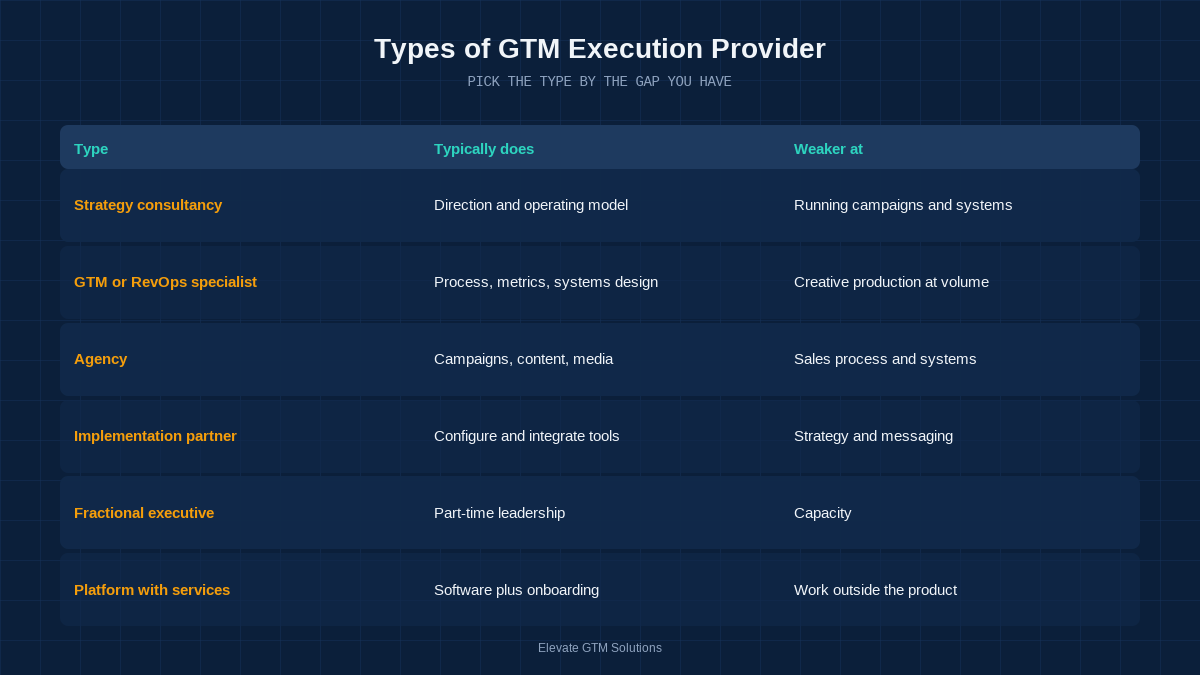
If you search for companies that specialize in go-to-market execution, you will find a long list that has little in common. Management consultancies, boutique GTM advisers, revenue operations shops, demand generation agencies, CRM implementation partners, fractional executives, freelancers and software platforms all say they "do GTM execution." They do different work, for different buyers, at very different prices, and most of the disappointment in this market comes from hiring one type when you needed another.
This guide sorts the providers by what they actually do, explains how engagements are usually structured, and gives you a way to choose and vet one. It is written for a buyer who has a strategy or a direction and needs help turning it into running work: campaigns, plays, systems, processes and routines. It also covers the closely related question of who can help you implement a unified GTM strategy platform, since that phrase means two different things.
We make a GTM platform, and we also offer guided programs and advisory alongside it, so we have a stake in this topic. We do not rank named firms here. We have not audited any of them, and a ranking from a company that sells in the same market would not be worth much. What we can offer is the sorting method, the vetting questions and an honest account of when each type fits, including when it is not us.
Which companies specialize in GTM execution?
There is no single list, because "GTM execution" covers several kinds of work. Management and strategy consultancies tend to set direction. Specialist GTM and revenue operations firms design the processes and systems. Agencies run campaigns and content. CRM and marketing automation implementation partners configure the tools. Fractional executives and freelancers provide leadership or skills part time. Software platforms automate parts of the work. Pick the type by the gap you have, then vet two or three firms within it on deliverables, references and who does the work.
Who can help implement a unified GTM strategy platform? The vendor's own services team, a certified implementation partner for the platform or the CRM it connects to, or an independent RevOps consultant. Ask which of them has done it with a customer like you.
Is a platform the same as a partner? No. A platform is software you operate. A partner does work for you or with you. Some vendors offer both.
What GTM execution is, in one paragraph
GTM strategy answers who you sell to, how you position the product, what you say, what you charge and through which channels. GTM execution is everything that turns those answers into daily work: the campaigns that run, the plays reps use, the routing and scoring rules in the CRM, the content and assets, the launch tasks, the weekly plans and the measurement. Our page on what GTM execution is goes deeper. For this guide, the practical point is that execution has many parts, and no single provider is strong at all of them.
The types of provider
| Type | What they typically do | Who usually buys | Typical engagement | Where they are weaker |
|---|---|---|---|---|
| Management or strategy consultancy | Market assessment, strategy, operating model, transformation plans | Executives of large companies | Project of weeks to months, led by senior staff | Hands-on running of campaigns and systems |
| Specialist GTM or revenue operations consultancy | GTM design, process, metrics, tool selection, systems work | Mid-size and large B2B companies | Project or retainer, often with an operator on your team | Creative production at volume |
| Demand generation or marketing agency | Campaigns, content, paid media, events, email | Marketing leaders | Monthly retainer tied to deliverables | Sales process and systems |
| Sales or outbound agency | Outbound prospecting, appointment setting | Sales leaders, startups | Monthly retainer or per meeting | Positioning, broader strategy |
| CRM and automation implementation partner | Configuration, integration, data migration, training | RevOps and IT | Fixed-scope project, then support | Strategy and messaging |
| Fractional or interim executive | Part-time head of marketing, sales, RevOps or product marketing | Startups and scale-ups | Days per week for months | Capacity, since they are one person |
| Freelancer or small specialist | A defined skill such as messaging, analytics or content | Any | Hourly or per project | Coordination across functions |
| Platform with services | Software plus onboarding and advisory | Teams that want a system they keep | Subscription plus optional services | Work outside the product's scope |
Most real engagements combine two types. A company might use a consultancy to set direction, an implementation partner to build the systems and an agency to run campaigns. The art is in choosing the smallest set that covers the gap and making sure one person on your side owns the whole.
First decide what kind of help you need
Before looking for providers, answer four questions in writing. They will narrow the field faster than any directory.
- What is the gap? Direction (we do not know what to do), design (we know, but have no process), capacity (we have a process and not enough people) or tooling (the systems do not work).
- What should exist when the work ends? A deck, a running system, trained people, results? An engagement that ends in a deck is a different thing from one that ends in a working process.
- Who will own it afterwards? If nobody, no provider can fix that, and the work will decay.
- How fast, and for how long? A one-quarter launch needs a different shape of help from a multi-year change.
Our page on GTM consulting alternatives lays out seven ways to get strategy and execution help without a long retainer, and when you still need a GTM consultant is a frank look at where outside people make a difference.
Matching the gap to the provider
| Gap | Best first move | Why |
|---|---|---|
| "We do not have a clear strategy" | A consultant or advisory engagement, or a strategy platform to produce a first draft you then test | Execution partners cannot fix unclear direction |
| "We have a strategy but sellers do not use it" | Enablement and operations help, plus a named internal owner | The problem is adoption, not direction |
| "Our CRM and routing are a mess" | A CRM implementation partner or RevOps consultant | A systems problem needs a systems person |
| "We need more pipeline now" | An agency or outbound team, with clear targets and a short review cycle | Capacity and channel expertise matter most |
| "We are launching a product in a quarter" | A launch-focused adviser or consultant, plus internal owners | Timing and coordination are the issue |
| "We need leadership, not labor" | A fractional executive | You need judgment and a leader on the team |
| "We want one system that keeps strategy and execution connected" | A GTM platform, with onboarding help if needed | The goal is a living system, not a one-off deliverable |
Two meanings of "implement a unified GTM strategy platform"
This phrase shows up in questions, and it hides an important difference.
Implementing the strategy. You want help making a unified go-to-market strategy real: agreeing the customer definition, aligning teams, building the plays, launching. This is consulting and operations work. The platform, if any, is a tool.
Implementing the platform. You have bought software and need it configured, integrated and adopted: connecting it to the CRM, loading context, training users, setting governance. This is implementation work. Vendors often provide it, and certified partners may.
When you ask a provider for help, say which one you mean. A firm that is excellent at strategy may know nothing about your software, and a firm that is excellent at configuration may have no view on your positioning. For the platform side, see our guide to implementing an enterprise GTM operating system.
How engagements are structured
Understanding the structure helps you read proposals.
| Structure | How it works | Good for | Watch for |
|---|---|---|---|
| Fixed scope and fee | A defined deliverable at a set price | Clear problems with a known end | Scope creep, thin work that meets the letter of the scope |
| Retainer | A monthly fee for an agreed amount of time or output | Ongoing work such as campaigns | Paying for hours that produce little |
| Time and materials | Hourly or daily rates | Uncertain work | Costs that drift upward |
| Milestone based | Payments tied to agreed milestones | Projects with checkpoints | Milestones that measure activity, not results |
| Performance based | Fees depend on outcomes | Outbound and lead generation | Disputes over attribution and definitions |
| Embedded operator | A person works inside your team part time | Capacity and leadership gaps | Dependence on one individual |
| Subscription plus services | Software with onboarding or advisory | Teams that want to keep the system | Services not covered by the subscription |
Our pages on how much GTM consulting costs and why it is expensive explain the cost structure of the consulting side in detail, and the total cost of GTM consulting covers what repeats.
What to look for in a provider
Deliverables you can name
Ask what exists at the end of week two, week six and the close. "A strategy" is not a deliverable. "A customer profile with five scored segments, a messaging framework by persona and a launch calendar with owners" is.
Who actually does the work
Many firms sell with senior people and staff with junior people. That is not automatically a problem, and you should know the ratio. Ask for the names and roles of the people who will work on your account, how many hours each will spend and whether you can meet them before signing.
Work with customers like you
Industry fit matters less than motion fit. A firm that has helped a sales-led enterprise software company may be more useful than one that has helped a product-led consumer app in your own industry. Ask for specific examples, and for the one that went badly.
References you can call
Ask for two references from the past year, including at least one where the engagement ended. A reference you find yourself is better than one the provider chooses.
What you keep
Check who owns the work product: documents, templates, workflows, configurations and data. Check whether you can run it without the provider afterwards.
How they handle handoff
A good provider plans the exit from day one. Ask what the handoff looks like. Our page on what a GTM strategy handoff should contain is a checklist you can use.
How they measure themselves
Ask how they will know the work succeeded, and what they will do if it does not. Good providers can name measures. Great ones can name the measure they would stop using if it misled.
A selection process that fits in three weeks
- Write the brief. One page: the gap, the desired end state, the owner, the timeline and a budget range.
- Long list of six. Include at least two types of provider, for example one specialist firm, one agency or implementation partner and one platform with services.
- Short call with each. Fifteen minutes to test fit and price range.
- Short list of three. Request a written proposal using your brief.
- Run the same test on each. Give each a small, real question and compare what comes back. For example, "tell us what you would change in our positioning and why."
- Speak to references.
- Score and decide. Use the matrix below.
- Start with a small first phase. A paid pilot of two to six weeks reduces risk.
A scoring matrix
Weight the rows by what matters to you, score each provider from one to five and discuss the gaps.
| Criterion | Weight | Provider 1 | Provider 2 | Provider 3 |
|---|---|---|---|---|
| Understands our problem and says so back to us | ||||
| Named deliverables and timeline | ||||
| People who will do the work are named | ||||
| Relevant work with comparable customers | ||||
| References were useful | ||||
| We keep the work and can run it | ||||
| Handoff plan | ||||
| Price and terms | ||||
| Cultural fit with our team | ||||
| Result of the small test |
Questions to put to any provider
- What would you do in the first thirty days?
- What do you need from us, and from whom?
- Which part of this problem is hardest, in your view?
- What would make you recommend we do not hire you?
- Who works on our account and how much of their time?
- What do you deliver, in what form and when?
- What do we own at the end?
- What happens if the work is not going well at the midpoint?
- Show us an example of a similar engagement, and one that did not go to plan.
- How do you charge, and what is not included?
- How do you work with our CRM and marketing tools?
- What does handoff look like?
Platform vendors as GTM execution partners
Some software vendors position themselves as partners as well as tools, offering onboarding, advisory and guided programs. This can be useful because the people who built the product know where it does and does not fit. It also means the adviser is not neutral about the tool.
Questions to ask a vendor that also offers services:
- Which services are included in the subscription and which are paid?
- Is the advice limited to what the product can do, or does it cover your wider approach?
- Who delivers the services: staff, or a partner network?
- What happens to the work if you cancel the subscription?
- Can you hire the services without the software, or the software without the services?
CRM and marketing platform partner ecosystems
Large CRM and marketing automation vendors run partner programs that certify implementation firms. Salesforce has a partner program that includes consulting and implementation firms, and HubSpot runs a solutions partner program for agencies and consultants. Membership or a certification tells you the firm has met the vendor's criteria for working on that tool. It does not tell you whether the firm is good at your problem. Treat it as a minimum filter for systems work and ask for customer references as you would with any other provider.
If your issue is how your GTM tools connect to a CRM, our guide to GTM platforms that integrate with Salesforce explains what to test.
Working with an outside provider without losing control
Outside help fails when nobody inside owns the result. Four habits reduce the risk.
Name an internal owner. One person with authority to decide, not a committee. See who owns GTM strategy.
Hold a weekly review. Thirty minutes, with the provider, the owner and one person from sales or customer success. Review what shipped, what is stuck and what changed.
Keep a decision log. Write down each decision, who made it and why. When the provider leaves, the log is what remains.
Test with the field. Anything that changes what sellers say or do should be tried with real sellers and real customers before it is rolled out widely.
What to ask a provider about AI
Many providers now use AI tools in their work, and many sell AI-based services. Reasonable questions:
- Where do you use AI in our engagement, and where do people review it?
- What data of ours goes into AI tools, and where does it go?
- How do you check AI outputs for accuracy before we see them?
- Do your prices reflect any time savings from AI?
- Which work do you not do with AI, and why?
An honest provider will have clear answers. A provider that says AI "does everything" is not describing how their own work gets done.
Red flags
- A proposal that restates your problem in general terms and then lists services. The provider has not listened.
- Guaranteed results. Execution depends on many things outside the provider's control.
- No named people.
- Reluctance to share references.
- A scope that is all activity. Weekly meetings and decks with no output you can use.
- Reluctance to explain who owns the work.
- Pressure to sign a long term before a test.
- A single answer to every problem. A firm that recommends its own service in every case is selling, not advising.
Cost, in shape rather than numbers
Prices vary a great deal by region, seniority and scope, and we will not quote figures that would go out of date. The shape is more useful.
| Type | Cost shape | What to compare |
|---|---|---|
| Consultancy | Project fee, rising with seniority and duration | Fee against the named deliverables |
| Specialist firm | Project or retainer | Fee against hours and the people who work |
| Agency | Monthly retainer plus media or tool costs | Fee against deliverables and results measures |
| Implementation partner | Fixed fee or time and materials, plus tool licenses | Fee against scope and acceptance criteria |
| Fractional executive | Day rate or monthly fee | Cost against a full-time hire, including benefits and ramp |
| Platform with services | Subscription plus optional services | Three-year total, including services |
For a fair comparison, add internal time and the cost of delay to every option, including doing nothing.
Examples, as illustrations
These are fictional.
A software company with a new product line. The company has a strategy draft and a launch date in three months. It needs a launch lead, content and sales readiness. It hires a fractional product marketing leader for four days a month, uses an agency for launch content and keeps the CRM work in house. It names the head of product as the owner. The choice is the smallest set that covers the gap.
A mid-size company whose routing and scoring are broken. Leads reach the wrong sellers and nobody trusts the scores. The company hires a CRM implementation partner for a fixed-scope project with acceptance tests, such as "every lead in the test set routes to the expected owner." The partner trains two administrators so the company can maintain the rules.
A startup with no GTM strategy. The founders have sold to early customers by hand and need a structured plan. They compare a consultant, a guided program and a platform's free first build. They start with the free build, test the draft with three customers and buy advice only for the parts that feel unclear. Our guide to building a GTM strategy without a consultant lays out a thirty-day path.
Glossary
Embedded operator. An outside person who works inside your team on a regular schedule.
Fractional executive. A senior person who works part time for several companies.
Implementation partner. A firm certified to configure and integrate a particular software product.
Retainer. A recurring fee for ongoing availability or output.
Revenue operations. The function that manages the processes, systems and data across marketing, sales and customer success.
Scope. The defined boundaries of what a provider will deliver.
Statement of work. The document that sets scope, deliverables, timeline and price.
Common mistakes
- Hiring for execution when the strategy is unclear.
- Hiring a strategy firm to fix a systems problem.
- Buying a deck. Ask for the thing that runs.
- Skipping the internal owner.
- Signing a long term before a small test.
- Not asking who does the work.
- Ignoring the handoff.
- Comparing hourly rates instead of results.
- Letting the provider choose the measures.
- Forgetting the cost of your own time.
A first ninety days with an outside provider
Whatever type you choose, the first three months set the pattern. A simple shape works for most engagements.
Days one to ten: alignment. Agree the brief, the success measures and the owner. The provider interviews five to eight people inside the company, including at least one seller and one person from customer success. You share the evidence you already have: win and loss notes, customer calls, current messaging, current metrics. The provider should come back with a short statement of what they heard, including where people disagreed. If the summary reads like a generic description of your industry, they have not listened yet.
Days eleven to thirty: first output. One real piece of work reaches the people who will use it. That might be a draft customer profile, a rebuilt lead routing rule or a first launch calendar. It does not need to be finished. It needs to be real enough that people can react to it. This is the point where many engagements reveal whether the provider and your team can work together.
Days thirty-one to sixty: test and revise. The output is tried with sellers, customers or live traffic. You compare what happens with what was expected and change the work. A provider who treats the first draft as final is selling a product, not solving your problem.
Days sixty-one to ninety: embed. The work moves into the daily routine. Owners are named, the weekly review runs without the provider leading it and the measures are reported on a regular schedule. By the end of this period you should be able to say what you would do if the provider left tomorrow.
If the ninety-day shape does not fit, the engagement may be too large for a first step. Cut it down.
What procurement and finance will ask
For a larger engagement you will probably go through procurement. They will ask for items that a provider can supply quickly if you ask early.
| Request | What it is for | What a provider should be able to give |
|---|---|---|
| Statement of work | Scope, deliverables, price | A draft you can mark up |
| Insurance certificates | Professional liability and general cover | Certificates on request |
| Security questionnaire | Handling of your data and systems | Completed answers, or a link to documentation |
| Data processing terms | Personal data in your CRM or analytics | A data processing agreement and list of subprocessors |
| Subcontractor list | Who else touches the work | Names and roles of any subcontractors |
| Conflict of interest statement | Work for your competitors | A clear statement of what they do and do not do |
| References | Evidence of past work | Two or three recent contacts |
| Payment terms | Cash flow and risk | Milestones tied to accepted deliverables |
Starting this paperwork in week one, in parallel with the evaluation, often saves a month.
Choosing by company stage
The right help changes as the company grows.
Pre-product-market fit. Most outside execution help is premature. The work is learning, and learning mostly happens in customer conversations the founders should have themselves. A framework, a free first strategy draft or a few hours of advice from an experienced person is usually enough.
Early traction, first repeatable sales. Capacity and focus are the problems. A fractional leader or a specialist freelancer for one function can help, and so can an outbound team if the target customer is already proven. A simple CRM setup matters more than a large tool stack.
Scaling, several segments or products. Consistency becomes the problem. This is where a specialist GTM or revenue operations firm, a strategy platform and an implementation partner earn their cost. The question is who owns the whole picture.
Enterprise, many regions and teams. Coordination and governance dominate. Expect a mix of providers, a formal selection process and a long implementation. Spend as much effort on ownership and change management as on the choice of firm.
When to end an engagement
Ending well is part of choosing well. Set the conditions at the start, and review them at each checkpoint.
- The deliverables have slipped twice without a clear reason.
- The people working on your account are not the people you were shown.
- The work is activity and not output. Meetings and decks with nothing that runs.
- Your internal owner no longer has the time or authority. Fix that first, or pause.
- The measures you agreed no longer matter. Change them deliberately, not quietly.
- You could now do the work yourselves. That is a success, not a failure.
Put a termination clause in the contract that lets you stop at a checkpoint without a penalty, and ask the provider to document the handoff when you do.
A brief for a provider, in outline
A one-page brief gets better proposals than a long conversation. A workable outline:
| Section | What to write |
|---|---|
| Company and product | Two sentences, plus who you sell to |
| The gap | What is not working, with one or two pieces of evidence |
| What exists now | Current strategy, tools, team and data, in a few lines |
| Desired end state | What should exist and run at the end |
| Constraints | Budget range, timeline, tools you will keep, people who will work with the provider |
| Owner | The named person who decides |
| How you will judge success | Two or three measures |
| What you want in the proposal | Named people, deliverables, timeline, price, references |
Send the same brief to each provider, and ask them to confirm back, in their own words, what they understood the problem to be. The quality of that restatement is often the best early signal of whether a provider will listen.
How Elevate GTM Solutions fits
Elevate GTM Solutions is an AI-native platform for GTM strategy and planning. It is software, and the company also offers Guided GTM, in which advisors support a team using the platform to develop and activate a strategy, and GTM Advisory, which is short, focused engagements on specific problems such as positioning, pricing and expansion. There is also a self-serve strategy framework and a partner program for specialists who work with the platform.
That makes us one of the options, and not the answer to every case. We are a fit when you want a connected strategy that stays current and that your own team keeps running. We are not a fit if the problem is a broken CRM, a need for outbound labor or a lack of internal ownership. For a view of the wider category, see Top GTM Platforms and GTM platform vs GTM consultant.
What to do this week
- Write the one-page brief: gap, end state, owner, timeline, budget range.
- Choose two types of provider to compare and shortlist three firms.
- Send each the same brief and the same small test question.
- Ask each for named people, deliverables and two references.
- Score them on the matrix and discuss the gaps.
- Start with a small paid first phase, with a review date.
Key takeaways
- "GTM execution" covers several kinds of work, so pick the provider type by the gap you have.
- Implementing a strategy and implementing a platform are different jobs.
- Ask for named deliverables, named people, references and a handoff plan.
- Start small, test with the field and keep an internal owner.
- No provider fixes missing ownership.
Sources
- Elevate GTM Solutions: services, advisory and partners: descriptions of Guided GTM, GTM Advisory, the framework and the partner program.
- The descriptions of provider types reflect common industry practice and the writers' judgment. They are not drawn from a single published survey, and we have not evaluated any named firm.
- Salesforce and HubSpot each describe their partner programs on their own websites. Check current program terms with the vendor.
Frequently Asked Questions
Which companies specialize in GTM execution?
There is no single list because the term covers different work. Consultancies set direction, specialist GTM and revenue operations firms design process and systems, agencies run campaigns, implementation partners configure tools, fractional executives provide leadership and platforms automate parts of the work. Choose the type by your gap, then vet two or three firms.
Who can help us implement a unified GTM strategy platform?
The vendor's services team, a certified implementation partner for the platform or the CRM it connects to, or an independent revenue operations consultant. Ask which has done it for a customer like you, and be clear whether you need help with the strategy or with the software.
What is the difference between a GTM consultant and an implementation partner?
A consultant helps decide what to do, often at the level of strategy and process. An implementation partner configures and integrates software. Many projects need both, and they are rarely the same firm.
How do I vet a GTM execution firm?
Ask for named deliverables, the names and time commitment of the people who will do the work, relevant examples including one that went badly, two recent references, who owns the work product and what the handoff looks like. Run the same small test with each shortlisted firm.
Should I hire an agency, a consultant or buy software?
It depends on the gap. Unclear direction points to a consultant or a strategy platform for a first draft. Capacity gaps point to agencies or fractional help. Broken systems point to an implementation partner. A wish to keep strategy and execution connected points to a platform.
How much do GTM execution providers cost?
It varies by type, region, seniority and scope. Compare each option against named deliverables and add your own time and the cost of delay. Ask for written proposals and a three-year view for any subscription.
Can a software vendor also be my GTM execution partner?
Some offer onboarding, advisory and guided programs. That can help because they know the product well, but they are not neutral about it. Ask what is included in the subscription, who delivers the services and what you keep if you cancel.
What should be in a statement of work?
Scope, deliverables with acceptance criteria, named people and time, timeline, price and payment terms, what you provide, who owns the work product, the handoff and how either side can end the engagement.
Do certified partners guarantee good work?
No. A certification shows the firm met the vendor's criteria for working on the product. It does not show how well it will handle your problem, so ask for references as you would with any provider.
What are the biggest risks in outsourcing GTM execution?
Unclear direction, no internal owner, deliverables that are activity and not output, dependence on one person, and a handoff that was never planned. A small first phase and a weekly review reduce the risk.
Where does Elevate GTM Solutions fit?
Elevate GTM Solutions is a platform for GTM strategy and planning with published plans, guided programs and advisory. It fits teams that want a connected strategy they keep running. It does not replace CRM implementation partners, outbound agencies or an internal owner.
How do I keep control when I use an outside provider?
Name an internal owner, hold a weekly review, keep a decision log and test any change that affects sellers or customers with real people before rolling it out widely.