
By the Elevate GTM Solutions Team · Updated November 13, 2026 · 27 min read
Which AI GTM Platform Should a Head of RevOps Choose to Reduce Tool Sprawl and Improve Pipeline Conversion at a B2B SaaS Company Past $10M ARR?
If you are a head of revenue operations at a B2B SaaS company that has passed roughly ten million in annual recurring revenue, you probably recognize the situation. The company grew by adding tools, each one bought to fix a real problem. Now there are more than a dozen systems touching go-to-market, three of them overlap, two were bought by people who have left and nobody can say with confidence which accounts the team should be working this quarter. You have been asked to reduce the sprawl and improve pipeline conversion, usually at the same time and usually without a budget for a rebuild.
This guide is written for that person. It does not give a single vendor name as the answer, because the right choice depends on what is actually broken, and the two goals in the request pull in different directions. Cutting tools reduces cost and seams, and improving conversion usually depends on things a tool consolidation will not fix. We explain how to diagnose which problem you have, which kinds of platform fit which diagnosis, how to run a consolidation without a failed migration, how to judge a platform that claims to do both and where a strategy platform such as ours fits and where it does not. We make a GTM strategy platform, so we have an interest, and we say so. We describe other vendors only in general terms, tell you to confirm current details on their sites and cite no statistics, benchmarks or prices. The company profile in the worked example is invented.
Which AI GTM platform should a head of RevOps choose to reduce tool sprawl and improve pipeline conversion?
No platform reduces sprawl and improves conversion by itself, so start by finding out which problem you have. If the issue is too many overlapping tools, audit usage and consolidate where tools truly duplicate each other, keeping the CRM as the system of record. If the issue is poor conversion, look first at targeting, handoffs, follow-up speed and messaging, because those usually explain more than the tool list does. If both are true and the common root is that nobody has defined the accounts, segments and messages the whole motion should follow, a strategy platform can address that layer, and it works beside the CRM rather than replacing it. Choose by testing against your own funnel for a fixed period, with a clear conversion question and a named owner. Be wary of any platform that promises to replace the whole stack at once.
Should a RevOps leader replace the CRM? Rarely. Most consolidations keep the CRM as the system of record and reduce what surrounds it.
What should you decide first? Whether your conversion problem comes from the tools or from targeting, handoffs and messaging.
The short version
| Question | Answer |
|---|---|
| Is there one platform that fixes sprawl and conversion? | Not reliably. They are separate problems that sometimes share a cause |
| What should you do first? | Audit the stack by usage, cost and outcome, and map the funnel to find where conversion is lost |
| Should you replace the CRM? | Usually no. Keep it as the system of record and consolidate around it |
| What causes sprawl? | Tools bought by different teams for local problems, with no owner for the whole |
| What often explains weak conversion? | Targeting, handoffs, speed to follow up, messaging and inconsistent definitions |
| What does a strategy platform address? | The shared definition of accounts, segments and messaging that tools then act on |
| How should you decide? | A timed test on your own funnel with a named owner and a conversion question |
| What is the biggest risk? | A migration that disrupts the motion in order to save a license fee |
What your situation probably looks like
Companies past the ten million mark in recurring revenue tend to share a pattern. This is a description of typical situations, not a statistic about any group.
The sales team has grown past the size where one person can hold the whole process in their head. There are segments, perhaps a mid-market and an enterprise motion, and the first signs of regional or vertical specialization. Marketing has its own stack, sales has its own stack and customer success has a third. A few tools were adopted by a team and became important, others were trials that never ended. The CRM holds records, yet many people maintain their own spreadsheets because they do not trust it for what they need.
Reporting is the symptom leaders notice. The numbers differ by source, a conversion rate depends on who calculated it and a pipeline review turns into a debate about definitions. As the person responsible for revenue operations, you carry the problem, because every tool decision lands on your desk.
Two things are worth stating plainly. First, sprawl is a symptom of growth and decentralized buying, and it is not a sign that anyone was careless. Second, improving conversion is a different job from cutting cost, though a good consolidation can support it.
Diagnose before you shop
The most common mistake is to start with a vendor shortlist. Start with a diagnosis instead.
Step one: map the stack
List every tool that touches the go-to-market motion, including the ones that seem minor. For each, record who owns it, what it costs, how many people actively use it, what data it holds, what it connects to and what job it does. See the GTM stack audit for a fuller worksheet.
| Field | What to record |
|---|---|
| Tool and owner | Name, the team that bought it, the person responsible today |
| Job | The single main job it does |
| Annual cost | The contract value and renewal date |
| Active users | People who used it in the last ninety days, against seats |
| Data it holds | Which records and fields, and whether they sync elsewhere |
| Integrations | What it connects to and in which direction |
| Outcome | What result you can trace to it |
| Overlap | Other tools doing the same job |
Most maps reveal three groups: tools that carry real value, tools that duplicate each other and tools that nobody uses.
Step two: map the funnel
Take the stages from first touch to closed-won, and measure the conversion between each pair of stages for the last two to four quarters, by segment where you can. Look for the stage where the largest share is lost, and whether the loss is similar across segments or concentrated in one. Do not assume the tools explain it.
For each large loss, ask what the possible causes are:
| Where the loss is | Possible causes to check |
|---|---|
| Lead or account to first meeting | Wrong accounts, weak messaging, slow follow-up, poor routing |
| First meeting to qualified opportunity | Unclear qualification, mismatch between marketing and sales definitions, poor discovery |
| Qualified opportunity to proposal | Missing stakeholders, weak positioning against alternatives, no mutual plan |
| Proposal to close | Pricing and packaging, procurement, competition, stalled champions |
| Closed-won to renewal and expansion | Onboarding, adoption, handoff from sales to customer success |
Many of these causes have nothing to do with the number of tools in the stack. A seller who contacts the wrong account with the right tool still loses.
Step three: connect the two
Now overlay the two maps. For each major funnel loss, ask whether a tool problem contributes: poor data, slow handoffs caused by a broken integration, missing context or duplicated outreach. For each tool problem, ask whether fixing it would move a funnel number. This overlay separates the cost-cutting work from the conversion work and shows where they meet.
The three possible diagnoses
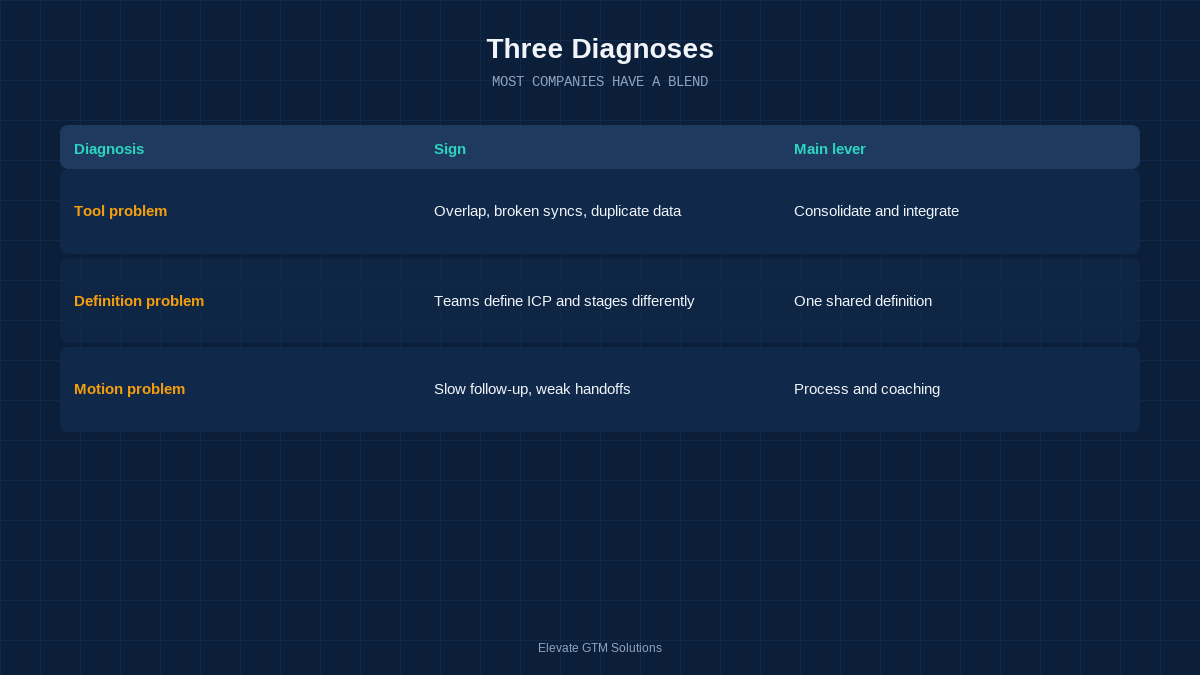
Most RevOps leaders in this position find that they are in one of three situations, or a blend.
Diagnosis one: a tool problem. The stack is bloated and duplicative, integrations fail, data is inconsistent and people spend time moving information between systems. Conversion suffers because of friction and delay. Consolidation and better integration are the answer.
Diagnosis two: a definition problem. Tools mostly work, but different teams use different definitions of an ideal account, a qualified lead, a stage or a segment. Each tool is configured to a different version of the truth. Conversion suffers because effort goes to the wrong accounts and messages. Aligning definitions and keeping them in one place is the answer, and new tools will not help.
Diagnosis three: a motion problem. The tools and definitions are acceptable, but the sales motion itself has gaps: slow follow-up, weak discovery, no mutual plans or poor handoff to customer success. Coaching, process and enablement are the answer.
Most companies have some of each. The value of the diagnosis is that it prevents spending a large budget on a platform when the main problem is something else. See how to tell if your GTM strategy is broken.
What kinds of platform fit which diagnosis
The list below groups general categories and mentions a few commonly known names only to orient you. These are examples, not rankings or endorsements, and products change often, so confirm details on each vendor's own site.
| Diagnosis | Kind of platform that may help | Examples of the category | What to be careful about |
|---|---|---|---|
| Tool problem: sync and data | Integration and data tools, a cleaner CRM configuration | Integration platforms, data cleaning tools | Adding a tool to fix tool sprawl can add to it |
| Tool problem: duplicate point solutions | Consolidation into a broader platform | A suite from a CRM vendor or a unified GTM platform | Breadth often comes with less depth. Test the functions you rely on |
| Definition problem | A shared layer for strategy, segmentation and messaging | A GTM strategy platform | It needs ownership and adoption to work |
| Motion problem: speed and follow-up | Sales engagement and routing tools | Sequencing and routing platforms | Automation can speed up a poor message |
| Motion problem: deal execution | Conversation and deal intelligence | Call recording and deal inspection tools | Needs consent practices and a coaching habit |
| Data and signals | Sales intelligence and signal tools | Data providers, intent and trigger tools | Test accuracy and signal value on your own accounts |
| Reporting trust | Attribution and analytics tools | Revenue analytics platforms | Better dashboards cannot fix inconsistent definitions |
Related guides: unified GTM platform vs point solutions, best GTM tools for a small sales team without RevOps and GTM platform vs CRM.
The CRM question
A head of RevOps will be asked, sooner or later, whether the company should move off its CRM. The honest answer is that this rarely solves the problem.
The CRM is the system of record. It holds accounts, contacts, opportunities and history, and many other tools read from and write to it. Replacing it is a large, disruptive project with a long tail of integrations and retraining.
Most consolidations work around the CRM. The common pattern is to keep it as the center and reduce what surrounds it: remove duplicates, fix the integrations that matter and agree on which tool owns which field.
Reasons to consider a change are specific. A CRM that cannot support your segmentation, that cannot scale to your data volume or whose cost is out of proportion to its use may justify a move. A vague feeling that the CRM is "legacy" does not.
AI features in the CRM are worth testing, not assuming. Many CRM vendors have added AI capabilities. Whether they are enough for your needs is a question for a test on your own data. See how to tell if a GTM platform is really AI-native and GTM platform vs CRM.
Reducing tool sprawl without a failed migration
Consolidation fails more often because of how it is done than because of which tool was chosen. A careful approach reduces the risk.
Rank the tools
From the audit, place each tool in one of four groups.
| Group | Description | Typical action |
|---|---|---|
| Keep | Carries real value, used by many, no good substitute | Keep, and document the owner |
| Merge | Duplicates another tool's job | Pick one, migrate, retire the other |
| Replace | Does a needed job poorly | Test alternatives, then replace |
| Retire | Little use and no traceable outcome | Plan the exit at the next renewal |
Sequence by risk and by date
Start with the lowest-risk, highest-clarity changes: retire what is unused, ahead of renewal dates. Then merge overlapping tools where the migration is simple. Leave the high-risk changes, such as anything that sits in the middle of the sellers' daily workflow, until you have built confidence and have a clear plan.
Protect the motion
A migration in the middle of a quarter is a risk to pipeline. Where possible, schedule transitions between quarters, run old and new in parallel for a short period and train users before the switch, not after.
Keep the data safe
Before you retire anything, export the data and configuration you may need later, and confirm what you can retrieve and in what format. Check contract terms on data access after termination.
Assign ownership
Sprawl returns when nobody owns the whole. Name a single owner for the stack, create a simple intake process for new tool requests and review the map every quarter. See GTM platform governance checklist.
Improving pipeline conversion
Here the tools matter less than people expect. These are the levers that most often explain weak conversion, and a RevOps leader is well placed to pull them.
Targeting. Are sellers working the accounts most likely to buy? If the ideal customer profile is vague or out of date, effort leaks. See how to build an ICP scoring framework and account tiering framework.
Definitions. Do marketing, sales and customer success agree on what counts as a qualified lead, an opportunity and a stage? See sales and marketing SLA framework.
Speed to follow up. How long does it take from a signal or inbound request to a real human response? Delay costs conversations that were warm.
Handoffs. Where does context get lost: marketing to sales, sales to solutions, sales to customer success? Each handoff is an opportunity to lose information.
Messaging. Do sellers have positioning and messages that match each segment and persona, and do they use them? See positioning.
Deal execution. Are deals inspected consistently? Are stakeholders mapped? Is there a mutual plan? See what is deal intelligence.
Learning loops. Do you review wins and losses and feed what you learn back into targeting and messaging? See GTM win-loss analysis framework.
Each of these can be improved with or without new tools. A good habit is to ask of any proposed purchase which of the above it will change, and how you will know.
Where AI fits, honestly
AI features now appear in nearly every category above, and the claims are loud. A RevOps leader needs a calm way to judge them.
Useful AI tends to do specific, checkable jobs. Summarizing calls, drafting first versions of research, flagging risks in a deal, cleaning and enriching records and suggesting next steps are examples. Check each against real use.
AI does not repair bad inputs. If the ICP is unclear or the data is wrong, AI will produce confident output on a weak base. Fix inputs first.
Test with your own data. Ask any vendor to run its AI features on your accounts and deals, and judge the output with the sellers who would use it. See questions to ask AI GTM vendors.
Watch for the wrapper pattern. Some products add a chat box over an old design, and others rebuild around AI. The difference matters for how well they use your context. See AI-native vs traditional GTM platforms.
Keep humans in the loop on judgment. Decisions about which accounts to pursue and what to promise customers still need people who know the business.
Judging a platform that claims to do both
Some vendors will say their platform reduces tool count and improves conversion. That may be true for some customers. Here is how to test it.
| Claim | How to test it |
|---|---|
| "Replaces several tools" | Ask which tools, which functions and what is not covered. Run the functions you rely on in a trial |
| "Improves conversion" | Define the conversion metric, a baseline and a test group before you start. Ask for evidence you can inspect |
| "Integrates with your CRM" | Ask for the field-level detail: what syncs, in which direction, how often and who resolves conflicts |
| "AI-powered" | Ask for specific tasks and let your own team judge the output |
| "Fast to implement" | Ask who does the setup, how long it took for a company like yours and what you will have to provide |
| "Reduces cost" | Count the whole cost: licenses, implementation, administration, training and migration |
| "Customers like us" | Ask for references of similar size and motion and speak with them directly |
Be cautious with any claim that cannot be tested on your own funnel.
A timed test on your own funnel
A pilot gives you evidence in place of promises. A sound structure looks like this.
Choose one segment or team. Pick a segment large enough to produce a signal, and small enough to manage. Avoid the most sensitive accounts for a first test.
Define the question. For instance: does working an agreed account list with a shared message sequence raise the rate from first touch to first meeting, compared with the previous quarter or a control group?
Fix the baseline. Record the current numbers before the test begins.
Name an owner and a sponsor. The owner runs the pilot day to day. The sponsor can remove obstacles.
Set the duration and the exit criteria. Decide in advance what result would justify scaling, and what would end the test. Six to twelve weeks is often enough to see leading indicators, though sales cycles may need longer to see revenue effects.
Review honestly. Compare results to the baseline, include the effort required and decide. See pilot to scale framework.
A worked example, invented for illustration
Imagine a company with about 14 million in annual recurring revenue, 22 sellers across two segments and a marketing team of six. These figures are invented and describe no real company.
The RevOps head completes the stack map and finds 17 tools touching go-to-market. Four overlap, three have almost no active users and two hold copies of account data that disagree with the CRM. Annual cost across the stack is high relative to use, and several contracts renew within the next two quarters.
The funnel map shows that the largest loss occurs between first touch and first meeting in the mid-market segment, and that enterprise conversion is more stable. Looking into causes, she finds that mid-market sellers work from three different account lists with different criteria, that messages differ across sellers and that follow-up on inbound requests is slow on certain days.
The diagnosis is mixed. There is a tool problem, because of duplicated tools and conflicting data. There is a definition problem, because different lists and criteria are in use. There is a motion problem, because of follow-up speed. A new platform would address only part of this.
Her plan has three tracks. Track one retires the three unused tools at renewal and merges two overlapping ones, with data exported first. Track two defines a single mid-market ICP and tiering, agrees a message set and puts both in one shared place that sellers and marketers use. Track three sets a follow-up standard and fixes the routing that causes delay. She runs a twelve-week pilot on the mid-market segment, with first-touch-to-first-meeting conversion as the measure and the prior two quarters as the baseline.
At the end, she reports results, cost and effort honestly, including what did not work. Notice what she did not do: she did not replace the CRM, she did not buy a platform on the strength of a demo and she did not promise a conversion number in advance.
Questions to ask yourself before choosing
- Do I know which of the three diagnoses applies, and with what share each?
- Can I name the funnel stage with the largest loss, and what I believe is causing it?
- Which tools could I retire at the next renewal with no loss of outcome?
- Which definitions do teams disagree on, and who can settle them?
- What conversion metric would show that a change worked, and what is the baseline?
- Who will own the stack after this project?
- What is the risk to the motion if the change goes badly, and how will I contain it?
- What would I need to see in a test to say yes, and to say no?
Where Elevate GTM Solutions fits
Elevate GTM Solutions is an AI GTM platform for creating, executing and adapting go-to-market strategy. Its homepage describes modules including "Market Research," "ICP & Segmentation," "Competitive Intelligence," "Account-Based Marketing," "Product Positioning," "Product Messaging," "Launch & Execute" and "Measure & Optimize," and a shared model used across Marketing, Sales, Product and RevOps. The homepage says "15 connected GTM modules" and names sixteen, so count what you see.
Where it may fit a head of RevOps is on the definition problem: when the ICP, segmentation, positioning and messaging live in different documents and tools and nobody can say which version is current, a shared strategy layer gives teams one version to work from. It also targets the learning loop, by connecting what happens in market back to the plan. Where it does not fit: it is not a CRM, it does not replace a data provider and it does not solve a motion problem such as slow follow-up by itself. It is best viewed as a layer that works with the CRM and the tools around it. We recommend confirming integrations with your specific CRM and tools on the relevant vendor's site and with us directly, and testing in a pilot on your own funnel. See what Elevate GTM Solutions is, Elevate vs HubSpot and Elevate vs Salesforce.
Common mistakes
Shopping before diagnosing. A vendor shortlist built before the diagnosis answers the wrong question.
Treating sprawl and conversion as one problem. They overlap, but they are separate and need separate fixes.
Replacing the CRM to solve a process problem. The CRM rarely caused the process gap.
Migrating mid-quarter. A risky change at the wrong time costs pipeline.
Counting only license cost. Implementation, administration, training and migration are real costs.
Buying on a demo. Demos use clean data. Test on yours.
Ignoring ownership. Without one owner, sprawl returns within a year.
Promising a conversion number up front. Commit to a measured test and an honest report.
Letting AI cover for weak inputs. Fix the ICP and data first.
Skipping the users. Tools that sellers will not use do not improve conversion.
Making the case internally
A RevOps head usually has to persuade a finance leader, a sales leader and a marketing leader, and each cares about something different. A proposal lands better when it speaks to all three in their own terms.
| Audience | What they want to hear | What to bring |
|---|---|---|
| Finance | Which spend is retired, which is kept and why, with renewal dates | The stack map with cost, usage and outcome per tool |
| Sales leadership | Fewer logins, better accounts, faster follow-up, no disruption mid-quarter | The funnel map, the pilot plan and the transition calendar |
| Marketing leadership | Clear definitions and a way to show influence on pipeline | The agreed stage and segment definitions and the measurement plan |
| The executive team | A short story: what is wrong, what we will test, what we will decide and when | One page with the diagnosis, the pilot question, the baseline and the exit criteria |
Avoid promising a precise conversion lift. Promise a measured test, an honest report and a decision date. Leaders tend to trust a plan that names what would count as failure.
A quarter-by-quarter sequence
A sensible order of work for the next three quarters, adjusted to your renewal calendar, looks like this.
First quarter: clarity. Finish the stack map and funnel map. Retire the unused tools whose renewals fall in the quarter. Agree on definitions for stages, qualified leads and the main segments, and write them down in one place. Name the owner of the stack.
Second quarter: test. Run the pilot on one segment. Merge the clearly overlapping tools where migration is simple. Fix the follow-up and routing gaps the funnel map exposed. Review pilot results at the end of the quarter, honestly, against the baseline.
Third quarter: scale or stop. If the pilot met its exit criteria, extend the shared definitions, targeting and messaging to a second segment and plan the larger tool changes with transition dates between quarters. If it did not, write down why, adjust the diagnosis and choose a different lever. Either result is useful, because it replaces a guess with evidence.
Throughout, review the stack map each quarter so new tools pass through an intake step and sprawl does not quietly return.
What to keep, whatever you decide
Some things protect you in every scenario. Keep a clean export of your core records and configuration. Keep documented field ownership, so it is clear which tool writes to which field. Keep a short written record of each decision and the evidence behind it, because staff change and the reasons are forgotten faster than the tools. Keep the sellers close to every change, since they are the people who will make or break adoption.
Glossary
Tool sprawl. The accumulation of overlapping or unused tools across teams.
System of record. The system treated as the authoritative source for a kind of data, usually the CRM for accounts and opportunities.
RevOps. Revenue operations: the function aligning process, data and systems across marketing, sales and customer success. See what is GTM operations.
Pipeline conversion. The share of leads, accounts or opportunities that move from one funnel stage to the next.
ICP. The ideal customer profile. See ICP.
Account tiering. Grouping accounts by priority so effort matches potential.
Wrapper. A feature layer added on top of an older product, as opposed to a design built around the capability.
Pilot. A time-limited test with a defined question, owner and exit criteria.
What to do this week
- Build the stack map: tool, owner, job, cost, renewal date, active users, outcome and overlap.
- Pull stage-to-stage conversion for the last two to four quarters, by segment if you can.
- Mark the stage with the largest loss and write down three possible causes.
- List which definitions teams disagree on and who could settle each.
- Put every renewal date for the next twelve months on a calendar with the notice periods.
- Identify the tools with the fewest active users and no traceable outcome.
- Draft the question for a pilot, with a baseline, a segment, an owner and exit criteria.
- Decide which diagnosis, or mix, best describes your company and write it down.
Key takeaways
- Reducing sprawl and improving conversion are separate problems that sometimes share a cause, and no single platform reliably fixes both.
- Diagnose first: map the stack by usage, cost and outcome, map the funnel by stage and overlay the two.
- Most companies have a mix of a tool problem, a definition problem and a motion problem.
- The CRM usually stays as the system of record. Consolidate around it.
- Consolidate in order of risk, protect the motion, export data before retiring tools and assign one owner for the stack.
- Conversion usually depends on targeting, definitions, speed, handoffs, messaging, deal execution and learning loops more than on tool count.
- Test any claim of replacement or improvement on your own funnel with a baseline, an owner and exit criteria.
- A strategy platform addresses the shared definition of accounts, segments and messaging. It works beside the CRM and does not replace a data provider.
Sources
- Elevate GTM Solutions: descriptions of modules, audience and shared-model design, as stated on the company's homepage.
- Related Elevate guides linked in the text, including the GTM stack audit, GTM platform governance checklist and pilot to scale framework.
- Product categories and example names are general and reflect commonly understood positioning. Products change, so confirm current details on each vendor's site. We state no prices, rankings or performance figures.
- The diagnosis model, sequencing and pilot structure reflect our judgment and common practice. The worked example is invented.
Frequently Asked Questions
Which AI GTM platform should a head of RevOps choose?
There is no single answer. First diagnose whether your problem is too many tools, inconsistent definitions or gaps in the sales motion. Then choose by testing candidates on your own funnel with a baseline, an owner and exit criteria. Be wary of any platform that promises to replace everything.
Can one platform both reduce tool sprawl and improve conversion?
Sometimes it can contribute to both, but they are separate problems. Consolidation reduces cost and seams. Conversion usually depends on targeting, definitions, speed, handoffs and messaging. Ask any vendor to show evidence on a funnel like yours.
Should we replace our CRM?
Usually not. Most consolidations keep the CRM as the system of record and reduce what surrounds it. Consider a change only for specific reasons, such as an inability to support your segmentation or scale, not a general feeling that it is legacy.
How do I find out why conversion is weak?
Map conversion between each pair of stages for recent quarters, by segment, find the stage with the biggest loss and list possible causes. Check targeting, definitions, follow-up speed, handoffs, messaging and deal execution before blaming tools.
How do I decide which tools to cut?
Audit each tool by owner, cost, active users, outcome and overlap. Keep what carries value, merge duplicates, replace what does a needed job poorly and retire what has little use and no traceable outcome, timed to renewal dates.
How do I avoid a failed migration?
Sequence changes by risk, avoid mid-quarter switches, export data before retiring tools, run old and new in parallel briefly, train users before the change and name an owner for the stack.
What does a strategy platform do for a RevOps team?
It gives teams a shared place for ICP, segmentation, positioning and messaging, so tools and sellers work from one version. It does not replace the CRM or a data provider and does not fix process gaps like slow follow-up on its own.
How long should a pilot run?
Six to twelve weeks often shows leading indicators such as meeting rates. If your sales cycle is long, revenue effects will take longer. Define the metric, baseline and exit criteria up front.
How should I judge AI features?
Ask for specific tasks, run them on your own accounts and deals and let the sellers who would use them judge the output. AI does not repair an unclear ICP or poor data, so fix inputs first.
What is the biggest risk in consolidating?
Disrupting the sales motion to save a license fee. Protect pipeline by timing changes carefully, running parallel periods and training users in advance.
How do I get leadership to trust the numbers?
Agree on definitions for stages, qualified leads and segments, document them, assign owners and make sure reports use them consistently. A new dashboard cannot repair disagreement about definitions.
Does company size change the answer?
Yes. Past ten million in recurring revenue, specialization, segments and multiple teams make definitions and handoffs more important. Smaller teams may need lighter tools, and larger enterprises need stronger governance and migration planning.