
By the Elevate GTM Solutions Team · Updated November 13, 2026 · 28 min read
What Are the Modules of a Unified GTM Platform, and Which Should You Start With?
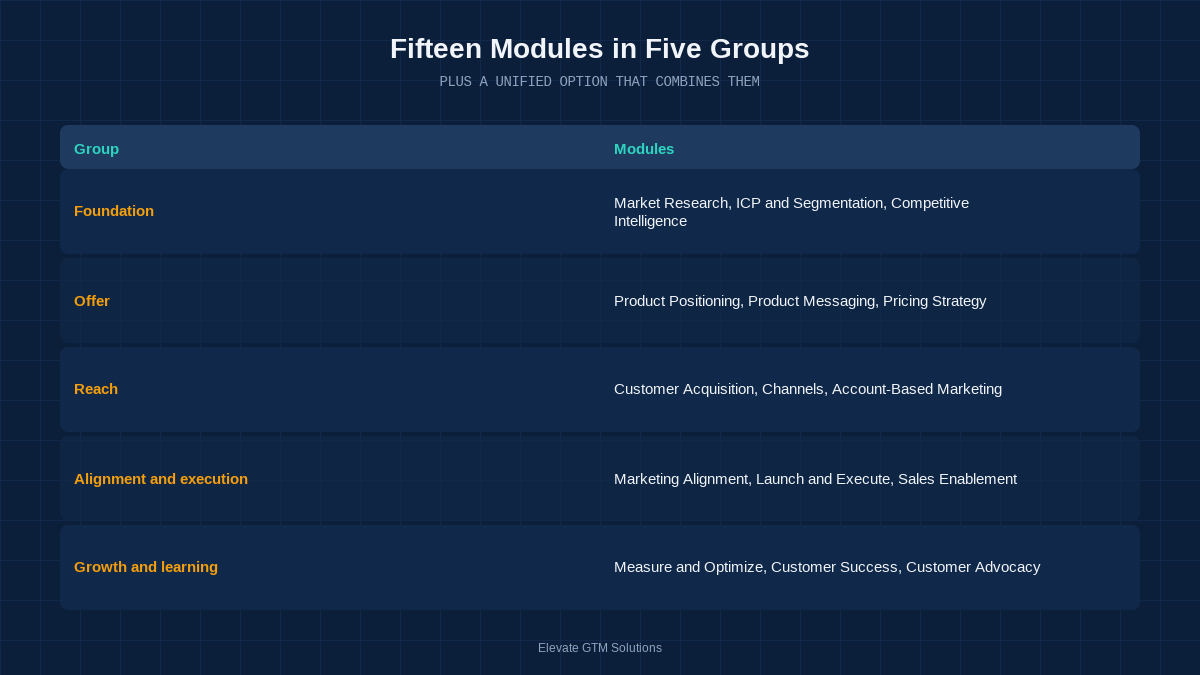
A unified go-to-market platform is often described as covering everything from market research to customer advocacy. That is a long list, and a buyer reasonably wants to know what each part does, how the parts connect and where to begin. Starting everywhere at once is a reliable way to finish nothing. Starting with the wrong module, say pricing before anyone has defined the customer, produces work that has to be redone.
This guide walks through the fifteen modules that Elevate GTM Solutions lists on its homepage, plus the unified option that combines them. For each, it explains what the module is for, the questions it should help answer, what it should produce, how it connects to the others, the mistakes to avoid and where to begin. It also gives a sequence for choosing a starting point, a set of starter paths for common situations and a way to judge whether any platform's modules are really connected. We make the platform, so we have an interest, and we describe our own modules at the level our homepage states and no further. We cite no statistics, we describe other approaches in general terms and our examples are invented and labeled.
What are the modules of a unified GTM platform, and which should you start with?
A unified GTM platform groups the work of go-to-market into modules that share one body of context. The modules on Elevate's homepage are Market Research, ICP and Segmentation, Competitive Intelligence, Account-Based Marketing, Product Positioning, Product Messaging, Pricing Strategy, Customer Acquisition, Distribution Channel Strategy, Marketing Alignment, Launch and Execute, Measure and Optimize, Sales Enablement, Customer Success and Customer Advocacy, plus a Unified GTM Strategy option that brings them together. Most companies should start with the modules that define the foundation: market, customer and positioning, because everything downstream depends on them. Then add the module that addresses the most urgent problem, such as pricing for a repricing decision or sales enablement for slipping win rates. Judge any platform by whether a change in one module, such as the ideal customer, flows into the others.
How many modules do I need? Usually two or three at first, then more as the foundation holds.
What is the Unified GTM option? A strategy that combines the modules into one connected plan, instead of working in each separately.
The short version
| Group | Modules | What they decide |
|---|---|---|
| Foundation | Market Research, ICP and Segmentation, Competitive Intelligence | Where you play and against whom |
| Offer | Product Positioning, Product Messaging, Pricing Strategy | What you say, to whom, and for how much |
| Reach | Customer Acquisition, Distribution Channel Strategy, Account-Based Marketing | How you find and win buyers |
| Alignment and execution | Marketing Alignment, Launch and Execute, Sales Enablement | How teams carry it out together |
| Growth and learning | Measure and Optimize, Customer Success, Customer Advocacy | How you learn, retain and grow |
| Combined | Unified GTM Strategy | One connected strategy across all of the above |
How to read the module list
The modules are not a checklist to complete in order. They are a map of the decisions go-to-market involves. A useful way to read them is in five groups, each answering a different question.
Where do we play and against whom? Market research, customer profile and segments, competitive intelligence.
What do we offer and how do we describe it? Positioning, messaging, pricing.
How do we reach and win buyers? Customer acquisition, channels, account-based work.
How do teams carry it out together? Marketing alignment, launch and execution, sales enablement.
How do we learn, keep and grow customers? Measurement and optimization, customer success, customer advocacy.
A platform is unified when the answer in one group changes the work in the others. If you change the target segment, positioning, messaging, pricing, channels and enablement should all feel the change. If each module is an island, the platform is a collection of tools with one login. See what is a GTM operating system and unified GTM strategy.
The foundation group
Market Research
What it is for. Understanding the market you operate in: its size and structure, the forces shaping demand, the trends that matter and the places where you might win.
Questions it should help answer. How is the market structured? Which parts are growing? Where is demand unmet? What is changing? What do we know and what do we only believe?
What it should produce. A written view of the market with its segments, drivers and uncertainties, separated into evidence and assumptions.
How it connects. It feeds segmentation, competitive analysis, positioning and pricing.
Mistakes to avoid. Treating a large total market as your opportunity. Copying figures without checking where they came from. Treating research as a one-time exercise.
Where to begin. Write the five facts about your market you are sure of and the five you are assuming. See market sizing framework.
ICP and Segmentation
What it is for. Defining who you serve best and grouping buyers into segments you can prioritize.
Questions it should help answer. Which customers get the most value and stay longest? What do they have in common? Which segments should we lead with? How do segments differ in need, buying process and willingness to pay?
What it should produce. An ideal customer profile and a ranked set of segments with the reasoning, including who you are choosing not to serve for now.
How it connects. Everything downstream depends on it: messaging, pricing, channels and enablement all change with the segment.
Mistakes to avoid. Segments based only on company size or industry without behavior or need. Too many segments with equal priority. An ICP built from guesses.
Where to begin. Compare your five best and five worst customers. See ICP, ICP scoring framework and account tiering framework.
Competitive Intelligence
What it is for. Understanding the alternatives buyers consider, including competitors, internal tools and doing nothing, and where you can credibly differ.
Questions it should help answer. Who do we meet in deals? Why do we win or lose? What do competitors claim? Where are they strong, and where are they exposed?
What it should produce. A picture of the alternatives, win and loss patterns and the angles where you are credibly different, with sources and dates.
How it connects. It shapes positioning, messaging, pricing and enablement, especially battlecards.
Mistakes to avoid. Tracking competitors' features without asking what buyers care about. Stale information. Overclaiming.
Where to begin. Review the last twenty wins and losses and group the reasons. See what is competitive intelligence and GTM win-loss analysis framework.
The offer group
Product Positioning
What it is for. Stating how you are different, for whom and in contrast to what.
Questions it should help answer. Who is this for? What alternative do they use today? What is the specific way we are better for them? What proof do we have?
What it should produce. A positioning statement and supporting points per priority segment, with the proof behind each.
How it connects. It sits between segmentation and messaging, and it constrains pricing and channels.
Mistakes to avoid. Vague superlatives. Positioning that cannot be proven wrong. One statement for every segment.
Where to begin. Write one sentence naming the buyer, the alternative and the difference. See positioning.
Product Messaging
What it is for. Turning positioning into the words and claims that sellers, marketers and partners use with each audience.
Questions it should help answer. What do we say to each persona? Which claims do we make and what proof backs each? How do we handle common objections?
What it should produce. Messages by persona and segment, an approved list of claims with proof, and responses to the main objections.
How it connects. It draws from positioning and feeds assets, sequences, decks and enablement.
Mistakes to avoid. One message for everyone. Language buyers do not use. Claims without proof.
Where to begin. Collect the exact words customers use to describe the problem. See how to align messaging, ICP and outreach across regions and verticals.
Pricing Strategy
What it is for. Deciding how to price and package, in a way that fits the market, your costs and the sales process.
Questions it should help answer. What do buyers value and what will they pay? What pricing model fits? How do tiers and packages work? How will sellers discuss price?
What it should produce. Options with assumptions and trade-offs, a recommended structure, and guidance for communicating it.
How it connects. It depends on segments and positioning, and it affects messaging, enablement and measures.
Mistakes to avoid. Setting price from cost alone. Changing price without preparing sellers. Treating the first price as final.
Where to begin. List the pricing options and the assumption behind each. See how to price a new B2B product.
The reach group
Customer Acquisition
What it is for. Planning how you find and win new customers in the priority segments.
Questions it should help answer. Which motions fit our segments: outbound, inbound, product-led, partner-led? What is the path from first contact to a customer? What does acquisition cost, and how long does it take to pay back?
What it should produce. A plan for acquisition motions by segment, with resources, expected conversion and a way to measure it.
How it connects. It draws on segments, positioning, messaging and pricing, and it needs channels and enablement to work.
Mistakes to avoid. Running every motion at once. Ignoring capacity. Judging motions on activity and not on outcomes.
Where to begin. Choose the one motion that best fits your best segment and plan it fully.
Distribution Channel Strategy
What it is for. Deciding how products reach buyers through direct sales, partners, resellers, marketplaces or other channels.
Questions it should help answer. Which channels do our buyers use? What do partners need to sell for us? How do we price and support channels? How do channels fit with direct sales?
What it should produce. A channel plan with roles, economics, enablement and rules of engagement.
How it connects. It affects pricing, messaging, enablement and measurement.
Mistakes to avoid. Adding partners without enablement or incentives. Channel conflict. No way to measure partner results.
Where to begin. List the three channel types you want and what each needs. See how to build a partner and channel GTM strategy.
Account-Based Marketing
What it is for. Focusing marketing and sales effort on a defined set of target accounts with tailored plays.
Questions it should help answer. Which accounts should we target and why? Who is in each buying group? What plays fit each tier? How do marketing and sales coordinate?
What it should produce. A tiered account list, plays by tier and a shared view of account status.
How it connects. It relies on the ICP, positioning and messaging, and it connects to enablement and measurement.
Mistakes to avoid. Choosing accounts by size alone. Treating all target accounts the same. Marketing and sales working from different lists.
Where to begin. Tier a small list of accounts and design one play for the top tier. See GTM platform vs ABM platform.
The alignment and execution group
Marketing Alignment
What it is for. Making sure marketing's work follows the strategy and fits with sales and product.
Questions it should help answer. Do campaigns serve the priority segments? Do marketing and sales agree on definitions and handoffs? Is demand creation connected to pipeline?
What it should produce. A marketing plan tied to the strategy, shared definitions of a qualified lead and handoff rules.
How it connects. It depends on segments and messaging and affects acquisition, enablement and measures.
Mistakes to avoid. A calendar of activity unconnected to strategy. Handoffs without agreed criteria.
Where to begin. Write the shared definition of a qualified lead and who owns what after the handoff. See sales and marketing SLA framework.
Launch and Execute
What it is for. Planning and running launches and major initiatives so that decisions become coordinated action.
Questions it should help answer. What must be ready on launch day? Who owns what? What is the sequence? How will we know it is working?
What it should produce. A launch plan with milestones, owners, dependencies and early measures.
How it connects. It uses positioning, messaging, pricing and enablement, and feeds measurement.
Mistakes to avoid. Treating launch day as the finish. Missing dependencies. No enablement.
Where to begin. List what must be true on launch day and who owns each item. See enterprise product launch readiness and first 90 days after a product launch.
Sales Enablement
What it is for. Equipping sellers, and often partners, with the knowledge, material and skills to carry the strategy into conversations.
Questions it should help answer. What do sellers need to know and say? Which materials help in each stage? How do we handle competitors and objections? How do we train and reinforce?
What it should produce. Sales materials such as decks, battlecards and guides, training plans and a way to check use.
How it connects. It translates positioning, messaging and competitive intelligence into daily practice.
Mistakes to avoid. A library nobody uses. Training once and never again. Material that tells the company's story, not the buyer's.
Where to begin. Ask sellers what stalls their deals and build the first asset to answer it. See what is GTM enablement.
The growth and learning group
Measure and Optimize
What it is for. Tracking whether the strategy is working and refining it with evidence.
Questions it should help answer. Which measures show success? What does the data say about segments, messages and channels? What should we change?
What it should produce. A small set of defined measures, a review rhythm and a record of changes and learning.
How it connects. It closes the loop back to every other module.
Mistakes to avoid. Too many measures. Vanity counts. Reviews that produce no decisions.
Where to begin. Choose five measures tied to the strategy's goals and name owners. See GTM metrics and KPIs, how to measure GTM strategy success and what is a weekly GTM scorecard.
Customer Success
What it is for. Helping customers reach value so they stay and grow.
Questions it should help answer. What does a successful customer look like? How do we onboard? What predicts churn and expansion? How do we align success with sales?
What it should produce. An onboarding plan, health signals, a success playbook and a handoff from sales.
How it connects. It feeds learning into the ICP and messaging, and into expansion plans.
Mistakes to avoid. Handoffs that lose context. Treating success as support. Ignoring early warning signs.
Where to begin. Define what a successful first ninety days looks like for your best segment.
Customer Advocacy
What it is for. Turning satisfied customers into references, case studies and referrals.
Questions it should help answer. Which customers are willing and able to advocate? What do they want in return? How do we use their stories honestly?
What it should produce. A program for references and case studies, with permissions and proof for the claims you make.
How it connects. It supplies proof for positioning, messaging and enablement.
Mistakes to avoid. Asking too early. Overstating results. Using material without permission.
Where to begin. Identify three customers with a clear outcome and ask for a conversation.
The Unified GTM Strategy option
The Unified GTM option brings the modules together into one strategy, so that the decisions in each are consistent. Instead of working through fifteen separate outputs and reconciling them, you get a single connected view: who you serve, what you say, how you price, how you reach buyers, how teams execute and how you measure.
The test of a unified strategy is coherence. Does the messaging match the positioning? Does the pricing fit the segment? Does the channel plan fit the sales motion? Do the measures reflect the goals? A unified strategy should make contradictions visible. See unified GTM strategy.
Which module to start with
Choose the starting point by situation, not by the order of the list.
| Situation | Start with | Then add |
|---|---|---|
| New product, no clear customer | ICP and Segmentation, Market Research | Product Positioning, Product Messaging |
| Strong product, unclear message | Product Positioning, Product Messaging | Competitive Intelligence, Sales Enablement |
| Win rates slipping | Competitive Intelligence | Product Positioning, Sales Enablement |
| Pipeline thin in a good segment | Customer Acquisition, Account-Based Marketing | Marketing Alignment |
| A launch is coming | Launch and Execute | Messaging, Enablement, Measure and Optimize |
| Considering a price change | Pricing Strategy | Positioning, Messaging, Enablement |
| Expanding through partners | Distribution Channel Strategy | Enablement, Messaging |
| Customers leaving or not expanding | Customer Success, Customer Advocacy | ICP and Segmentation |
| Teams disagree and work in silos | Unified GTM Strategy, Marketing Alignment | Measure and Optimize |
Two or three modules at first is enough. Add others as the foundation holds. If you are unsure, begin with ICP and Segmentation and Product Positioning, because everything else rests on them.
How to tell whether modules are really connected
The word unified invites a test.
| Test | What to do | A good result |
|---|---|---|
| Change the ICP | Change the primary segment | Positioning, messaging and plans change coherently or flag a conflict |
| Change a price | Alter the pricing model | Messaging and enablement reflect it, or the platform shows what needs updating |
| Remove a claim | Delete a claim from the messaging | Dependent assets and enablement material are flagged |
| Add a competitor | Update the competitive context | Positioning and battlecards update or prompt a review |
| Trace a measure | Pick a measure and ask where it came from | It links to a goal in the strategy |
| Export | Ask for the strategy in a format teams use | It is usable, complete and consistent |
If changing one module leaves the others untouched, the modules are separate tools with a common interface. See how to tell if a GTM platform is really AI-native and unified GTM platform vs point solutions.
A worked example, invented for illustration
Imagine a company of about forty-five people selling inventory software to specialty retailers. The details are invented.
The founder is unsure where to start among the modules. She notices that her sellers describe the product differently, that win rates are uneven and that the website talks about features no customer mentions. She chooses ICP and Segmentation first, comparing her best and worst customers. The best are multi-location retailers with a small operations team, and the worst are single-store shops that churn quickly.
With the segment clear, she moves to Product Positioning. The positioning she writes is for operations leads at multi-location retailers who use spreadsheets today, and it rests on reducing stock-outs across locations. She then does Product Messaging, using language from customer calls, and Sales Enablement, building a one-page battlecard and an FAQ from the objections sellers report.
Competitive Intelligence comes next, after a review of recent losses shows one rival appearing in most of them. She updates the battlecard. Pricing Strategy waits, because she has no evidence yet that price is the problem. Measure and Optimize starts with five measures and a weekly review.
After a quarter, win rates have improved in the target segment. She adds Customer Success, since early churn among single-store customers made clear that the onboarding approach needs work. Notice that she started with the foundation, added modules in response to evidence and left others for later.
Common mistakes
Starting everywhere. Pick two or three modules and finish them.
Starting with pricing or channels before the customer is clear. Foundations first.
Treating modules as separate projects. Check that they stay consistent.
Skipping measurement. Set measures from the beginning.
Ignoring customer success and advocacy. Retention and proof feed everything else.
Confusing modules with outputs. A module is a set of decisions, and the output is only useful if people act on it.
Believing a module's output without checking. Test claims against customers and data.
Questions to ask yourself
- Which three modules address my most urgent problem?
- Do I have a clear ICP, or should that come first?
- Where does my positioning fail to guide messaging?
- Which modules would change if my target segment changed?
- Who owns each module's decisions?
- How will I know modules are consistent with each other?
- What would I measure to see whether it worked?
- Which modules can wait?
Which modules depend on which
Understanding dependencies prevents rework. In rough terms, decisions flow downward through the modules, and learning flows back up.
| Module | Depends mainly on | Feeds mainly into |
|---|---|---|
| Market Research | Your own knowledge and external information | ICP and Segmentation, Competitive Intelligence, Pricing |
| ICP and Segmentation | Market Research, customer evidence | Positioning, Messaging, Acquisition, Account-Based Marketing, Success |
| Competitive Intelligence | Market Research, win and loss data | Positioning, Messaging, Enablement, Pricing |
| Product Positioning | Segments, competitive context | Messaging, Pricing, Channels, Enablement |
| Product Messaging | Positioning, customer language | Assets, Enablement, Acquisition |
| Pricing Strategy | Segments, positioning, costs, competition | Messaging, Enablement, Channels, Measurement |
| Customer Acquisition | Segments, positioning, messaging, pricing | Channels, Account-Based Marketing, Measurement |
| Distribution Channel Strategy | Positioning, pricing, acquisition plan | Enablement, Measurement |
| Account-Based Marketing | ICP, positioning, messaging | Enablement, Measurement |
| Marketing Alignment | Segments, messaging, shared definitions | Acquisition, Measurement |
| Launch and Execute | Positioning, messaging, pricing, enablement | Measurement, Success |
| Sales Enablement | Positioning, messaging, competitive context | Win rates, Measurement |
| Measure and Optimize | All of the above | Every module, through learning |
| Customer Success | Segments, positioning, onboarding plan | ICP refinement, Advocacy, Expansion |
| Customer Advocacy | Success outcomes | Positioning proof, Messaging, Enablement |
When a module near the top of the table changes, expect the ones below it to need attention. When a module near the bottom produces learning, such as a pattern in churn, expect it to prompt changes near the top.
A year-long phasing plan
A company that adopts modules over a year might phase them like this. This is an illustration, and your order will depend on your situation.
First quarter: foundation. ICP and Segmentation, Product Positioning, Product Messaging. Start Measure and Optimize with a few measures and a weekly review.
Second quarter: win and reach. Competitive Intelligence and Sales Enablement to improve conversion, and Customer Acquisition for the priority segment.
Third quarter: scale and structure. Marketing Alignment, Account-Based Marketing where relevant and Distribution Channel Strategy if partners matter. Revisit Pricing Strategy with evidence.
Fourth quarter: retention and proof. Customer Success and Customer Advocacy, with the learning folded back into the ICP and messaging. Run a full review of the strategy.
At each quarter's end, review what the earlier modules produced, update them and decide whether the next phase is still the right one. A plan that never changes is a sign that nobody is learning.
Who owns each module
Even in a small company, ownership matters. A starting point:
| Module | Typical owner |
|---|---|
| Market Research | Head of strategy or product marketing |
| ICP and Segmentation | Head of go-to-market or marketing, with sales input |
| Competitive Intelligence | Product marketing or competitive intelligence lead |
| Product Positioning and Messaging | Product marketing |
| Pricing Strategy | Product or finance leader with sales input |
| Customer Acquisition | Marketing and sales leaders jointly |
| Distribution Channel Strategy | Head of partnerships |
| Account-Based Marketing | Marketing, with sales |
| Marketing Alignment | Marketing operations or revenue operations |
| Launch and Execute | Launch lead or product marketing |
| Sales Enablement | Sales enablement lead or head of sales |
| Measure and Optimize | Revenue operations |
| Customer Success | Customer success leader |
| Customer Advocacy | Marketing or customer success |
| Unified GTM Strategy | Strategy owner, ideally one named person |
In small companies, one person may own several. The aim is that every module has a named owner who keeps its decisions current and consistent with the rest.
What good output looks like from each group
A short guide to judging what you get back, whichever tool you use.
Foundation outputs should separate evidence from assumption, name what is unknown and rank segments with reasons. If everything is presented as fact, be suspicious.
Offer outputs should be specific enough to be wrong. A positioning statement that no buyer could disagree with is not doing its job. Messaging should include the proof behind each claim.
Reach outputs should fit your capacity. A plan that needs three times your team is a wish list.
Alignment and execution outputs should have owners, dates and dependencies. Without them, they are descriptions.
Growth and learning outputs should connect to decisions. A measure that nobody would act on does not belong.
If a module's output fails these tests, return to the inputs and revise. Most weak output traces back to vague context.
When fewer modules are the better answer
More modules do not make a better strategy. A company with a single product, one segment and a small team may get nearly all the value from three modules: customer and segment, positioning and messaging, and measurement. Adding pricing, channels and account-based work before there is a repeatable motion only creates documents. A useful rule is to add a module when a specific problem demands it and when someone is ready to own its decisions. If neither is true, leave it for later. The point of a unified platform is that the pieces fit together when you need them, not that you must use them all.
Glossary
Module. A group of related go-to-market decisions and outputs within a platform.
Unified strategy. A single connected strategy in which decisions across modules are consistent.
ICP. The ideal customer profile. See ICP.
Segment. A group of buyers with shared needs and behavior.
Positioning. How you are different, for whom and in contrast to what.
Battlecard. A short sales aid for a competitive situation.
Enablement. Material and training that help sellers sell. See what is GTM enablement.
Account-based marketing. Coordinated marketing and sales effort aimed at chosen accounts.
Optimization. Refining the strategy using evidence from results.
Where Elevate GTM Solutions fits
Elevate GTM Solutions is an AI GTM platform for building, executing and evolving go-to-market strategy. Its homepage lists fifteen modules, Market Research, ICP and Segmentation, Competitive Intelligence, Account-Based Marketing, Product Positioning, Product Messaging, Pricing Strategy, Customer Acquisition, Distribution Channel Strategy, Marketing Alignment, Launch and Execute, Measure and Optimize, Sales Enablement, Customer Success and Customer Advocacy, together with Unified GTM Strategy. Our homepage mentions fifteen connected GTM modules, which is the fifteen modules above, with the unified option as the sixteenth listing.
As we describe the product flow, you enter details in GTM Insights, capture triggers and signals in Strategy Context and then, in the Strategy Builder, enter your company, product, industry and segment and choose one of the fifteen modules or the Unified GTM option. The strategy moves through Draft, Defined, Launched and Optimizing stages in the Workflow Engine. GTM Activation turns selected reports into focus assets, GTM Playbooks record methodology and decisions and GTM Pulse and executive dashboards support the weekly and executive view.
What it does not do: choosing a module does not replace customer research or judgment, and the sequence in this guide is a suggestion, not a requirement. We suggest starting with two or three modules that address your most urgent problem, running the connection tests above and checking with us directly about how modules relate in your case. See what Elevate GTM Solutions is.
What to do this week
- Write your most urgent go-to-market problem in one sentence.
- Choose two or three modules that address it, using the table above.
- Write what you know and what you assume about your customer and market.
- Compare your five best and five worst customers.
- Decide who will own each chosen module's decisions.
- List the modules you will defer and why.
- Prepare the connection tests for any platform you evaluate.
- Set a review date to decide which module to add next.
Key takeaways
- A unified GTM platform groups go-to-market work into modules that share context, and the modules are a map of decisions, not a checklist.
- Elevate lists fifteen modules, plus a Unified GTM Strategy option that combines them.
- The modules fall into five groups: foundation, offer, reach, alignment and execution, and growth and learning.
- Start with the foundation, market, customer and positioning, then add the module that addresses your most urgent problem.
- Two or three modules at first is enough.
- A platform is unified only if a change in one module flows into the others, so test it.
- Each module has typical mistakes, and most trace back to starting before the customer is clear.
- Measurement and customer success close the loop and should not be left until last.
Sources
- Elevate GTM Solutions: the module list, the Unified GTM Strategy option and the product flow, as stated on the company's homepage and in its product flow.
- Related Elevate guides linked in the text, including unified GTM strategy and what is a GTM operating system.
- The grouping, starter paths and tests reflect our judgment and common practice. The worked example is invented. We state no statistics and make no claims about other vendors.
Frequently Asked Questions
What are the modules of a unified GTM platform?
Elevate lists fifteen: Market Research, ICP and Segmentation, Competitive Intelligence, Account-Based Marketing, Product Positioning, Product Messaging, Pricing Strategy, Customer Acquisition, Distribution Channel Strategy, Marketing Alignment, Launch and Execute, Measure and Optimize, Sales Enablement, Customer Success and Customer Advocacy, plus a Unified GTM Strategy option.
Which module should I start with?
Start with the foundation: ICP and Segmentation and Product Positioning, often with Market Research. Then add the module that addresses your most urgent problem.
How many modules do I need?
Two or three at first. Add more as the foundation holds and as problems appear.
What is the Unified GTM Strategy option?
A strategy that combines the modules into one connected plan, so that decisions on segments, positioning, messaging, pricing, channels, execution and measures are consistent.
How do I know modules are really connected?
Change one input, such as the target segment or a price, and see whether positioning, messaging, plans and enablement change coherently or flag a conflict.
Why does the homepage say fifteen modules and list sixteen?
Elevate offers fifteen modules plus the Unified GTM Strategy option, which accounts for the sixteenth listing.
Should I do pricing early?
Usually not before the customer and positioning are clear, unless a pricing decision is your most urgent problem.
Where do customer success and advocacy fit?
They feed learning and proof back into the strategy. Do not leave them until the end, since retention and references affect everything else.
Can I use only some modules?
Yes. Many companies start with two or three and add others over time.
Does choosing a module replace customer research?
No. A module structures decisions and outputs, and customer conversations and data test them.
How does this relate to the workflow stages?
Modules define what you decide. The Workflow Engine tracks a strategy through Draft, Defined, Launched and Optimizing as you decide and execute.
What is the most common mistake?
Starting everywhere, or starting with downstream modules like pricing or channels before the customer and positioning are clear.