
By the Elevate GTM Solutions Team · Updated November 13, 2026 · 27 min read
Elevate GTM Solutions vs Traditional GTM Consultancies and Point Solutions: Which Is Better for Running a Continuous Go-to-Market System?
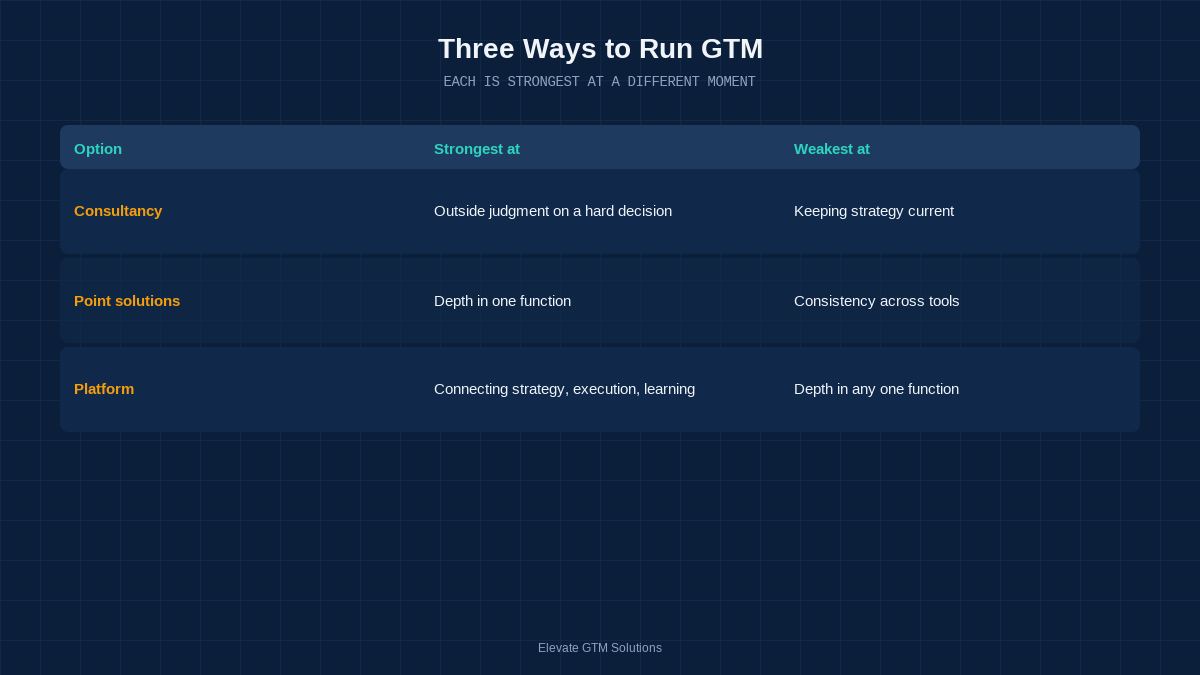
A buyer who reaches this comparison has usually already decided that the go-to-market motion needs help and is weighing three different ways to get it. One is to hire a traditional GTM consultancy to define and document the strategy. One is to assemble point solutions, each excellent at one job, such as data, intent, engagement, conversation intelligence and analytics. The third is to adopt a platform that tries to hold strategy, execution and learning together, which is what we build at Elevate GTM Solutions.
We have an obvious interest in how this comparison turns out, so we have tried to make it useful even to a buyer who ends up choosing something else. Each option is good at something, each fails in a predictable way and the right answer depends on what you mean by running a "continuous" system. We explain what continuous means, what each option does well and badly over time, where the costs hide, how to combine them, how to decide by situation and where Elevate fits and does not. We describe consultancies and point-solution vendors in general terms, cite no pricing, rankings or statistics and invent no customer stories. The examples are labeled as invented.
How does Elevate GTM Solutions compare with traditional GTM consultancies and point solutions for running a continuous go-to-market system?
A traditional consultancy is strongest at a defined engagement: it brings outside experience, hard conversations and a finished strategy, and the work usually ends when the engagement does. Point solutions are strongest at one function each, such as data, signals, engagement or analytics, and give depth where you need it, with the cost of integrating and keeping them consistent. A GTM platform such as Elevate aims to keep strategy, execution and learning in one connected system that teams keep using after the plan is written, so it suits a company that wants the strategy to stay alive and shared. It does not replace the outside judgment a good consultant brings in a hard moment, and it does not replace deep specialist tools where one function needs maximum depth. Many companies combine them: a consultant or an internal lead for judgment, a platform for the connected strategy layer and a few point tools where depth matters.
Which is best for a continuous system? The one that keeps the strategy shared and current between engagements, which is where static deliverables and disconnected tools both struggle.
Can they be combined? Yes, and for many companies that is the practical answer.
The short version
| Question | Traditional consultancy | Point solutions | Platform such as Elevate |
|---|---|---|---|
| Main strength | Outside experience and judgment, a finished strategy | Depth in one function | Strategy, execution and learning in one connected place |
| Typical shape | Time-bound engagement with deliverables | Several tools, often from several vendors | An ongoing subscription used by several teams |
| What happens after delivery | The strategy can age in a document | Each tool keeps working on its own data | The shared strategy keeps being used and updated, if teams adopt it |
| Main weakness | Static output and dependence on the advisor | Seams, duplicated data and inconsistent definitions | Less depth than a specialist in any single function |
| Cost pattern | Concentrated in engagements | Spread across many contracts plus integration work | Subscription plus the effort to adopt it |
| Best for | Hard strategic moments needing outside judgment | A function that needs maximum depth | Keeping a multi-team motion consistent over time |
| Biggest risk | Handoff failure | Sprawl and conflicting data | Shelfware if nobody owns it |
What "continuous" actually means
"Continuous go-to-market" is easy to say and rarely defined. In practice it means four things.
The strategy stays current. Segments, positioning and priorities are revisited as the market and the product change, not once a year in a workshop.
Teams work from one version. Marketing, sales, product and customer success use the same definition of the ideal customer, the same messages and the same priorities.
Execution feeds learning. What happens in market, including wins, losses, replies and objections, returns to the strategy and changes it.
Someone owns the loop. A named person or team is responsible for keeping the whole system consistent and for making decisions when the evidence changes.
A continuous system is not a bigger tool stack and it is not a bigger document. It is a habit of keeping the plan connected to reality. Each of the three options supports that habit differently. See continuous GTM optimization, GTM operating system and death of the static GTM strategy.
Traditional GTM consultancies
What they do well
A good consultancy brings things that are hard to build internally.
Outside perspective. People who have seen many companies can spot patterns and challenge assumptions your own team has stopped questioning.
Hard conversations. An outsider can say what internal staff cannot, such as that a favored segment is not working.
Speed on a defined problem. For a launch, a repositioning or an entry into a new market, a focused team can produce a plan faster than a stretched internal group.
Structured method. Experienced firms bring frameworks, interview techniques and facilitation skill.
Executive credibility. A recommendation from an outside firm can help align leaders who disagree.
Where they struggle with continuity
The engagement ends. The consultancy leaves, and the strategy lives in a document and in the memory of the people who attended workshops.
Documents age. Slides and reports are snapshots. Months later, segments, competitors and priorities have moved, and the document does not.
Handoff is hard. The team that receives a strategy often did not build it, and the context does not transfer fully.
Dependence. If the knowledge sits with the advisors, the company needs them again for each revision.
Cost concentration. Spending is lumpy and tied to engagements, which makes it hard to maintain a steady cadence of review.
None of these are criticisms of good consultants. They follow from the shape of the work. See GTM platform vs GTM consultant, GTM consulting alternatives and how much does GTM consulting cost.
When a consultancy is the right choice
A consultancy fits when you face a one-off strategic problem with high stakes and limited internal experience: entering a new market, repositioning after a failed launch, preparing for a major funding or acquisition moment or resolving a disagreement among leaders that internal staff cannot settle. It also fits when you need outside challenge more than you need a system.
Point solutions
What they do well
Depth. A tool built for one job usually does that job in more detail than a broad platform does. A specialist in conversation intelligence, intent data, sales engagement or analytics tends to go deeper in its area.
Flexibility. You can choose the best tool for each function and replace one without disturbing the others.
Speed to value in one function. Adding a single tool for a specific gap can be quick and low-risk.
Familiarity. Teams often already know the leading tools in each category.
Where they struggle with continuity
Seams. Each tool has its own data model, fields and definitions. Keeping them aligned takes continuous work.
Duplicated truth. The same account may be described differently in several tools, and nobody is sure which is right.
No shared strategy layer. Point solutions act on whatever targeting and messaging you configure in them. Unless someone keeps those inputs consistent, each tool drifts.
Integration cost. Connecting tools takes engineering or operations time, and connections break.
Ownership gaps. Each tool has an owner, and nobody owns the whole.
Sprawl. Over time, tools accumulate, overlap and go unused. See why outbound, intent and messaging stay disconnected in CRM stacks.
When point solutions are the right choice
Point solutions fit when one function is the bottleneck and needs maximum depth, when you have operations capacity to integrate and govern the stack and when your strategy is already clear and consistently shared. See unified GTM platform vs point solutions and custom stack vs unified platform.
A platform such as Elevate
What it aims to do well
Elevate GTM Solutions describes itself as an AI GTM platform for creating, executing and adapting go-to-market strategy. Its homepage describes modules including "Market Research," "ICP & Segmentation," "Competitive Intelligence," "Account-Based Marketing," "Product Positioning," "Product Messaging," "Launch & Execute" and "Measure & Optimize," built on a shared model used across Marketing, Sales, Product and RevOps. The homepage says "15 connected GTM modules" and names sixteen, so count what you see.
The design aim is a connected system. Strategy and the work that follows from it live in one place, so that targeting, positioning and messaging stay consistent, and so that results can feed back into the plan.
Where it is limited
Less depth than a specialist. A broad platform will usually not match a dedicated tool in a function that tool was built around.
It needs adoption. A platform that teams do not use becomes another unused license.
It does not replace judgment. Software can organize and accelerate, and it cannot replace the experience of someone who has handled your kind of problem before.
It does not replace data providers. If you need contact and company data, you still need a source for it.
Integration still matters. How it connects to your CRM and other tools is something to verify with us directly and in a test.
See what Elevate GTM Solutions is, what is a GTM operating system and what is an AI-native GTM operating system.
Comparing them across the life of a system
Because the question is about running a system over time, compare the options at different points.
| Stage | Consultancy | Point solutions | Platform |
|---|---|---|---|
| Month one: define the strategy | Strong, with outside experience and facilitation | Weak, since tools do not define strategy | Moderate to strong, with structure and AI assistance, plus your own input |
| Months two to three: execute | Usually limited. The engagement may have ended | Strong in each function | Moderate, since it links strategy to execution but may lean on other tools for depth |
| Months four to six: adjust | Needs a new engagement or internal capacity | Each tool adjusts alone, and consistency depends on people | Designed for updating the shared strategy as evidence arrives |
| Year two: staff turnover | Knowledge walks out unless documented well | Tool owners leave, and configurations become mysterious | Shared model preserves much context, if it is kept current |
| Year two: market change | A new engagement may be needed | Re-tune each tool | Update segments, positioning and messaging in one place |
| Cost of keeping it current | Lumpy, tied to engagements | Spread across contracts, plus integration upkeep | A steady subscription, plus the time to keep content current |
The pattern is that a consultancy is strongest at the start, point solutions are strongest in the middle and a platform aims at the long tail where strategy has to keep pace with change. A company that cares most about the long tail will weigh that heavily. A company facing a single hard decision will weigh the start more.
Where the costs hide
Comparing price tags misses most of the cost. We state no prices here, and you should get current quotes from each provider.
Consultancy. Beyond fees, count the internal time to support the engagement, the cost of implementing the recommendations and the cost of repeating the exercise when the document ages.
Point solutions. Beyond licenses, count integration work, administration, training, duplicated data cleanup, the cost of tools that go unused and the cost of inconsistent definitions across teams.
Platform. Beyond the subscription, count the time to set up your context, the effort to adopt it across teams, any complementary tools you still need and the cost of switching later.
A useful exercise is to estimate, for each option, the total over two to three years including people's time, and to include the cost of doing nothing: continued drift, slow decisions and duplicated work. Treat the estimate as a rough guide and make your assumptions visible. See AI GTM platform pricing guide.
Combining the options
For many companies the real answer is a combination.
Consultant plus platform. An advisor or internal strategist leads the hard thinking and challenge, and the platform holds the result and keeps it alive after the engagement. This addresses the handoff problem directly.
Platform plus selected point solutions. The platform holds strategy, segmentation and messaging, and a few specialist tools supply depth in data, engagement or conversation intelligence. This reduces the number of tools without forcing a single vendor to do everything.
Internal lead plus platform plus occasional outside help. A strong internal owner runs the system day to day, and outside advisors are brought in for specific decisions.
Consultant plus point solutions. A familiar pattern, with the risk that the strategy still lives in a document while tools run on separate configurations.
When you combine, decide up front which system is the source of truth for strategy, who owns it and how changes propagate to the tools.
A decision guide by situation
These are patterns, not rules.
You are launching a product or entering a market and lack experience. An outside advisor may be the fastest route to a sound plan. Consider a platform afterward to keep the plan alive.
You have a clear strategy but weak execution in one function. A point solution for that function is likely enough.
You have several tools, several teams and conflicting definitions. The shared strategy layer is the gap. A platform, or at least a disciplined internal process, addresses it.
You have a small team and a tight budget. Start with a clear ICP and message, and a small number of tools. A platform may help if it is adopted. A large consultancy engagement may be hard to justify.
You are a large enterprise with many regions and products. You may need all three, with governance. See best GTM platform for an enterprise with several products and regions.
Your strategy changes often. Favor an approach that makes updates cheap: a platform or a strong internal owner, over a series of static deliverables.
Your leadership team disagrees on direction. An outside facilitator may be needed before any tool helps.
How to test each option
Whatever you choose, test before committing.
Consultancy. Ask for references from companies of your size and problem type, a clear description of what you will have at the end and how the work will be handed over, and who will actually do the work. Ask how the deliverable stays current.
Point solutions. Run a trial on your own data, with the actual users, and measure a specific outcome in that function. Check how it integrates with your CRM and the other tools you keep.
Platform. Run a pilot on one segment or team with a defined question, a baseline, an owner and exit criteria. Check the quality of its output on your real context, and how well teams adopt it. See pilot to scale framework and questions to ask AI GTM vendors.
A worked example, invented for illustration
Imagine a company with about 60 sellers and a marketing team of 12, selling to mid-market and enterprise customers in two regions. The details are invented and describe no real company.
Two years ago, the company hired a consultancy to define its strategy. The engagement produced a clear report and a good set of segments. Within a year, a new product line had launched, a competitor had changed its pricing and the company had added a vertical. The report was not updated. Sales used one set of messages, marketing used another and the tools were configured to the original segments.
The head of go-to-market considers three options. A second consulting engagement would refresh the strategy and risk the same aging. Adding more point solutions would deepen individual functions without addressing the inconsistency. A platform would give the company one shared place for segments, positioning and messaging, and a way to update them as things change.
After discussion, she chooses a combination. She asks a senior internal strategist to own the system. She runs a twelve-week pilot of a platform on the mid-market segment, with first-touch-to-first-meeting conversion as the measure. She keeps two existing point tools where the teams need depth, and retires one overlapping tool at renewal. She budgets a short outside advisory session for a leadership disagreement about the enterprise segment, since a tool cannot settle that.
Notice what she did not do: she did not assume one option would cover everything, she did not promise a result and she put a person in charge of the loop.
What good looks like after six months
Regardless of which route you choose, a healthy continuous system shows a few signs. Segments, positioning and messaging have a visible owner and a last-updated date. Sellers and marketers can find the current version without asking. A change in the market, such as a competitor move or a lost deal pattern, leads to a visible update within weeks. Definitions for the ideal customer and the main stages match across teams. Tools are configured from the shared strategy, not separately. And leadership reviews a short set of learning metrics on a regular schedule. See GTM metrics and KPIs.
Questions to ask yourself
- Is my problem a single hard decision, a weak function or an inconsistent system?
- How often does my strategy need to change, and what does a change cost today?
- Who owns the whole go-to-market system, and do they have time for it?
- Where do definitions of ideal customer and stage differ across teams?
- Which functions need maximum depth, and which can use something broader?
- What would I need to see in a test to choose each option?
- What does the total cost look like over two to three years, including people?
- What is the cost of leaving things as they are?
Common mistakes
Choosing by habit. Companies that have always hired consultants hire another, and companies that buy tools buy another, without asking what is actually missing.
Expecting a document to stay alive. A strategy that lives in a slide deck needs a mechanism for updating it.
Expecting a platform to supply judgment. It organizes and accelerates, and people decide.
Comparing prices instead of total cost. People's time and integration upkeep often exceed license fees.
Skipping ownership. A system without an owner decays whichever option you choose.
Buying breadth when you need depth, or the reverse. Match the tool to the actual bottleneck.
Forgetting adoption. Teams use what fits their work and ignore what does not.
Treating the choice as permanent. Review it after a year.
What a good consultancy engagement looks like, and how to make it last
If you do hire a consultancy, you can reduce the continuity problem by shaping the engagement from the start.
Ask for a handover plan before you sign. Who on your side will own the output? What training or working sessions are included? How will decisions and the reasons behind them be recorded?
Make the output usable, not only readable. A report is useful once. Ask for the segments, positioning and messages in a form your teams can work from, with owners and review dates, and ask whether they can be loaded into the place where your teams will keep them.
Involve the people who will carry it. Include sellers, marketers and product staff in interviews and reviews. People defend what they helped build, and ignore what arrived from outside.
Build the refresh into the plan. Agree at the start when the strategy will be reviewed and who will lead that review. A scheduled review in six months is worth more than a perfect document.
Keep the judgment, not just the paper. The most valuable thing a good advisor leaves behind is a way of thinking about trade-offs. Ask them to explain why they chose what they chose, so your team can make the next call without them.
What a good point-solution stack looks like, and how to keep it coherent
If you build around specialist tools, a few habits keep the stack from fragmenting.
One owner for the whole stack. A named person who sees every tool and its overlap, with authority to say no to a new one.
One agreed source for definitions. Decide where the ideal customer, the stages and the segments are defined, and configure every tool from that definition instead of defining them separately in each.
A small number of well-chosen integrations. Every connection is a future failure point. Prefer a few reliable, monitored ones to many fragile ones.
A quarterly review. Check usage, cost, overlap and outcome for each tool, and retire what no longer earns its place. See GTM stack audit.
A rule for new requests. Before adding a tool, ask what job it does, which existing tool does it today and who will own it.
Companies that do these things can run a point-solution stack well. Companies that do not tend to find that the stack grows faster than the value.
What to ask a platform vendor about continuity
Any platform vendor, including us, will say the product keeps strategy alive. Ask for specifics, because the claim is easy to make and harder to demonstrate.
| Question | What you are looking for |
|---|---|
| How does a change to a segment or message reach the people and tools that use it? | A clear mechanism, not a manual reminder |
| How is the history of strategy decisions kept? | A record of what changed, when and why |
| How do results from market return to the plan? | A defined path from outcomes to revisions, with a person responsible |
| Who in a typical customer owns the platform day to day? | A named role, and honesty about the time it takes |
| What do customers typically need to provide to get started? | Realistic effort, not "nothing" |
| What does a pilot look like, and what would count as failure? | A limited test with exit criteria |
| What happens to our content if we leave? | Export rights in a usable format |
| Which tools does it connect to, and what is the scope of each connection? | Field-level detail, confirmed in a test |
A vendor that answers these plainly, including the limits, is easier to trust than one that answers in slogans.
Reading the three options as stages, not rivals
It is tempting to treat the comparison as a contest, and many companies find it more useful to see the options as parts of a maturity path.
An early-stage company with a small team often needs clarity first: who the customer is, what to say and what to measure. That work can be done with a few workshops, a simple document and a couple of tools. As the company grows, definitions start to drift, and the cost of inconsistency rises. At that point a shared strategy layer begins to matter, and a platform or a disciplined internal process earns its place. At a larger scale, with several products and regions, governance, specialist depth and occasional outside challenge all matter at once, and the mix of options becomes richer.
Seen this way, the question is less which option is best and more which problem you have now, and which one you will have in a year. Choose for the present problem, and review when the situation changes.
A short checklist for the first ninety days of a continuous system
Whichever route you choose, the first ninety days decide whether the system becomes a habit or a one-time project.
Days one to thirty: agree the foundations. Write down the ideal customer, the two or three priority segments and the positioning for each, in plain language. Name the owner. Agree where this lives and who may change it. Collect the objections and loss reasons from the last two quarters, since they are the first evidence the system will use.
Days thirty-one to sixty: connect the work. Make sure each team and each tool that targets or messages customers uses the agreed definitions. Remove or retire the old documents, so there is only one version. Decide on three learning metrics, such as meeting rate by segment, win rate by segment and the share of deals lost to each main objection, and put them on a single page that leaders see.
Days sixty-one to ninety: run the loop once. Hold the first review. Look at the learning metrics, the notes from sellers and the changes in the market. Change one thing in the strategy on the basis of evidence, record why and make sure the change reaches the teams and the tools. The first full turn of the loop matters more than its size, because it proves the mechanism works.
After ninety days, set a cadence, such as a short monthly review and a deeper quarterly one, and keep it. A system that is reviewed on a calendar stays alive, and one that is reviewed when someone remembers does not.
Glossary
GTM consultancy. An outside firm that helps define go-to-market strategy, usually in time-bound engagements.
Point solution. A tool built for one function, such as data, engagement or analytics.
GTM platform. A product that aims to connect several go-to-market functions, such as strategy, execution and learning, in one place.
Continuous GTM. A practice of keeping strategy current and shared as the market and product change.
Strategy layer. The shared definitions of segments, positioning, messaging and priorities that tools and teams act on.
Shelfware. Software that is paid for and not used.
Source of truth. The system treated as authoritative for a kind of information.
What to do this week
- Write what you mean by "continuous" for your company in four sentences.
- List where your current strategy lives and the date it was last updated.
- Check where definitions of ideal customer and stage differ across teams.
- Name the person who owns the whole system, or admit nobody does.
- List your point solutions with owner, cost, usage and overlap.
- Decide whether your biggest gap is judgment, depth in one function or consistency across the system.
- Draft a pilot question and baseline for the option you want to test.
- If you plan to combine options, write down which system will be the source of truth for strategy.
Where Elevate GTM Solutions fits
Elevate GTM Solutions suits companies whose main gap is a strategy that does not stay connected, with segments, positioning and messaging that drift across teams and tools, and who want a shared place to create, execute and adapt it. It is a poorer fit if you need contact data, a single function at maximum depth or outside judgment on a one-off decision, and in those cases the other two options, or a combination, will serve you better. We are not able to tell you from this page what Elevate costs or exactly how it integrates with your stack, so please confirm both with us directly and run a pilot. See Elevate vs HubSpot, Elevate vs Salesforce and can a GTM platform replace GTM consulting.
Key takeaways
- A consultancy, a set of point solutions and a platform each solve a different part of the problem, so the right choice depends on what you need.
- Continuous GTM means the strategy stays current, teams use one version, execution feeds learning and someone owns the loop.
- Consultancies bring outside judgment and speed on a defined problem, and struggle with aging documents and handoff.
- Point solutions bring depth in one function, and struggle with seams, duplicated data and no shared strategy layer.
- A platform aims to keep strategy, execution and learning connected, and gives up depth in any single function and depends on adoption.
- Compare total cost over two to three years, including people's time and the cost of drift.
- Combining options is common, and it works best when one system is named as the source of truth for strategy.
- Test before committing, with a baseline, an owner and exit criteria.
Sources
- Elevate GTM Solutions: descriptions of modules, audience and shared-model design, as stated on the company's homepage.
- Related Elevate guides linked in the text, including GTM platform vs GTM consultant, GTM consulting alternatives and unified GTM platform vs point solutions.
- Descriptions of consultancies and point solutions are general and reflect common patterns, not any named firm. We state no prices, rankings or performance figures, and the worked example is invented.
- The comparison reflects our judgment and common practice. We have an interest in the outcome, as noted at the start.
Frequently Asked Questions
How does Elevate GTM Solutions compare with a traditional GTM consultancy?
A consultancy brings outside judgment and speed on a defined problem, and the work usually ends with the engagement. Elevate is a platform meant to keep strategy shared and current afterward. It does not replace outside judgment on a hard decision.
How does Elevate compare with point solutions?
Point solutions go deeper in one function, such as data or conversation analysis. Elevate aims to connect strategy, execution and learning across teams, and gives up depth in any single function. Many companies use both.
What does continuous go-to-market mean?
It means the strategy stays current, teams work from one version, execution feeds learning back into the plan and a named owner keeps the loop going.
Which is best for a small company?
Often a clear ICP and message, a few well-chosen tools and one owner. A platform may help if it will be adopted. A large consulting engagement may be hard to justify, though a short outside session can help with a specific decision.
Can a platform replace a consultant?
For some tasks, such as structuring research and keeping a plan current, partly. It does not replace the outside perspective and difficult conversations a good consultant provides. See our guide on whether a platform can replace consulting.
Why do consultant-built strategies go stale?
Because the engagement ends and the document is a snapshot. Without a mechanism and an owner for updating it, segments, competitors and priorities move on while the document stays the same.
What are the hidden costs of point solutions?
Integration work, administration, training, duplicated data cleanup, unused licenses and inconsistent definitions across teams. These often exceed the license fees.
Can we combine a consultant, a platform and point solutions?
Yes. A common pattern is an advisor or internal lead for judgment, a platform for the shared strategy layer and a few point tools where depth matters. Decide which system is the source of truth for strategy.
What does Elevate cost?
We do not state pricing in this guide. Please confirm current pricing directly with us.
How do we test whether a platform works for us?
Run a pilot on one segment or team with a defined question, a baseline, an owner and exit criteria, and judge both the output quality and team adoption.
When is a consultancy clearly the right choice?
For a one-off, high-stakes problem with limited internal experience, such as entering a new market, repositioning after a failed launch or resolving leadership disagreement that internal staff cannot settle.
How often should we revisit this choice?
At least annually, and whenever your strategy, team or market changes significantly. Review usage, outcomes and total cost.