
By the Elevate GTM Solutions Team · Updated November 13, 2026 · 25 min read
GTM Operating System vs GTM Operating Framework: What Is the Difference and Which One Do You Need?
Two phrases keep showing up in go-to-market conversations: "GTM operating framework" and "GTM operating system." Sometimes they are used as synonyms. Sometimes a vendor uses one to sell software and a consultant uses the other to sell a workshop. If you have been asked to evaluate either, or to build one, it helps to know what each word should mean, because the practical consequences are quite different. One is mostly a way of organizing decisions. The other is something that runs.
This guide separates the two, adds a third term that people also mix in, shows how they fit together, explains when you need which, and gives you tests for judging claims. We make a GTM platform that describes itself in operating-system terms, so we have an interest. We say where definitions are loose, we use no benchmarks and the examples are invented.
What is the difference between a GTM operating system and a GTM operating framework?
A GTM operating framework is a designed structure for how your go-to-market work is organized: the stages, decisions, roles, definitions, meeting rhythms and rules you agree to follow. It can live in a document, a slide deck or a wiki, and people carry it out. A GTM operating system is the running system that applies that structure day to day: shared data, connected tools and workflows, automated steps and feedback loops that keep strategy, execution and results in step. The framework is the design. The operating system is the design in operation, usually supported by software. You can have a framework without an operating system, and many companies do. An operating system built without a framework tends to automate whatever confusion already exists.
Which comes first? Almost always the framework, even a rough one. Software that runs a structure nobody agreed on only makes the disagreement faster.
Do I need both? A small team often needs only a clear framework. As teams, products and regions multiply, the effort of keeping a framework alive by hand grows, and that is when an operating system earns its place.
The short version
| Question | GTM operating framework | GTM operating system |
|---|---|---|
| What is it? | A designed structure for how GTM work is organized | A running system that carries out and updates that structure |
| Form | Documents, diagrams, definitions, calendars, role descriptions | Software, data model, integrations, workflows, plus the habits around them |
| Who operates it? | People, by following and maintaining it | People and software together |
| How does it stay current? | Someone updates it, or it goes stale | Updates flow through connected data and processes, with people approving |
| Main strength | Clarity and agreement | Consistency and speed at scale |
| Main risk | Becomes a shelf document | Automates a bad design or becomes shelfware |
| Cost to start | Mostly time and attention | Software cost, setup and change management |
| Best for | Small teams, early stages, any team without agreed structure | Teams with several products, regions or functions that need to stay aligned |
What a framework is
A framework is a structure for thinking and deciding. In go-to-market terms, it answers questions such as these:
- What are the stages from market research to customer advocacy, and what happens in each?
- What decisions must be made, in what order, and who makes them?
- What are our core definitions: customer, qualified lead, segment, pipeline stage, churn?
- How do marketing, sales, product and customer success hand work to each other?
- What meetings and reviews keep the plan alive, and what is each for?
- What do we measure, and what does each number mean?
A good framework is specific enough to settle arguments. "We align sales and marketing" is a wish. "A lead is passed to sales when it meets these three criteria, and sales responds within one business day, and unaccepted leads are returned with a reason" is a framework element.
Frameworks come in different sizes. A company might have a one-page definitions sheet, a quarterly planning template or a full written operating model. Some are published for general use, such as stage models and maturity models. See the unified GTM framework, the GTM strategy framework and the GTM maturity framework for examples.
What a framework does well
It creates agreement. Writing things down forces disagreements into the open, which is uncomfortable and valuable. It gives new hires something to read. It makes handoffs predictable. It costs very little to start, and it works at any company size.
Where a framework struggles
It depends on people to keep it alive. In a growing company, the framework drifts: a new product launches with a different stage definition, a region adds a field, a team makes an exception, and six months later the document no longer describes reality. Nobody decided to abandon it. It just stopped being updated. The framework also cannot move data between systems, calculate anything or remind anyone. Everything it describes must be carried out by hand or by whatever tools you already have.
What an operating system is
The word "operating system" is borrowed from computing, where it is the layer that manages resources and lets applications run. In go-to-market usage, it is a metaphor, and an imprecise one. Vendors use it for anything from a tightly integrated platform to a bundle of features with one login. Nobody certifies the term. For a useful definition, look at what a system must do to deserve the name.
A GTM operating system, in the stricter sense, has these parts:
A shared data model. Customers, segments, accounts, plays, messages and metrics are defined once and used everywhere. When you change the definition of a segment, every plan, list and report that depends on it changes or flags the inconsistency.
Connected tools. It links the places where GTM work happens: the CRM, marketing automation, sales engagement, customer success tools and analytics. Data flows in a defined way rather than through manual exports.
Running workflows. Work moves through the system according to rules: a signal triggers a play, a handoff creates a task, a stage change updates a plan. The workflows are the framework in motion.
Feedback loops. Results return to the plan. If a segment converts better or worse than expected, that shows up where the planning decisions live, so someone can act.
A planning layer. The system holds strategy, not just activity. It knows why a campaign exists, which segment it serves and what it was supposed to achieve.
Governance. Permissions, approvals and history. Who can change what, and who decided.
Interfaces for people. Dashboards, planning views, and alerts that let people see and steer the system without needing an analyst for every question.
If a product has two or three of these and calls itself an operating system, that is a marketing choice, not a technical fact. See what is a GTM operating system and what is an AI-native GTM operating system for fuller definitions.
What an operating system does well
It keeps things consistent across many teams. It removes repetitive handoff work. It shortens the distance between a result and a changed decision. It gives leadership one view rather than five. Those benefits grow with the number of people, products and regions involved.
Where an operating system struggles
It is expensive to implement and easy to implement badly. It encodes whatever design you give it, so unclear definitions, disputed ownership and poor data become permanent features. It also requires change management, because people have to work in it. A system nobody trusts gets bypassed with spreadsheets, and then you have two systems and no truth.
The third term: operating model
A third phrase often gets mixed into this discussion, and separating it clears up a lot of confusion.
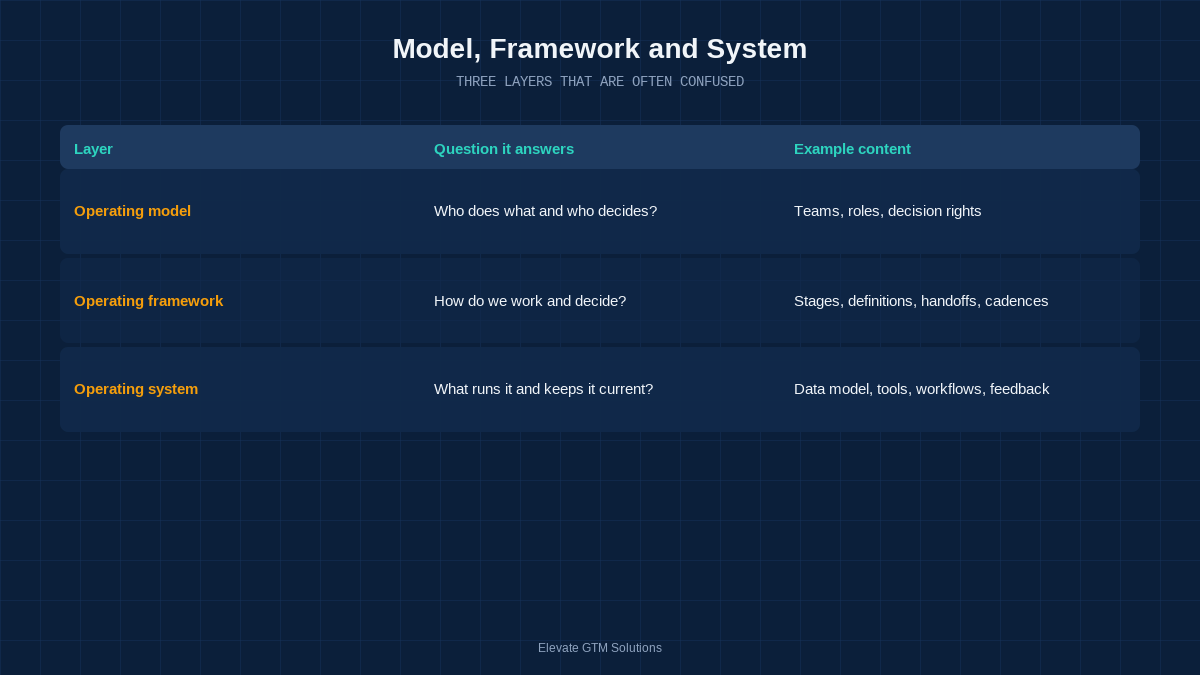
An operating model describes how the organization is structured to deliver its go-to-market: teams, reporting lines, responsibilities, coverage, decision rights and funding. It answers who does what and who decides.
The three terms layer like this:
| Layer | Question it answers | Example content |
|---|---|---|
| Operating model | Who does what, and who decides? | Team structure, roles, territories, decision rights |
| Operating framework | How do we work and decide? | Stages, definitions, handoffs, cadences, scorecards |
| Operating system | What runs it and keeps it current? | Data model, tools, workflows, automation, feedback loops |
A company can have a clear model and framework and run on spreadsheets. It can have a sophisticated system and a muddled model. The layers are related, but they are different things, and a purchase of software addresses only the third. See how to structure a GTM team for the model layer.
How the two fit together
The cleanest way to see the relationship is that the framework is the specification and the operating system is the implementation. A building has a floor plan and a structure that people live in with heat, power and water. You can draw a floor plan with no building. You should not build without one.
In practice, the sequence usually looks like this:
- Write a first framework. Define the stages, the key terms, the handoffs, the cadence and the metrics, even roughly.
- Run it by hand for a while. Use documents, the CRM you have and a weekly meeting. See where it breaks.
- Fix the framework. The first version is always wrong in places.
- Automate the parts that hurt. Where manual upkeep is the bottleneck, add tools, integrations and workflows.
- Consolidate into a system as scale demands it. When several teams, products or regions need the same decisions to stay in step, a shared platform becomes worth its cost.
Jumping straight to step five is common, usually because a vendor is persuasive. The risk is that you configure the software around assumptions you never examined.
Ten differences that matter in practice
1. Where the knowledge lives. In a framework, it lives in documents and in people's heads. In an operating system, it lives in the data model and the workflows, as well as in people.
2. How change spreads. In a framework, change spreads by announcement and training. In an operating system, change can propagate through the system, though people still need to understand it.
3. How drift shows up. A framework drifts silently. A system can detect some kinds of drift, such as fields that no longer match definitions, if it is built to.
4. What happens when someone leaves. A framework held in one person's head disappears with them. A system holds more, though it also needs an owner.
5. Cost shape. A framework costs attention. A system costs money, setup and ongoing administration.
6. Speed of getting started. A framework can exist in a week. A system takes longer, even a good one.
7. Scale behavior. A framework works well at small scale and strains as complexity grows. A system has overhead at small scale and pays off as complexity grows.
8. Accountability. A framework needs people to hold each other to it. A system can enforce some rules directly, such as required fields or routing, and people still must handle the rest.
9. Failure mode. A framework fails by being ignored. A system fails by being distrusted or by faithfully running a poor design.
10. Reversibility. A framework is easy to change. A system is harder to change once integrations, reports and habits depend on it.
When a framework alone is enough
You probably do not need an operating system if:
- You have one product, one main segment and one sales motion.
- A single team of fewer than a dozen people owns most GTM decisions and talks daily.
- Your definitions are not yet stable, and you are still figuring out who the customer is.
- The main problem is that nobody agreed on the plan, not that the plan cannot be maintained.
- Your CRM and a few well-kept documents handle the volume of work.
In that situation, spend a week writing the framework, a month running it and then revisit. Our guide to GTM strategy for startups goes further on early-stage choices.
When you need an operating system
The pull toward a system usually begins when the symptoms look like this:
- Several products or regions use different definitions and cannot compare results.
- Plans live in many documents that disagree, and nobody can say which one is current.
- Handoffs between teams are manual and often fail silently.
- Leadership cannot get one view of the plan, the pipeline and the results without a week of spreadsheet work.
- Changes to ICP, messaging or pricing take months to reach the field.
- You maintain a large stack of tools that do not share data, and integration work consumes a team. See the GTM stack audit.
These are signs that the cost of keeping the framework alive by hand has passed the cost of a system. See where existing GTM stacks break down.
A worked example, invented for illustration
Consider a company with three product lines and four regions, selling to mid-size manufacturers. This is invented to show the reasoning.
Stage one: no framework. Each region plans on its own. "Qualified lead" means three different things. The quarterly business review takes two weeks of data cleanup, and the numbers still do not reconcile.
Stage two: framework only. Leadership writes a six-page framework: shared stage names, one definition of qualified lead, a common planning calendar and a scorecard. It helps immediately. Arguments about definitions mostly stop. Within two quarters, though, a product team adds a new stage for its own motion, one region keeps a private spreadsheet and the scorecard is rebuilt by hand every month. The framework is mostly followed and increasingly out of date.
Stage three: operating system. The company chooses a platform to hold the definitions, the plan, the segment model and the scorecard in one place, connected to the CRM and the marketing tools. The framework does not disappear. It becomes the specification the system implements. The scorecard now updates without a monthly rebuild, regional plans inherit global definitions and changes are approved in one place.
Notice that the system did not replace the thinking. It kept the thinking from decaying. If the company had skipped stage two, the system would have encoded three competing definitions of "qualified."
How to tell whether a vendor's "operating system" is real
Because the term is loose, test it. These questions are less about the name than about what the product does.
- Is there a shared data model? Ask to see how a segment, a play and a metric are defined, and where each is used.
- What happens when I change a definition? Do plans and reports update, flag a conflict or stay the same?
- What connects, and how? Which tools, which objects, which direction, how often?
- Do workflows run, or only display? Can the system trigger actions, or is it a dashboard?
- Do results come back to the plan? Show me a result changing a planning decision.
- Where is the history? Who changed what, and when?
- Where does the product end? What do customers still do outside it?
- What did a customer need to have in place first? A good vendor will mention definitions, ownership and data hygiene.
A product that answers these concretely is closer to the stricter meaning. A product that answers with phrases such as "everything in one place" is closer to a bundle. For more tests aimed at AI claims in particular, see how to tell if a GTM platform is really AI-native.
How to build a framework in a week
If you have none, here is a plan that fits in five working days.
Day one: list the decisions. Write the ten to fifteen decisions that shape your GTM: target segments, ICP, positioning, pricing, channels, handoffs, targets, tool ownership. Note who makes each today.
Day two: write the definitions. Customer, lead, qualified lead, opportunity, closed-won, churn, expansion. Get every function to read them and write what they would change.
Day three: draw the flow. From first awareness to renewal, which team does what and what triggers each handoff? Keep it to one page.
Day four: set the cadence and the scorecard. Weekly pipeline review, monthly performance review, quarterly planning. List the eight or ten numbers that matter and how each is calculated. See GTM metrics and KPIs.
Day five: assign owners and publish. Every element has an owner. Put it where everyone can find it. Schedule the first review in thirty days.
That is a first version, and it will be wrong in places. The point is to have something specific enough to be wrong.
How to move from framework to system without a big bang
Automate the single most painful manual step first. It might be keeping segment definitions in sync, building the scorecard or routing handoffs. One good automation builds trust.
Keep the framework as the source. When the system and the document disagree, decide which is right and fix the other. Do not let both drift.
Pilot with one product or region. Learn how the system handles your definitions before you spread it.
Plan for the people side. Training, a named owner and a way to report problems matter as much as configuration. See the enterprise GTM operating system implementation roadmap.
Keep an exit. Know how you would get your data and definitions out if the product stops fitting.
Governance: who owns what
Whether you have a framework, a system or both, ownership has to be clear.
| Layer | Typical owner | What they do |
|---|---|---|
| Operating model | CEO or chief revenue officer | Decides structure, roles and decision rights |
| Operating framework | Head of GTM operations or a senior marketing or revenue leader | Writes and maintains definitions, stages, cadences and scorecards |
| Operating system | GTM operations or RevOps with IT | Configures, administers and connects the tools |
| Individual elements | Named function leads | Own their definitions, plays and metrics |
See what is GTM operations and the GTM platform governance checklist.
How to measure whether it is working
For a framework:
- Do teams use the same definitions when they talk and in their reports?
- Do handoffs happen on time and with the information the next team needs?
- Does a new hire understand how the machine works within their first weeks?
- Is the document current, with a recent review date?
For an operating system:
- How long does it take to get one agreed view of plan versus results?
- How much manual reconciliation has been removed?
- How long does a change in ICP or messaging take to reach the field?
- Are people working in the system, or around it?
- When a result challenges the plan, does the plan change?
Do not measure the system by the number of features switched on. Measure by whether decisions get better and faster.
Common mistakes
Buying a system to avoid writing a framework. Software cannot decide your definitions. It will make you decide them during setup, under more pressure and at more cost.
Writing a framework and never revisiting it. A framework that is not reviewed becomes folklore.
Calling a bundle of features an operating system. If there is no shared data model and no feedback loop, you bought a suite.
Confusing the operating model with the framework. Reorganizing the team does not give you shared definitions. Writing definitions does not settle who owns the budget.
Over-engineering the first version. Fifty pages of framework will not be read. Start with what settles real arguments.
Automating before the manual process works. If the handoff fails by hand, it will fail faster when automated.
Ignoring adoption. The best system is useless if the field keeps its own spreadsheet.
Letting the vendor define your framework. A vendor's default model may fit you or not. Treat it as a starting point and check it against how your buyers buy.
A week in the life under each setup
Abstract definitions only go so far, so here is what an ordinary Tuesday and Friday look like in each case. The scenes are invented.
Framework only. On Tuesday, a regional marketing lead wants to launch a campaign for a new segment. She opens the framework document, checks the definition of the segment and the messaging guidelines, and builds the campaign in the marketing automation tool. She emails the sales lead so he knows what is coming. On Friday, the operations manager pulls a report from the CRM, copies it into a spreadsheet, adds marketing numbers from another export and builds the weekly scorecard. It takes most of the afternoon. When the numbers do not match, he messages two people to find out why. The framework works, because everyone knows the definitions. The effort is in carrying information between places.
Operating system. On Tuesday, the same marketing lead opens the plan, sees the segment definition and the current messaging, and the system shows which accounts belong to the segment. She launches the campaign, and the account list and message version go to the tools automatically. The sales lead sees the campaign in his view without an email. On Friday, the scorecard is already current, because it reads from the same data the teams work in. The operations manager spends the afternoon on the reasons a number moved, not on assembling it. The system works when the data and definitions are good. When they are not, the scorecard is confidently wrong, which is why the framework still matters.
The difference is not that one group is smarter. It is where the effort goes: carrying information, or acting on it.
Frameworks you may already have without calling them that
Many teams believe they have no framework, and then discover they have several, scattered and unwritten.
- The sales stage definitions in the CRM are a framework element, even if no document describes them.
- The lead scoring model encodes a view of who is worth pursuing.
- The quarterly planning template your finance team asks for shapes how GTM decisions are made.
- The onboarding deck for new sellers describes the buyer and the pitch, which is positioning.
- The monthly report defines which numbers the company treats as real.
Collecting these is a useful first exercise. Put them on one page and look for contradictions. Often the most valuable output of "writing a framework" is simply noticing that three of these artifacts disagree.
Why vendors lean toward "operating system"
Language in software marketing follows incentives. "Framework" suggests a document, a method or a service. "Operating system" suggests a product that a company runs on, which is easier to sell as a subscription and harder to replace. That does not make the term dishonest, because some products do hold a shared model and run workflows. It does mean the label tells you about the vendor's ambition more than about the product. Judge the product by what it does under the tests above.
The same caution applies in the other direction. Consultants who sell frameworks have an interest in telling you that software will not solve your problem, and sometimes they are right and sometimes they are protecting their engagement. The honest position is that you usually need both in some proportion, and the proportion depends on your scale and your maturity. See GTM platform vs GTM consultant for the trade-offs.
Where a playbook fits
A fourth word shows up often: playbook. A playbook is smaller than a framework. It describes how to run one particular play, such as a product launch, a competitive displacement or an expansion campaign. Think of the framework as the rules of the game and playbooks as specific plays you run within it. A company with a good framework can produce playbooks quickly, because the definitions, handoffs and metrics are already agreed. A company without one writes each playbook from scratch and gets slightly different answers each time.
Glossary
GTM operating framework. A designed structure for how GTM work is organized: stages, decisions, roles, definitions, cadences and rules.
GTM operating system. A running system, usually software-supported, that carries out and updates the framework through shared data, connected tools, workflows and feedback loops.
Operating model. How the organization is structured to deliver go-to-market: teams, roles, decision rights and funding.
Data model. The shared definitions of the entities a system tracks, such as accounts, segments, plays and metrics, and how they relate.
Feedback loop. A path by which results return to the plan so decisions can change.
Playbook. A defined, repeatable set of actions for a situation. Smaller than a framework. See what is a GTM playbook.
Governance. Permissions, approvals and history that control who can change what.
Drift. The gradual gap between how things are documented and how they work in practice.
Where Elevate GTM Solutions fits
Elevate GTM Solutions positions itself as an AI GTM platform for creating, executing and adapting go-to-market strategy, and it uses operating-system language for the idea. Its homepage describes connected modules, including "Unified GTM Strategy," "Market Research," "ICP & Segmentation," "Competitive Intelligence," "Product Positioning," "Product Messaging," "Pricing Strategy," "Launch & Execute," "Measure & Optimize" and "Sales Enablement," with a shared model across teams, executive dashboards and continuous visibility. The homepage says "15 connected GTM modules" and names sixteen, so count what you see.
Apply the tests above to that description, as you would to any vendor, including us. Ask to see the shared data model, what happens when a definition changes and how results return to the plan. Ask what the product does not do. A platform is the implementation layer. It does not decide your definitions, and it works better when you bring a framework to it. If you want help writing that framework first, our unified GTM framework and GTM planning template are starting points, and what Elevate GTM Solutions is explains the product itself.
What to do this week
- Write down what your company currently calls its GTM framework, system and operating model. Notice whether people use the words the same way.
- List the definitions that differ across teams: lead, qualified, customer, churn.
- Pick the ten decisions that shape your GTM, and name an owner for each.
- Check how current your framework is. When was it last reviewed, and what has changed since?
- Identify the single manual step that costs the most time or causes the most errors.
- If you evaluate a platform, run the eight tests and ask where the framework would live.
- Decide whether the problem is agreement (a framework problem) or upkeep at scale (a system problem).
- Schedule a thirty-day review of whatever you write.
Key takeaways
- A GTM operating framework is the designed structure: stages, decisions, roles, definitions, cadences and rules. A GTM operating system is the running implementation, usually supported by software.
- An operating model is a third thing: who does what and who decides. The three layer on each other.
- The framework comes first. A system without one automates confusion.
- Frameworks create agreement and cost little but drift without upkeep. Systems keep things consistent at scale but cost more and need adoption.
- The term "operating system" is loose. Test for a shared data model, connected tools, running workflows, feedback loops, governance and a planning layer.
- Small, single-motion teams usually need only a framework. Multi-product, multi-region teams feel the pull toward a system.
- Move in steps: write it, run it by hand, fix it, automate the pain, then consolidate.
- Measure by whether decisions get better and faster, not by how many features are switched on.
Sources
- Elevate GTM Solutions: descriptions of modules, audience and shared-model design, as stated on the company's homepage.
- Related Elevate guides linked in the text, including the unified GTM framework, what is a GTM operating system and the GTM maturity framework.
- The definitions, the layer model, the criteria and the build plan reflect our judgment and common practice. The terms are not standardized, and companies use them differently. We cite no benchmarks.
- The worked example is invented for illustration.
Frequently Asked Questions
What is the difference between a GTM operating system and a GTM operating framework?
A framework is the designed structure for how go-to-market work is organized: stages, definitions, roles, handoffs and cadences. An operating system is the running implementation, usually software-supported, that applies the structure through shared data, workflows and feedback loops. One is the design, the other is the design in operation.
Which one should I build first?
The framework. Even a rough, one-page version forces agreement on definitions and handoffs. Software built before that tends to encode disagreement.
Can I have a framework without an operating system?
Yes, and many companies do, running on documents, the CRM and regular meetings. It works well at small scale. The strain appears as products, regions and teams multiply.
Is an operating system just software?
Not entirely. Software is a large part, but the system also includes the shared definitions, ownership, cadences and habits around it. Software with no agreed framework is just software.
What is an operating model, and how is it different?
An operating model describes how the organization is structured: teams, roles, coverage and decision rights. A framework describes how work and decisions flow. A system runs and updates it. They are related, but they are different layers.
Do small companies need a GTM operating system?
Usually not. A clear framework, a well-kept CRM and a weekly review often cover it. A system becomes worthwhile when coordination across teams, products or regions is the constraint.
How do I know if a vendor's operating system claim is real?
Ask for the shared data model, what happens when a definition changes, which tools connect and how, whether workflows run or only display, how results return to the plan and where the product ends. Concrete answers suggest a real system. Vague ones suggest a bundle.
Does an operating system replace my CRM?
Not necessarily. A GTM operating system usually sits alongside or above the CRM and connects to it. The CRM often remains the system of record for contacts, accounts and deals. Check any vendor's claim to replace it carefully.
How long does it take to write a GTM framework?
A useful first version can be written in about a week, if the right people are available. It will have gaps. Expect to revise it after running it for a month.
What happens if my framework and my system disagree?
Decide which is right, fix the other and note why. Letting both drift creates two versions of the truth, which is the problem the system was meant to solve.
Can AI build the framework for me?
AI can draft one quickly from your inputs, and that is a useful starting point. People still have to decide your definitions, ownership and priorities, because those are choices, not facts.
How do I measure whether the investment worked?
Look for shared definitions in use, faster agreed views of plan versus results, less manual reconciliation, quicker propagation of changes to the field and more evidence that results change plans. Avoid judging by features enabled.