
By the Elevate GTM Solutions Team · Updated November 13, 2026 · 27 min read
How to Plan Go-to-Market for an AI Product: What Is Different From Ordinary Software and a Plan That Earns Buyer Trust
Selling an AI product in 2026 is harder in some ways than selling ordinary software, and the difficulty is not mainly technical. Buyers have heard "AI-powered" so many times that the phrase has stopped meaning anything. They have been burned by demos that worked once and pilots that never reached production. They worry about accuracy, data exposure, cost surprises and whether the product will exist in two years. Meanwhile competitors, including the large model providers and your own customers' internal teams, can ship similar features quickly.
A go-to-market plan for an AI product has to deal with those facts directly. This guide covers what is different from a conventional software launch, how to decide what kind of AI product you actually have, how to choose the right first customers, how to position without leaning on the word "AI," how to earn trust through proof, how to price when your costs vary with usage, which channels and sales approaches fit, what to measure and where the main risks sit. We make an AI GTM platform, so we sell an AI product ourselves and have an interest in the topic. We apply the same skepticism to ourselves, cite no market statistics and use invented examples.
How do you plan go-to-market for an AI product?
Plan it like any B2B go-to-market, with extra attention to six things that AI changes: what the product really is, who is ready to adopt it, how you position without relying on the label "AI," how you earn trust before and after the sale, how you price when cost varies with usage and how you keep a lead when competitors can copy features quickly. Start by deciding whether AI is a feature, the core of the product or the infrastructure beneath other people's products, because each needs a different plan. Choose early customers who have a painful, measurable problem, usable data and the ability to try things. Position on the outcome and the evidence, not the technology. Run pilots with written success criteria, and be honest about what the product does not do. Price so customers can predict their bills and you can protect your margin. Measure real usage and retention, not signups or demo excitement.
Is AI go-to-market a different discipline? Mostly the same fundamentals, applied to a market where trust is scarcer, differentiation is fragile and costs behave differently.
What is the single biggest mistake? Selling the technology instead of a measurable result, then discovering that buyers cannot tell your product from five others.
The short version
| Question | Answer |
|---|---|
| Is it a different GTM? | Same fundamentals, with more weight on trust, proof, pricing design and defensibility |
| What should you decide first? | Whether AI is a feature, the core product or infrastructure for others |
| Who are good first customers? | Teams with a painful, measurable problem, usable data and freedom to experiment |
| How should you position? | On the outcome and the evidence. "AI-powered" is not a differentiator on its own |
| How do you earn trust? | Pilots with written criteria, honest limits, clear data handling and visible human review |
| How should you price? | A metric that tracks value, predictable bills and margin protection against variable model costs |
| What channels fit? | Depends on buyer. Product-led for builders and individuals, sales-led for enterprise, plus partners and marketplaces |
| What should you measure? | Activation, depth of use, retention, pilot-to-paid conversion, quality metrics and gross margin |
| Main risks | Commoditization, dependence on a model provider, margin pressure, trust incidents, over-promising |
What is different about selling AI products
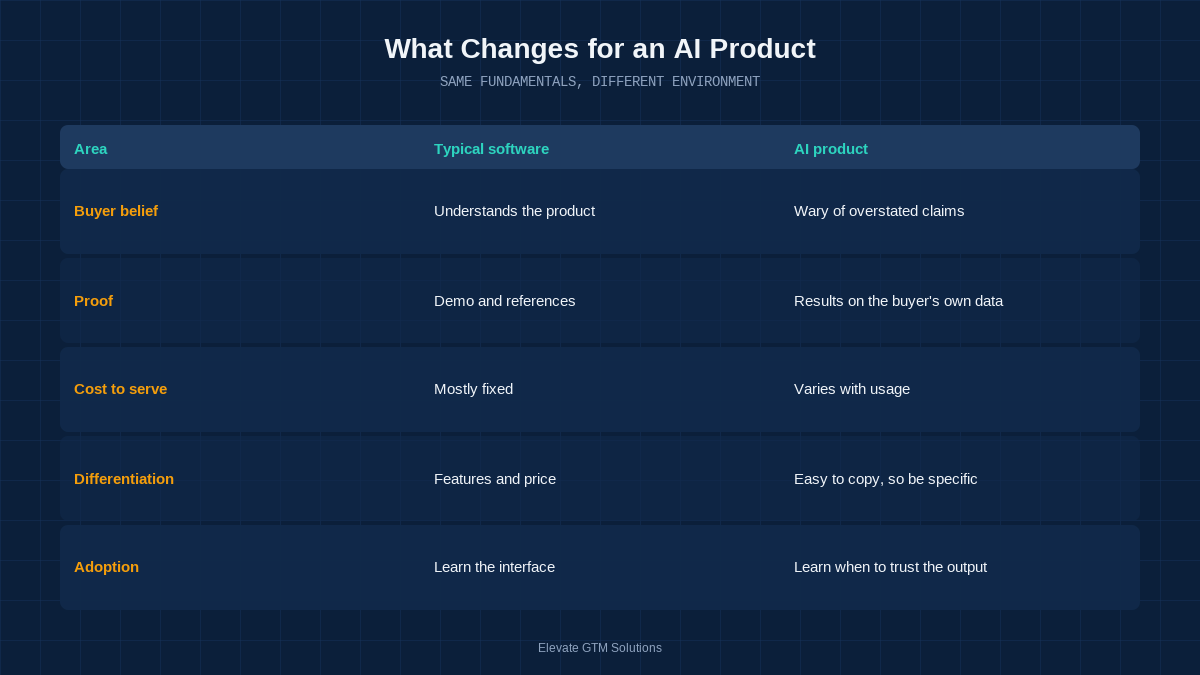
The fundamentals of go-to-market do not change: know your customer, state your value, reach them, price sensibly, measure what happens. What changes is the environment in which you do it.
| Area | Typical software | AI product |
|---|---|---|
| Buyer belief | Buyers understand what software does | Buyers are unsure what the product can do and are wary of overstated claims |
| Differentiation | Features, integrations, price | Outputs can look similar across vendors, and features can be copied quickly |
| Proof | A demo and references | Results on the buyer's own data, often through a pilot |
| Risk concerns | Uptime, security, integration | Accuracy, data use, bias, confidentiality, explainability, vendor stability |
| Cost to serve | Mostly fixed, with small marginal cost | Variable cost per use that can grow with volume |
| Pricing | Seats, tiers | Seats, usage, outcomes or hybrids, with margin implications |
| Adoption | Learn the interface | Learn when to trust the output, and change habits |
| Pace of change | Product roadmaps move on a yearly rhythm | Underlying capabilities can change in months |
| Distribution | Search, outbound, partners | All of those, plus AI assistants and answer engines as a discovery channel. See AI search visibility audit |
Hold on to the first row. The most common failure in AI go-to-market is assuming buyers share your enthusiasm. Many are curious, a few are eager and most are cautious. A plan that respects the caution tends to outperform a plan that tries to overcome it with hype.
Step 1: Decide what kind of AI product you have
"AI product" covers very different businesses. The go-to-market plan depends on which one you are.
| Type | What it is | Typical buyer | Main GTM challenge |
|---|---|---|---|
| AI feature in an existing product | AI added to a product customers already use | Existing customers | Showing the feature matters, pricing it or bundling it |
| AI-native application | A product built around AI to do a job | Business teams | Differentiation, trust and proof |
| AI agent or service | Software that performs work previously done by people | Operations, support, sales, finance | Accountability, handoffs, outcome pricing |
| AI infrastructure or tooling | Tools used by other builders | Developers, data teams | Developer adoption, ecosystem, pricing by usage |
| AI-enabled service | A service firm that uses AI to deliver faster | Buyers of the service | Explaining what is different from a conventional provider |
Be honest about which one fits. A company that adds a chat box to an existing product and calls it an AI-native platform will be found out. See how to tell if a GTM platform is really AI-native for tests buyers use, and apply them to your own product before they do.
This decision sets the rest of the plan. A feature inside an existing product is mostly an adoption and packaging challenge. An AI-native application is a full go-to-market with a new category to explain. Infrastructure sells to technical users who evaluate for themselves. An agent that replaces human work raises questions of accountability that other products avoid.
Step 2: Choose the first customers
AI products often struggle because they target "everyone who could benefit," which is a very large group with very different readiness. A better approach is to find the customers for whom the product works best today.
What makes a customer ready
A painful, measurable problem. The cost of the problem is visible, such as hours spent, errors made or revenue lost. If no one can say what success looks like, a pilot will end in opinions.
Usable data. AI products often depend on the customer's data. If it is scattered, poor or inaccessible, results will disappoint. Ask about data early.
Ability to try. A team that can start a pilot without a six-month procurement cycle gives you faster learning.
Tolerance for imperfection, where appropriate. Some tasks can accept a good-but-not-perfect output with human review. Others cannot. Match your product's reliability to the task.
An owner with authority. Someone who can decide, redirect budget and remove obstacles.
A realistic view of AI. Customers who expect magic are hard to satisfy. Customers who expect a useful tool, with limits, are easier.
Who to avoid at first
- Buyers whose problem has no measurable result.
- Buyers in heavily regulated settings where your product is not yet ready to meet the requirements, unless you are built for them.
- Customers who want a custom build disguised as a product.
- Anyone who needs flawless accuracy on a task where your product is not that reliable.
See what is an ICP and the ICP scoring framework. For an AI product, add data readiness and risk tolerance as scoring dimensions.
Step 3: Position without relying on the label
By now, "AI-powered" tells a buyer almost nothing. Many products use the phrase, and buyers have learned to discount it. Positioning that works usually follows a different pattern.
Lead with the job and the result. "Cuts the time to prepare a customer renewal brief from hours to minutes" says more than "AI-powered renewal assistant." Use only results you can back up.
Say what is actually different. Possible differences include: the data you use, how deeply you integrate into the workflow, how you handle accuracy, how fast the product improves with use, what you refuse to do. Pick the one or two that are true and verifiable.
Be specific about how the AI is used. Buyers trust "it drafts, a person reviews and approves" more than "it handles everything automatically."
Name the alternatives honestly. The real alternatives may be a person doing the work, a spreadsheet, a general-purpose assistant or an internal build. Explain why your product is better for the job, and when it is not.
Avoid claims you cannot support. Superlatives about accuracy, savings or intelligence invite scrutiny. If you quote numbers, label their source and conditions.
A useful test: remove the words "AI," "intelligent" and "smart" from your messaging. If it still says something specific and valuable, it is positioned. If it falls apart, there is no position. See positioning and GTM intelligence.
Step 4: Earn trust through proof
Proof matters more for AI than for most software, because buyers cannot judge quality from a feature list. They want to see it work on their problem.
Run pilots that can fail
A good pilot has a defined scope, a written success criterion, a time limit and an agreed decision at the end. Example criteria: "Reduce the average time to produce the weekly report by at least a specified amount, compared with the baseline we measured last month" or "Reviewers accept the draft with minor edits in most cases." Agree on the baseline before the pilot starts, and agree what happens if the target is met. See pilot to scale framework.
Pilots that have no stated criteria produce enthusiasm and no purchase. Pilots with criteria produce a decision, and sometimes the decision is no. A clear no is cheaper than a long maybe.
Show your evaluation honestly
If you measure accuracy or quality, explain how: what the test set was, how outputs were judged, what the failure cases look like. Show the cases where the product does poorly. Buyers who see only successes assume you are hiding the rest.
Address the questions buyers will ask
| Buyer concern | What to be ready to explain |
|---|---|
| "Will it make things up?" | How you reduce errors, how outputs are checked and where human review is required |
| "What happens to our data?" | Where data is stored, who can access it, whether it is used to train models, how long it is kept and how it can be deleted |
| "Is it secure?" | Your security practices and any independent assessments you hold. State only what is true |
| "What if the model provider changes?" | Your plan for continuity, and which parts of the product depend on third-party models |
| "Can we see why it said that?" | What explanation and audit information the product provides |
| "What about bias and fairness?" | How you test, where the limits are and what the customer's responsibilities are |
| "Will it replace people?" | Honest answer about the intended role, such as augmenting a team or automating a defined task |
| "What does it really cost?" | A clear view of price drivers and a way to predict bills |
| "Will you still be here?" | Honest information about your company, plans and customer base |
Rules about AI use, data protection and automated decisions differ by region and industry and are changing. This is not legal advice. Involve your legal and security advisers before you make claims about compliance, and do not claim certifications you do not hold.
Make human oversight visible
Many buyers feel safer when they can see where a person stays in control. Show where outputs are reviewed, how corrections are made and how the system learns or does not learn from them. Avoid implying that human oversight is unnecessary when it is.
Build proof assets
Customer stories with measured results, with the customer's permission and clear conditions. Independent reviews. Documentation of how the product works. A public page that explains what the product does and does not do. These help buyers, and they help answer engines and review sites that increasingly shape discovery. See review sites and B2B purchase influence.
Step 5: Price for value and for your own costs
Pricing an AI product is harder than pricing conventional software, for two reasons: customers find it harder to predict value, and your own costs may rise with use.
Common models
| Model | How it works | Strengths | Risks |
|---|---|---|---|
| Per seat | Fixed price per user | Predictable for customers and for you | May not match value if usage varies widely, and heavy users can cost you margin |
| Usage-based | Price follows volume of use | Tracks cost and often value | Bills can surprise customers, which creates distrust |
| Outcome-based | Price tied to a result, such as a completed task | Aligns with value | Hard to define and measure, and disputes can arise |
| Tiered with limits | Packages with usage allowances | Predictable with room to grow | Limits can frustrate users at the wrong moment |
| Hybrid | Base subscription plus usage | Balances predictability and fairness | More complex to explain |
Principles that help
Understand your cost per unit of value. Know what a typical use costs you, including model charges, and how that changes with volume and with your choice of models. Your margin depends on it.
Make bills predictable. Offer caps, alerts or committed tiers so customers are not surprised. Surprise bills end relationships.
Charge for value, not only for cost. If your product saves a team substantial time, a price near your cost undersells it. If the value is modest, a high price will not hold.
Test with real buyers. Price conversations during pilots are informative. See how to price a new B2B product.
Plan for changes. Underlying costs and competitor prices may shift. Build in the ability to adjust, with notice and fairness to existing customers.
Be honest about pilots. A free pilot may be useful, but a paid pilot filters for real intent. Consider the trade-off for your market.
For context on how others price this category, see the AI GTM platform pricing guide.
Step 6: Choose channels and a motion
The right route depends on who buys and how.
Product-led. Fits when individuals or small teams can try the product on their own, such as developers and prosumers. Needs a quick path to a first useful result. See what is product-led growth.
Sales-led. Fits when buyers are enterprises with security reviews, larger budgets and several stakeholders. Needs strong proof assets and solution engineers who can work with the buyer's data. See what is sales-led growth.
Land and expand. Fits when a small first deployment can prove value and grow. See what is land and expand.
Partners and marketplaces. Cloud marketplaces, platform integrations and consultancies can bring trust and distribution. They also bring fees and dependence. See how to build a partner or channel GTM strategy.
Community and content. Technical audiences value clear documentation, examples and honest comparisons. Buyers of business AI tools value case studies and practical guides.
AI assistants and answer engines. More buyers ask an AI assistant to recommend tools. That makes clear, factual, well-structured public information about your product a distribution channel. Make sure your site says plainly what the product does, who it is for, how it differs and where it falls short. See AI search citation studies roundup.
Most AI companies end up with a blend. Choose a primary motion for the first customers, and add others as you learn.
Step 7: Sell with honesty
Sales conversations around AI go better when the seller treats the buyer's skepticism as reasonable.
Demo with the buyer's data
A polished demo with prepared inputs impresses and convinces few. If possible, run a short working session with the buyer's own examples, including a messy one. If the product handles it, you have proof. If it does not, you have saved both sides a long pilot.
Handle common objections
| Objection | Weak response | Stronger response |
|---|---|---|
| "AI makes mistakes." | "Ours is very accurate." | "Yes. Here is where it is reliable, where it is not and how review catches the rest." |
| "We can build this ourselves." | "Building is hard." | "You can. Here is what we have already built, what it would cost you to maintain and where building makes sense." |
| "Why not use a general-purpose assistant?" | "Ours is smarter." | "Those are useful. Here is what is different about ours for this job, and when the general tool is enough." |
| "We worry about our data." | "It's secure." | "Here is exactly where data goes, who can see it and how to delete it." |
| "Your category is moving fast." | "We are the leader." | "It is. Here is how we handle change, and what you can do if our product no longer fits." |
| "Show me the ROI." | A large claim | A pilot with agreed criteria and a baseline |
Qualify honestly
Say no to deals where the product will not work. A customer who buys and fails becomes a detractor in a market that talks. Written qualification criteria help: data availability, clear problem, an owner, a realistic timeline and an agreement on what success means.
Step 8: Plan onboarding and adoption
Many AI purchases fail after the sale, because users never develop habits around the tool.
Time to first value. Get new customers to a useful result quickly, ideally in the first session. A long setup kills enthusiasm.
Teach judgment, not just features. Users need to know when to trust the output and when to check. Provide examples of good and bad outputs.
Name an internal owner. Someone at the customer who is responsible for adoption.
Set up feedback loops. Make it easy to flag poor outputs, and show customers that feedback leads to change.
Check usage regularly. Fall-offs are early warnings. See what is deal intelligence for how signals inform account work, and use the same thinking for product adoption.
Plan the change management. Workflows, roles and approvals may change. The customer needs help with that, not just with the software.
Step 9: Measure what matters
| Measure | What it tells you | Caution |
|---|---|---|
| Activation | Whether new users reach a first useful result | Define "useful" carefully |
| Depth of use | Whether users rely on the product for real work | Logins alone are weak signals |
| Retention | Whether customers keep using and paying | Look by cohort and segment |
| Pilot-to-paid conversion | Whether proof turns into revenue | Count pilots with agreed criteria separately |
| Quality metrics | Accuracy, acceptance rate of outputs, edit rate | Use your own definitions, shown honestly |
| Gross margin | Whether the business works at scale given variable costs | Track by customer and by usage tier |
| Time to value | How fast customers get results | Compare cohorts |
| Support burden | Cost of keeping customers successful | Watch for products that need heavy hand-holding |
| Win and loss reasons | Why you win and lose | Include competitors and "do nothing." See win-loss analysis framework |
Avoid leaning on signups, demo requests or social attention as evidence of success. In AI, curiosity is plentiful and cheap. Repeat use and renewals are the real tests. See GTM metrics and KPIs.
Risks specific to AI products
Commoditization. If many products produce similar outputs, price pressure follows. Mitigation: build advantages that are hard to copy, such as proprietary data, workflow depth, integrations, trust and customer relationships.
Dependence on a model provider. Changes in pricing, capabilities or terms can affect your product and margins. Mitigation: design for flexibility, understand your options and be honest with customers about dependencies.
Margin pressure. Variable costs can erode margin as usage grows. Mitigation: monitor cost per unit, price with that in mind and offer tiers with limits.
Trust incidents. One serious error, data exposure or misleading claim can damage a young product. Mitigation: testing, clear limits, human review, an incident process and honest communication.
Over-promising. The market rewards bold claims until customers find the gap. Mitigation: promise what you can show.
Regulatory change. Rules about AI, data and automated decisions are evolving. Mitigation: follow developments, involve advisers and avoid claims about compliance that you cannot support. This is not legal advice.
Platform competition. Large platforms may add similar features. Mitigation: serve a specific customer or workflow better than a general platform will, and integrate where customers already work.
Talent and attention. Customers may have internal AI teams. Mitigation: position as a faster, more reliable route for the job, and make integration easy.
A worked example, invented for illustration
Imagine a startup with a product that drafts and checks vendor contracts for procurement teams at mid-size companies. This is invented to show the reasoning.
What it is. An AI-native application with human review built in.
First customers. Procurement teams that review many standard contracts each month, have a template library and a lawyer or contract manager who approves. They are not yet targeting heavily regulated industries with special requirements, because the product is not ready for them.
Positioning. "Cuts first-pass contract review from a long manual task to a short review of flagged items, with every flag traced to the clause that triggered it." No claim about replacing lawyers.
Proof. A four-week pilot on the customer's last two months of contracts. Success criterion agreed in advance: reviewers confirm that a large majority of flagged issues are real, and average review time drops against the measured baseline. The company shares its own test results, including contract types where it performs poorly.
Pricing. A platform fee plus a per-contract charge with a monthly cap, so procurement can forecast spending. The company tracks cost per contract, including model use.
Channels. Direct outreach to procurement leaders, content explaining how the product handles confidential data and partnerships with two contract-management platforms.
Sales approach. A working session with a sample of the buyer's own contracts. The company declines deals where contracts are mostly handwritten or in rare formats.
Metrics. Pilot-to-paid conversion, share of flags accepted by reviewers, time saved per contract, gross margin per customer and renewal.
Nothing in this plan depends on the word "AI." It depends on a measurable result, honest limits and an agreed way to test.
A ninety-day launch plan
Days 1 to 15: decide and define. Settle what type of product you are, the first segment and the problem. Write the positioning without the word "AI." Draft the pilot criteria and the data-handling explanation.
Days 16 to 40: build proof. Recruit three to five pilot customers who fit the readiness criteria. Agree baselines and success criteria. Prepare security and data answers with your advisers.
Days 41 to 70: run pilots and tune pricing. Run the pilots, collect results, test price points in conversations and refine onboarding.
Days 71 to 90: convert and publish. Turn successful pilots into contracts and case studies, with permission. Publish clear product information, including limits. Review the metrics and decide what to scale. See first 90 days after a product launch.
Common mistakes
Selling the technology. Buyers purchase results, not models.
Targeting everyone. Narrow to customers who are ready now.
Hiding the limits. Buyers will find them. Better to state them.
Free pilots with no criteria. They produce enthusiasm and no revenue.
Ignoring data readiness. A great product on poor data disappoints.
Pricing without knowing your cost per use. Margin problems arrive late and hurt.
Surprising customers with bills. Predictability builds trust.
Overpromising in demos. A prepared demo can create expectations that the product cannot meet.
Copying consumer AI marketing. Business buyers want evidence, not spectacle.
Neglecting adoption. A purchase is not a result.
Making compliance claims without support. Never claim certifications or legal conclusions you cannot back.
Glossary
AI-native. A product designed around AI as the core way the job is done, as opposed to AI added as a feature.
Pilot. A time-limited trial with a defined scope and success criteria.
Human in the loop. A design where a person reviews or approves AI outputs.
Inference cost. The cost of running a model to produce an output.
Usage-based pricing. Pricing that varies with the amount of use.
Outcome-based pricing. Pricing tied to a defined result.
Data readiness. The state of a customer's data with respect to what the product needs.
Hallucination. An AI output that sounds plausible but is false.
Commoditization. The process by which products become similar enough that price becomes the main differentiator.
Answer engine. An AI system that gives direct answers to questions and often recommends products or cites sources.
Where Elevate GTM Solutions fits
Elevate GTM Solutions is itself an AI GTM platform, which is worth stating plainly: we are an AI product company writing about AI product go-to-market, and the tests on this page apply to us. Our homepage describes modules including "Unified GTM Strategy," "Market Research," "ICP & Segmentation," "Competitive Intelligence," "Product Positioning," "Product Messaging," "Pricing Strategy," "Distribution Channel Strategy," "Launch & Execute" and "Measure & Optimize," and it offers a free strategy you can generate in about five minutes. The homepage says "15 connected GTM modules" and names sixteen, so count what you see.
For a team launching an AI product, the relevant parts are the planning steps above: choosing the segment and ICP, positioning and messaging, pricing and channel choices, and measuring results after launch. A platform can help you organize those decisions, draft materials and keep them consistent. It does not supply customer proof, replace pilots or fix a product that does not yet work for the buyer. Test any such claims, including ours, against your own situation. See what Elevate GTM Solutions is, how to build a GTM strategy with AI and questions to ask AI GTM vendors for the other side of the table.
What to do this week
- Decide which type of AI product you have: feature, AI-native application, agent or service, infrastructure, or AI-enabled service.
- Write your positioning without the words "AI," "smart" or "intelligent," and see whether it still says something.
- List your best five potential customers and score them on problem pain, data readiness, ability to try and owner authority.
- Write a pilot template with scope, baseline, success criteria, time limit and decision.
- Draft plain answers to the nine buyer concerns above, and have your legal and security advisers review them.
- Calculate your cost per unit of use, and test whether your price model protects your margin.
- Check what AI assistants say about your product today, and what your public pages say about its limits.
- Choose the five measures you will review monthly.
Key takeaways
- AI go-to-market follows the same fundamentals as other B2B, with more weight on trust, proof, pricing design and defensibility.
- Decide first whether AI is a feature, the core of the product, an agent doing work or infrastructure for others. Each needs a different plan.
- Choose first customers with a painful, measurable problem, usable data, ability to try and an owner with authority.
- Position on the outcome and the evidence. "AI-powered" no longer differentiates.
- Earn trust with pilots that have written criteria, honest evaluation, clear data handling and visible human oversight.
- Price on a metric that tracks value, keep bills predictable and know your cost per use.
- Demo with the buyer's own data, qualify honestly and plan onboarding for adoption.
- Measure activation, depth of use, retention, pilot conversion, quality and gross margin, and treat curiosity as cheap.
Sources
- Elevate GTM Solutions: descriptions of modules and the free strategy offer, as stated on the company's homepage.
- Related Elevate guides linked in the text, including how to tell if a GTM platform is really AI-native, pilot to scale framework and how to price a new B2B product.
- Many agencies and software companies publish go-to-market playbooks for AI products, often with market statistics we could not trace to a clear method, so we cite none. The steps, tables and plan reflect our judgment and common practice.
- The worked example is invented for illustration. Legal, security and compliance points are not legal advice, so confirm them with qualified advisers.
Frequently Asked Questions
How is go-to-market for an AI product different from other software?
The fundamentals are the same. The differences are that buyers are more skeptical and need proof on their own data, features can be copied quickly, costs vary with usage and pricing needs care, and adoption depends on users learning when to trust the output.
Should I market my product as "AI-powered"?
Use the word sparingly. It no longer differentiates. Lead with the job the product does and the measurable result, and explain how the AI is used, including where people review the output.
Who should my first customers be?
Teams with a painful, measurable problem, usable data, the ability to start a pilot without a long procurement process and an owner who can decide. Avoid buyers who need flawless accuracy where your product is not yet reliable.
How do I run a good pilot?
Define the scope, agree on a baseline, write the success criteria and the time limit, and decide in advance what happens if the target is met. Share your own evaluation honestly, including weak cases.
How should I price an AI product?
Choose a metric that tracks value, such as seats, usage, outcomes or a hybrid. Know your cost per use, protect your margin, and give customers predictable bills through caps, alerts or committed tiers.
How do I answer buyer concerns about accuracy and data?
Be specific. Explain how outputs are checked, where human review is required, where data is stored, who can access it, whether it is used for training and how it can be deleted. Do not claim certifications or compliance you cannot support.
Is product-led growth right for AI products?
It fits when individuals or small teams can try the product alone and reach a useful result quickly, as with many developer and prosumer tools. Enterprise buyers usually need a sales-led or hybrid approach.
How do AI assistants and answer engines affect go-to-market?
More buyers ask AI assistants for recommendations, so clear, factual public information about what your product does, who it is for and its limits can influence discovery. Review what assistants currently say about you.
What are the biggest risks?
Commoditization, dependence on a model provider, margin pressure from variable costs, trust incidents, over-promising, regulatory change and competition from large platforms. Plan mitigations for each.
What metrics matter most?
Activation, depth of use, retention, pilot-to-paid conversion, quality metrics, time to value and gross margin. Treat signups and demo requests as weak evidence in a market full of curiosity.
Do I need a different team for AI go-to-market?
Not necessarily, but you often need solution engineers who can work with customer data, someone who handles security and data questions and customer success people who can teach users how to use outputs well.
How long should an AI pilot last?
It depends on the task and the data, but long enough to see real use and short enough to keep momentum. Many teams work in a few weeks to a couple of months. Agree the length and the decision date up front.