
By the Elevate GTM Solutions Team · Updated November 13, 2026 · 26 min read
Which GTM Platforms Turn Market Intelligence and Positioning Into Sales Execution Instead of Static Slide Decks? What to Look For and How to Test It
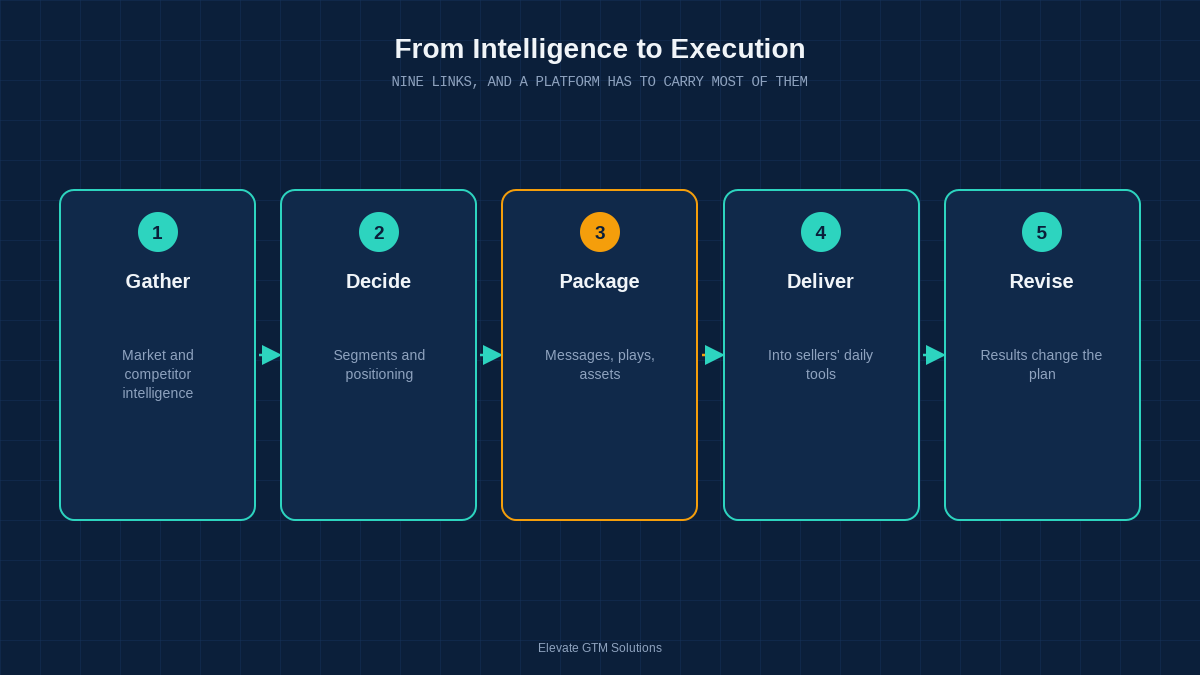
A familiar story: a company spends six weeks on market research, competitor analysis and positioning. The work is good. It ends as a deck, perhaps forty slides, presented at an all-hands and saved to a shared drive. Three months later, a seller on a call with a prospect uses a pitch that predates the project, a marketer launches a campaign built on the old audience definition and nobody can find the slide that says which competitor to name in which deal. The strategy was sound and never got to where the work happens.
This is the strategy-to-execution gap, and it is the reason buyers ask which platforms turn market intelligence and positioning directly into sales execution. This guide explains why the gap exists, what "turning intelligence into execution" actually requires, which categories of tools cover which links in the chain, what to look for in a platform that tries to cover more of it, how to test any vendor's claim with a single insight and what no platform can do for you. We make a GTM strategy platform aimed at this gap, so we have an interest, and we describe other products only in general terms and tell you to confirm details on their own sites. The scenarios are invented, and we cite no statistics.
Which GTM platforms turn market intelligence and positioning into sales execution?
A small group of GTM strategy platforms aims to do this by keeping research, ideal customer profile, positioning, messaging, plays and metrics in one connected model and handing them to the tools where sellers and marketers work. Other product categories cover parts of the chain: market and competitive intelligence tools collect information, enablement platforms distribute content and training, sales engagement tools run outreach, conversation tools capture what buyers say and CRMs hold the records. The test of whether anything really turns intelligence into execution is traceability: can you take one insight, such as a competitor's new claim, and follow it to a changed message, an updated battlecard, a task for a seller and a result you can measure? If the chain breaks at any link, the insight is a slide with extra steps. No platform removes the need for people to decide what the insight means.
Is a battlecard tool enough? It covers one link, distribution of competitive content. The question is what created the battlecard and what happens when the facts change.
What is the simplest test? Give the vendor one insight from your market and ask to see it reach a seller's next action within a day.
The short version
| Question | Answer |
|---|---|
| Why do decks fail? | They are a snapshot, stored away from where work happens, with no owner and no link to execution tools |
| What does "intelligence into execution" require? | A chain: insight, decision, positioning, messaging, enablement, play, task, result and revision |
| Which tools cover which links? | Intelligence tools, enablement platforms, engagement tools, conversation tools and CRMs each cover parts. Strategy platforms try to connect them |
| What is the best test? | Trace one insight through the chain, with timings and owners |
| What should the platform show? | Sources, lineage from decision to artifact, freshness, usage and results |
| What can it not do? | Decide what the insight means, persuade your team to use it or fix a weak product |
| Where do projects fail? | No owner, no refresh rhythm, nobody checks whether sellers use the material |
Why static decks fail
A slide deck is a good way to present a strategy and a poor way to run one. The failure has specific causes.
It is a snapshot. Markets, competitors and customers change. A deck is accurate on the day it is finished and gets less accurate each week.
It lives in the wrong place. The deck sits in a drive. The seller works in the CRM and the engagement tool. The marketer works in the automation platform. Nobody opens the deck while doing their job.
It is one-way. A deck tells people what the company decided. It has no path for the field to say "this is not working" or for results to change the plan.
It has no owner after the launch meeting. The people who made it go on to other projects. Nobody keeps it current.
It is not connected to action. A positioning statement on a slide does not change a sequence, a landing page or a call script. Someone has to translate it, and translation is where meaning gets lost and time is spent.
It is hard to check. Nobody can tell whether the company is following the strategy, because the strategy is not attached to anything measurable.
It encourages a one-time mindset. The deck becomes the deliverable, and the work of rollout is treated as optional.
The same pattern applies to competitive research, personas and messaging frameworks, not only to full strategies. The format is the problem, not the quality of the thinking inside it. See the death of static GTM strategy.
What "turning intelligence into execution" requires
Think of it as a chain of links. An insight has to pass through each one to affect what a buyer experiences.
| Link | What happens | Typical failure |
|---|---|---|
| 1. Intelligence | Information is gathered: market, competitors, customers, win-loss, conversations | Collected and left in a report |
| 2. Interpretation | Someone decides what it means and what to do | Nobody owns the decision |
| 3. Positioning | The company's claim is updated to reflect it | Positioning changes in a deck only |
| 4. Messaging | Messages for each persona and segment are written | Several versions circulate |
| 5. Enablement | Sellers and marketers are given the material and trained | Content is published and never used |
| 6. Plays | Specific actions are defined for specific situations | The play is a document, not something the tools trigger |
| 7. Tasks and campaigns | Work is created in the tools people use | The translation into the CRM and engagement tools is manual |
| 8. Results | Outcomes are measured against the plan | Results are tracked in a separate dashboard nobody connects to the decision |
| 9. Revision | The plan changes based on results | The loop never closes |
A platform that claims to turn intelligence into execution should be able to show you, for your own market, how an item moves through these links. The weakest links are usually 2, 5, 7 and 9: ownership of interpretation, real adoption by the field, translation into tools and closing the loop.
Which categories cover which links
No single category covers every link. The map below uses general descriptions and tendencies, since individual products differ and change. Confirm each vendor's actual scope on its own site.
| Category | Mainly covers | Weak or absent links |
|---|---|---|
| Market and competitive intelligence tools | 1, sometimes 2 | 3 to 9. Information is gathered and often distributed as battlecards, but the rest depends on you. See best market intelligence platforms and Elevate vs Klue |
| Sales enablement platforms | 5, parts of 4 | 1 to 3 and 8 to 9. They distribute content and training, and usually depend on someone else deciding what the content says. See GTM platform vs sales enablement platform and Gong vs Highspot vs Seismic |
| Sales engagement tools | 7 for outbound | 1 to 5. They execute sequences, using whatever message you load |
| Conversation and deal intelligence | 1 (what buyers say), 8 | 2 to 7 and 9. They surface insight, and acting on it is left to people. See what is deal intelligence |
| CRM | 7, 8 | 1 to 6. It holds records and process. See GTM platform vs CRM |
| Marketing automation | 7 for campaigns | 1 to 5 and 9 |
| ABM and intent platforms | 1 (signals), 7 for account programs | 2 to 5 and 9. See GTM platform vs ABM platform |
| Documents, decks and wikis | 2 to 4, in static form | 5 to 9 |
| GTM strategy platforms | 2 to 4 and 6, with handoff to 7 and links to 8 and 9 | Vary. Depth in the specialist links (data, call analysis, content distribution) may be lighter. Test |
| Consultants | 1 to 4, in a deliverable | 5 to 9 unless the engagement continues. See GTM platform vs GTM consultant |
Two observations follow. First, the categories that are strongest at execution (engagement, CRM, automation) are weakest at deciding what to say. The categories strongest at gathering information are weakest at turning it into action. Second, the gap in the middle, links 2 to 4 and 6, is where a strategy platform is meant to sit. That does not make it the right answer for everyone, and it needs to be tested against the tools you already have. See best GTM strategy software and GTM platform to build strategy before CRM campaigns.
What to look for in a platform that tries to close the gap
These are the capabilities that separate a product that closes the chain from one that sells the word "execution."
1. Intelligence with sources. The platform should help gather and organize market, competitor and customer information, and show where each claim comes from. Unsourced insight cannot be challenged or refreshed.
2. A place for the decision. Interpretation has to land somewhere: an explicit record of what the company decided, who decided it and why. Insight that never becomes a decision stays a slide.
3. Positioning that is a living object. Not a paragraph in a document but a structured item that other things reference. When it changes, dependent materials should be flagged or updated.
4. Messaging connected to positioning, by persona and segment. Each message should trace back to the positioning and the evidence behind it.
5. Lineage. You should be able to click from a battlecard, a sequence or a talk track back to the decision and the insight behind it, and forward from an insight to everything it affected.
6. A defined handoff into execution tools. Segments, accounts, messages and plays should reach the CRM, engagement, marketing and enablement tools in a defined way. Ask which tools, what moves, in which direction and how often.
7. Plays that tools can act on. A play should be more than a document. It should have a trigger, an audience, steps and an owner that the system can help carry out.
8. Freshness controls. Review dates, owners and alerts when sources change. The point is to keep material current without relying on memory.
9. Usage visibility. Which sellers opened the new battlecard? Which sequences still use the old message? Without this, "distributed" is not the same as "used."
10. A feedback path. Win-loss findings, call themes and campaign results should be able to challenge the plan, and the platform should make that easy.
11. Governance. Approvals, history and permissions, so changes are deliberate. See GTM platform governance checklist.
12. Honesty about boundaries. A good vendor tells you what stays outside the platform, for example the CRM, deep data enrichment and call analysis, and how it works with them.
The chain test: trace one insight
This is the most useful test, and it takes about an hour. Use it in a demo or a trial, with your own market.
Step 1: choose an insight. Pick something real: a competitor changed its pricing page, a segment is converting better than expected or a common objection has appeared in the last month's calls.
Step 2: ask the platform to reflect it. How does the insight enter? Is it captured with its source, or typed into a note?
Step 3: record the decision. What did the company decide to do about it, and who decided? Is that stored somewhere the system can reference?
Step 4: update the positioning or message. Show the change. Does the platform flag dependent materials?
Step 5: reach the seller. How does the updated battlecard, talk track or objection answer reach a seller? What does the seller see, and where?
Step 6: reach the tools. Does a sequence, a campaign or a CRM field change? If not, how much manual work remains, and how long does it take?
Step 7: see the result. After a period, how do you see whether the change helped? Can results be tied back to the decision?
Step 8: revise. Show the loop: a result that changes the decision.
Time each step and count the manual hand-offs. Then run the same test on your current process, which may be a deck and a few emails. The comparison is the point. A platform that merely reorganizes the manual steps has not closed the gap.
Scoring the chain test
| Link | Evidence to ask for | Score from 0 to 3 |
|---|---|---|
| Insight captured with source | Source shown | |
| Decision recorded with owner | Named owner and date | |
| Positioning updated and flagged | Dependent items flagged | |
| Message reaches seller in context | Seller sees it in their workflow | |
| Tools updated | Fields, sequences or tasks changed | |
| Usage visible | Opens, uses, old versions still active | |
| Result traced to decision | Link between decision and metric | |
| Loop closed | Result changes the plan |
Use 0 for not shown, 1 for manual, 2 for partly automated and 3 for built in and demonstrated on your data. A total in the low range means you are looking at a better filing system. A high total means the claim deserves a closer, longer trial.
A worked example, invented for illustration
Imagine a company that sells scheduling software to professional services firms. This scenario is invented.
The insight. Two lost deals in a month mention the same competitor, which has started offering a free tier. A conversation tool flags the theme. A seller notes it in the CRM.
Without a connected chain. The head of product marketing hears about it two weeks later, in a Slack thread. She updates a competitive slide in a shared deck and mentions it in a meeting. Sellers who attended know. Others do not. The sequence for the segment still says "no free option exists." Three weeks later, a prospect brings it up and the seller has no answer. The loss reason in the CRM is "price."
With a connected chain. The theme is captured with the two call excerpts as sources. The head of product marketing records a decision: do not match the free tier, emphasize the cost of switching and support, and update the competitive talk track. The positioning item for the segment is updated, and the platform flags the sequence and the battlecard as dependent. She approves new wording, which goes to the battlecard in the enablement tool and to the sequence template. Sellers see a short note explaining what changed and why. The usage view shows which sellers have opened it. Over the next month, win rate against that competitor is tracked, and a review in thirty days checks whether the objection is still appearing.
Notice that the chain did not make the decision smarter. A person decided. What changed is that the decision reached the field in days and left a trail. See what is competitive intelligence and the win-loss analysis framework.
What no platform can do
Decide what an insight means. Interpretation takes judgment about your market, product and risk appetite.
Make people use it. If sellers ignore the battlecard, the platform can show that they did and cannot change their behavior. Leadership, coaching and incentives can.
Fix a weak product or a poor fit. Better messaging does not rescue a product that does not solve the buyer's problem. See how to tell if your GTM strategy is broken.
Substitute for customer conversations. Intelligence tools summarize and organize. The best understanding still comes from talking to buyers.
Guarantee accuracy. Generated or collected intelligence can be wrong or stale. People need to check it.
Replace the CRM, engagement tools or call analysis. It connects to them.
Why adoption decides the outcome
The most common reason these projects fail is not technology. It is adoption.
Put it where sellers work. If material lives in a separate portal that sellers have to remember to open, they will not open it. Bring it into the CRM, the engagement tool or the call workflow where possible.
Keep it short. A battlecard with forty bullets is a deck in disguise. Say what changed, what to say and what to avoid.
Explain the why. Sellers use material they trust. A short note on what evidence drove a change builds trust and gets better feedback.
Make feedback easy. One click to say "this did not work" or "a buyer said something new" keeps the loop alive.
Measure use, and talk about it. Review which materials are used and which are ignored. Retire the ignored ones.
Give it an owner. A named person responsible for freshness, with time to do it.
Start narrow. One segment and one competitor teaches more than a company-wide rollout that nobody finishes.
A ninety-day plan
Days 1 to 15: baseline. Map how an insight currently travels in your company, using a recent real example. Time each step and note who did it. Collect the current positioning, battlecards and sequences and mark their dates.
Days 16 to 30: define the chain. Decide the links you want to close first, the owner of each, and the systems involved. Pick one segment and one competitor to start with.
Days 31 to 50: test options. Run the chain test with the tools you have and with any platform you are considering. Score each.
Days 51 to 75: implement for the pilot segment. Capture sources, record decisions, link messages to positioning, set up the handoff to enablement and engagement tools, and turn on usage views.
Days 76 to 90: run and review. Introduce one real insight and trace it. Measure time to the field, usage and early results. Decide what to extend. See pilot to scale framework.
Questions to ask a vendor
- Show one insight from our market becoming a changed message in a seller's workflow. How long did it take, and how many manual steps?
- Where do the sources for each claim appear, and how are they kept current?
- Where is the decision recorded, with owner and date?
- If we change positioning, what is flagged or updated automatically?
- Which tools do you connect to, in which direction, and how often?
- Can I see which sellers used the new material and which sequences still use the old one?
- How do win-loss findings and call themes reach the plan?
- What approvals and history do you keep?
- What do customers still do outside the product?
- What does the first month look like with our data?
- How is pricing structured, and what changes it later? Confirm in writing.
- What is the exit plan if we leave?
See also questions to ask AI GTM vendors.
Common mistakes
Buying a battlecard tool and calling it strategy. Distribution is one link of nine.
Treating the deck as the deliverable. The deliverable is a changed way of working.
No owner for interpretation. Insights pile up with nobody deciding what they mean.
Measuring distribution, not use. "Published" is not "used."
Skipping the field. Material written without seller input gets ignored.
Over-trusting generated intelligence. Check sources, especially for competitor claims and pricing.
Rolling out everywhere at once. Start with one segment and one competitor.
Letting the loop stay open. If results never change the plan, you have built a faster way to ship a static strategy.
Underestimating the translation work. Moving a message into sequences and campaigns is real work. Know who does it.
Three more ways the chain breaks, invented for illustration
The worked example above shows a competitor change. Intelligence also enters from other directions, and each has its own failure.
A segment is converting better than expected. Pipeline data shows that firms with several offices close faster and renew more often. The insight lives in a report. Without a chain, nothing changes: the target account list still ranks by employee count, the messaging still addresses a single-office buyer and marketing spends equally across segments. With a chain, the finding becomes a recorded decision to prioritize multi-office firms, the ICP is updated, the account tiering reflects it, the message for that persona is revised and the plan shows spend moving. Six weeks later the team can check whether the bet paid off. See ICP scoring framework and account tiering framework.
A buyer objection is appearing in calls. The conversation tool shows that "we already have this in our practice software" appears in a growing share of calls. Without a chain, sellers improvise, and the best improviser wins. With a chain, product marketing reviews examples, writes an honest answer that names where the company is better and where it is not and distributes it with the evidence. The objection tracker shows whether it is still growing.
A regulation or market event changes buyer priorities. A rule change makes an old pain urgent. The insight arrives in a newsletter. Without a chain, one person notices and a few sellers hear about it. With a chain, the item is captured with its source, a decision is made about whether and how to respond, the relevant messages and campaigns are flagged and a new play is created with an owner. This is where speed matters most, since the window is limited.
In all three, the platform does not supply the judgment. It shortens the distance from judgment to action and leaves a record, which is what makes learning possible.
What good looks like after six months
It is easier to evaluate a tool or process when you know what success looks like. These are signs that the chain has closed, not promises of any result.
- A seller can tell you what changed in the positioning last month and why, without looking it up.
- Product marketing can name the sequences and battlecards affected by any change within minutes.
- The time from "we decided" to "the field is using it" is measured in days, and the number is falling.
- Out-of-date materials are retired, not left to circulate.
- Win-loss findings and call themes appear in a regular review, and at least one decision per quarter changes because of them.
- Leadership can see plan and results together without a spreadsheet project.
- New hires learn the current positioning from the system, not from whoever trained them.
- When someone asks why a message says what it says, there is an answer with evidence.
If most of these are false after six months, either the process or the tool is not doing its job, and it is worth finding out which before spending more.
Metrics for the chain itself
Measure the chain as well as the sales outcomes it is meant to improve, since outcomes are slow and noisy.
| Measure | What it shows | Notes |
|---|---|---|
| Time from decision to field use | Speed of the chain | Measure from approval to the first seller using the new material |
| Share of active sequences using current messaging | Translation quality | Count by segment |
| Material usage by sellers | Adoption | Look at opens and use in live deals, not just downloads |
| Age of top materials | Freshness | Flag anything older than your review period |
| Decisions linked to evidence | Rigor | Share of decisions with recorded sources |
| Decisions changed by field feedback | Loop closure | Count per quarter |
| Win rate against named competitors | Outcome | Track by segment, with caution about causation |
| Seller-reported usefulness | Perceived value | A short, regular pulse question |
None of these proves that revenue grew because of the platform. They show whether the machinery that should produce better outcomes is working. See GTM metrics and KPIs and how to measure GTM strategy success.
Glossary
Strategy-to-execution gap. The loss of meaning and time between a strategic decision and what the field actually does.
Market intelligence. Information about markets, competitors, customers and conditions used to guide decisions.
Positioning. The company's claim about who it is for, what it does and why it is better for them. See positioning.
Battlecard. A short reference that helps sellers handle a competitor or objection.
Enablement. Training and content that help sellers and marketers do their jobs. See what is GTM enablement.
Play. A defined set of actions for a situation, with a trigger and an owner.
Lineage. A traceable link between an insight, the decision it led to and the materials and actions it affected.
Handoff. The movement of decisions into the tools where execution happens. See GTM strategy handoff.
Freshness. How current a piece of material is relative to the facts it describes.
Where Elevate GTM Solutions fits
Elevate GTM Solutions is an AI GTM platform for creating, executing and adapting go-to-market strategy, and it is aimed at the gap this guide describes. Its homepage lists modules including "Market Research," "ICP & Segmentation," "Competitive Intelligence," "Product Positioning," "Product Messaging," "Sales Enablement," "Launch & Execute" and "Measure & Optimize," and describes a shared model across Marketing, Sales, Product and RevOps with executive dashboards and continuous visibility. The homepage says "15 connected GTM modules" and names sixteen, so count what you see.
By the chain above, that module list maps to the middle links: intelligence, positioning, messaging, enablement and measurement, with the aim of keeping them connected. The things to test are the ones that decide whether a chain really closes: whether the sources are shown, whether a positioning change flags dependent material, how the handoff into your CRM and engagement tools works and what the usage and feedback views show. Run the chain test on your own insight, and apply the scoring to us as you would to anyone. Do not expect the platform to replace deep competitive monitoring, conversation analysis or your CRM. See what Elevate GTM Solutions is and Elevate vs Klue.
What to do this week
- Pick a recent insight, such as a competitor change or a new objection. Trace how it reached sellers and how long it took.
- Mark where your current chain breaks, using the nine links.
- Find the date on your current positioning, battlecards and top sequences. Count how many disagree.
- Name an owner for interpreting insights, and an owner for keeping material current.
- Decide which segment and which competitor to use for a pilot.
- Run the chain test and the eight-row score on your current process first.
- If you evaluate platforms, ask for the test on your own insight, not a prepared demo.
- Add a one-click way for sellers to report what is not working.
Key takeaways
- Decks fail because they are snapshots, stored away from where work happens, with no owner and no path from insight to action or from results back to the plan.
- Turning intelligence into execution is a chain of nine links: intelligence, interpretation, positioning, messaging, enablement, plays, tasks, results and revision.
- Intelligence tools, enablement platforms, engagement tools, conversation tools and CRMs each cover parts of the chain. Strategy platforms aim to connect the middle.
- Test any claim by tracing one real insight through the chain, timing each step and counting manual handoffs.
- Look for sources, recorded decisions, lineage, handoff into tools, usage visibility, freshness controls and a feedback path.
- No platform decides what an insight means, makes people use it or fixes a weak product.
- Adoption decides the outcome: put material where sellers work, keep it short, explain the why and give it an owner.
- Start with one segment and one competitor, and measure use as well as publication.
Sources
- Elevate GTM Solutions: descriptions of modules, audience and shared-model design, as stated on the company's homepage.
- Related Elevate guides linked in the text, including what is competitive intelligence, GTM strategy handoff and the death of static GTM strategy.
- Descriptions of product categories are general and reflect their commonly understood roles. Individual products vary and change, so confirm each vendor's current capabilities on its own site. We did not analyze review-site content for this page.
- The chain, the tests, the scoring and the plan reflect our judgment and common practice. The worked example is invented for illustration. We cite no statistics.
Frequently Asked Questions
Which GTM platforms turn market intelligence into sales execution?
A small group of GTM strategy platforms tries to, by keeping research, ICP, positioning, messaging, plays and metrics in one connected model and handing them to execution tools. Other categories cover parts of the chain. Test any claim by tracing one real insight through to a seller's action.
Why do slide decks fail as strategy?
They are snapshots, stored away from where work happens, with no owner after launch, no path for field feedback and no connection to the tools that carry out the work.
Is a battlecard tool enough?
It covers one link, distributing competitive content. The questions are who decides what the battlecard says, how it stays current and whether sellers use it.
What is the chain test?
You take one real insight, such as a competitor's change, and trace it through capture, decision, positioning, message, seller workflow, tools and results. You time each step and count manual handoffs.
What should a platform show me in a demo?
Sources for its claims, a recorded decision with an owner, lineage from insight to materials and actions, how a change reaches the CRM and engagement tools, usage by sellers and how results feed back. Ask for it on your own market.
Can a platform replace my CRM or call analysis tool?
Not usually. The CRM remains the system of record, and specialist tools may go deeper in call analysis or data. A strategy platform typically connects to them. Test any claim of replacement carefully.
What is the biggest reason these projects fail?
Adoption. If material is not in sellers' workflow, is too long or has no owner, it will be ignored. Technology cannot fix that without leadership attention.
How do I know whether sellers actually use the new material?
Look for usage visibility: who opened it, which sequences still use older versions and whether win rate or objection handling changed. If a platform cannot show this, you cannot tell distribution from use.
Where should I start?
With one segment and one competitor. Trace how an insight travels today, close the weakest links first and measure time to the field, usage and early results.
How often should positioning and battlecards be refreshed?
On a set rhythm and whenever the facts change. Assign an owner and review dates. A quarterly review is common, with ad hoc updates for major changes.
Does AI solve the strategy-to-execution gap?
AI can speed up summarizing, drafting and flagging, which helps. It does not decide what an insight means or make teams use the material. It also needs good context, or different agents will invent different versions.
Do I need a platform, or can I fix this with process?
Often a clear owner, a short refresh rhythm and a simple way to push changes into tools get you part of the way. A platform helps when many teams, segments or tools make that manual process too slow or fragile.